LinkedinTwitterThe DetailsConnectBlog Facebook Meet the TherapistHome For Writers

Monday, October 14, 2013

Your Character's Greatest Fear...or Anxiety?

Before you can answer this question, perhaps a brief tutorial on the difference between anxiety and fear is needed.

What writer circles call our character's "greatest fear," is, in actuality, our character's greatest worry/anxiety.

Definition of Fear and Anxiety

Fear: negative emotional state triggered by the presence of a stimulus that has the potential to cause harm.

Anxiety: negative emotional state in which the threat is not present but anticipated.

Both have the same response in a person, such as stress hormones flooding the body, increased heart rate, increased blood pressure to deliver power to muscles, sweat increases to cool those same muscles, non-essential systems are shut down, and your focus is on the threat to the exclusion to everything else.

The REAL Difference

But the difference is in what triggers this response.

Fear is triggered by an actual, immediate threat or danger. You could be hiking and run into a mountain lion. You might see a brown recluse while cleaning. An armed robber breaks into your home. These are actual, immediate threats, not implied. So in the psychology field, we say that fear has an object.

Anxiety is triggered by your thoughts.You can be sitting in your home and begin to worry about something, ruminate over it, and have a response in your body similar to the response your body would have if faced with an actual threat. Humans can project ourselves into the future unlike any other animal, and anxiety greatly increases with this ability, because the future is unknown. In the field, we say that anxiety is objectless.

What Writers Should Keep In Mind

Our characters might very well encounter legitimate fears, such as intruders, heights, spiders, and anything else on the phobia list. But the majority of the book will likely deal with their anxiety about one of these encounters happening in the future. (Click to tweet!) See the distinction?

So what does your character have anxiety about happening in the future?

Writers should keep in mind that often times, characters don't use the word "anxiety" when they talk to you. That word is fairly front-loaded with a lot of psychological stigma and vulnerability.

Characters, like folks in my office, might be more inclined to use the following language to describe their anxiety:

"I'm totally stressed out about..."
"I'm scared that..."
"I'm afraid that..."
"I couldn't sleep last night, thinking about..."
"I've been worrying about..."

The answer to any of these prompts might give you insight into a character's deep-seated anxiety...anxiety that would become their greatest fear (read: danger/threat) if realized.

Emily Dickinson on Fear/Anxiety

I wanted to leave you with the hauntingly beautiful words of Emily Dickinson, who some say suffered from severe anxiety. Her words here would lend credence to this theory. Pay close attention to lines 7-8, because they exactly speak to the difference between anxiety (line 7) and fear (line 8).

Part One: Life
XCVIII

WHILE I was fearing it, it came,
  But came with less of fear,
Because that fearing it so long
  Had almost made it dear.
There is a fitting a dismay,        5
  A fitting a despair.
’T is harder knowing it is due,
  Than knowing it is here.
The trying on the utmost,
  The morning it is new,        10
Is terribler than wearing it
  A whole existence through.

Let's Analyze

Have you ever thought about the difference between fear and anxiety as I've outlined? Or do you disagree with me and think I'm feeding you a load of you-know-what? Is anxiety and fear the same to you? Why or why not? All opinions welcome.

Friday, October 11, 2013

Dear Jeannie: Sci-Fi Exclusive


Dear Jeannie,

Dahlia has spent her young life focused on escaping the mining outpost where her family lives so she can get an education and spend more time with fewer aliens (sci-fi alert). She was taken over by a parasite who hijacks her body and dominates her words and actions, even to the point of forcing her to commit crimes. She is eventually rescued from her attacker/parasite, but she spends the next several books coping with the rape-like trauma. I'm concerned about her relationships post-rescue. She formed some friendships while the entity had her, and I'm not sure how she's going to interact with them in the aftermath. Distancing herself? Codependency? Promiscuity and/or social marathons (this would be extremely out of character for the old Dahlia)?

Whiplashed in Space


Dear Whiplashed,

This makes me think of The Host somewhat. Having your body taken over by something else would probably have some traumatic symptomology not unlike PTSD, yet Stephenie Meyer doesn't address this at all. Her heroine is just peachy when the alien is taken out. But for your book, the biggest question is should she be fully aware or not when she's "not herself." If she's not fully aware (i.e., dissociated), then she wouldn't even know who the friends are she made while the parasite had her. I think there's more tension if she is aware, because then she'll have to deal with more angst afterward, having been privy to everything she was "forced" to do. I think she'd stay away from these friends, given that the Dahlia they knew isn't who she is. Even more so, they would remind her of this traumatic period in her life that she's trying to move on from. Not sure how to answer your promiscuity question...was she promiscuous with the friends? At any rate, people who have experienced trauma generally try to avoid anything that could connect them with that trauma. Hope this helps!


Dear Jeannie, 

Conner and Sierra are from the same world. Conner was sent to Earth as a baby by his father in an effort to save his life. He grew up as an orphan and has always felt like an outcast, especially when he develops powers he can't control. Sierra is developing her skills as a Light Mage in Conner's old world. She's told she needs to summon a Guardian Spirit to help protect and defend her. Inexperienced, she inadvertently summons Conner from Earth. Since Conner is used to being on his own and not growing close to others (mainly from fear of abandonment and being used by those he came to trust), how would Conner react to suddenly being thrust into this new world where he is magically bound to protect this girl he doesn’t know? And would it make sense that Conner grows close to Sierra and comes to realize he loves her, or would he be distant to her for fear of her abandoning or using him?

Muddled in Missouri

Dear Muddled,

I like this plot line...reminiscent of Emma's story in Once Upon A Time. Conner has grown up extremely distrustful of others. Most system kids are, whether orphaned or fostered. Adults are synonymous with unsafe and untrustworthy. The only thing Sierra would have going for her is that she's his age. You didn't mention whether Sierra's father was in the picture, but it's also in her favor (and by that, I mean Conner won't be turned off by her) that she's somewhat orphaned as well. This will make them kindred spirits underneath all the awkwardness and confusion about mages summoning mages and being bound to protect her, something no one did for Conner (that he can remember). He's going to be resistant, resentful, and fearful, though he'd never admit it to anyone. But yes, love can develop amidst the most extreme circumstances, so that shouldn't be a problem. But let them get to it slowly. Thanks for writing in!


GOT QUESTIONS?

Post them anonymously below using monikers like Sleepless in Seattle, and I'll post my answers in next week's column. The queue is EMPTY!

And if you haven't taken my writer's survey about whether your partner is supportive of your writing, please do so now! I'm closing in on 100 responders!

Wednesday, October 9, 2013

The Perfect Gift Idea for Writers

I know Christmas is a ways off, but couldn't wait to share this with you!!

I purchased some jewelry for myself while I was laid up at home with a sprained ankle. I HAVE to share with you how beautiful they turned out and make you green with envy!

People have been "upcycling" typewriter keys from vintage typewriters from the 40s and 50s. Etsy.com has become a new kind of addiction for me, checking out the earrings, necklaces, bracelets, and rings made out of these keys.

As a writer, I love the idea that many fingers have typed who-knows-what on these keys: love letters, novels, extortion notes...ah, but I digress.

Etsy shops are known for working with customers on customized exchanges. I contacted a few shops (which I'll give the information below) and had them send me pictures like the one below of uncleaned, unpolished keys so I could select which one I wanted for the jewelry.

 
I picked the middle key, and Laureen from Allstrungoutjewelry made this for me:

It's sterling silver, and is adjustable for whatever finger you want to wear it on. Is this just not the coolest idea ever? I was delighted to discover that the back had a copyright HEA on it, which of course, in writer world means happily ever after. I'm wearing it as I type this very post and will wear it when I work on my novel later. There's something incredibly poetic about that. If you want one for yourself or for another writer friend, click here.

I also had a pair of earrings made for me, utilizing J and C initials. Jacqueline Thorne of jmtjewelry customized these beauts for me:
If you want a pair for yourself or someone else, click here.

And there you have it. The most original gift idea for writers I've ever come across. Gifts for guys are available, too...they have cufflinks here for them.

So what are you waiting for?

Let's Analyze

What's the most creative gift for writer's you've ever heard of? (Besides what's listed above!)

Monday, October 7, 2013

What Does Your Character Value?

I ran across this quote yesterday, and it, coupled with something said by someone I highly respect, led to this post today. 

“Many of the things you can count, don't count. 
Many of the things you can't count, really count.” 
 ― Albert Einstein
 
I know Albert's a genius, and all that, but I'm not sure I agree with this. 

Everyone counts multiple things every day, whether you are consciously aware of it or not. Most people have a running tally of minutes and pennies in their mind, because the world seems to revolve around money and time. Do these things count count?

I think that's individualized. I don't value money as much as I value time, but the old adage, "time is money," rings very true for me. So perhaps I do value money more than I thought.

What about the other things you can count? Here's some counts involving time that might not come to mind initially, but how many people do you know define themselves by one of these below?

1) months sober
2) years since an act of abuse or being diagnosed with cancer
3) years married/separated
4) birthdays of your children
5) anniversaries of deaths

As to things unrelated to time, like:

1) number of states/countries you've visited
2) how many movies you've seen
3) how many signed first edition books you own
4) number of techno-gadgets you stood in line for to buy
5) number of suicide attempts

Where am I going with this post, and why should you care?

People count what they care about. If they didn't care, they wouldn't keep up with the count. Can you see how any of the above examples could be something that a person defines themselves by? A recovering addict keeps close watch on clean time, the same way someone who suffers from PTSD due to a rape would count the passage of time since that event changed the outlook on their life.

A film critic would naturally count movies seen, as would a traveler the number of states. They easily could define each of themselves by these values.

My current character in my YA counts the number of years she has gone without being kissed. For her, this lack of experience defines her.

What about your character? What does s/he  value? What do they spend their time counting, whether they consciously realize it or not? Is it something tangible, or intangible?

And once you've figured that out, how can you impact their ability to count it--value it--through your plot? Here are three ideas to help you brainstorm:

What could change how they count what they count?

Say a military man on the front lines counts number of lives saved. Could an injury get him honorably discharged and unable to count this particular category in this way anymore? Now he'd have to find some other way to meet this need, because his counting has been categorically changed due to a limitation he suffered.

What could take away what they count? 

Say an employee counts the number of reports done a certain way since being hired. Could a new boss come in and declare that report no longer needed, taking away her feeling of worth and productivity? making her counting category inherently change in some way as to throw the meaning out for her?

What could disrupt their ability to count?

Say a woman counts the number of animals she could rescue in an community, because rescuing them feeds her need to take care of something else besides herself. Could a freak storm or flood render this counting useless for several weeks?

Let's Analyze

Have you ever thought about the fact that we count about what we care about and value? What's one thing YOU count?


Friday, October 4, 2013

Dear Jeannie: Adverse Childhood Experiences and Alopecia (Hair Loss)

Dear Jeannie,
 

I'm writing about an over-sized family of kids orphaned in contemporary America. After several years in the foster care system (some good experiences, some bad), these siblings are finally under one roof again. I'm thinking they'll have anger management issues, identity conflicts (for the elementary/middle school kids), and serious power/authority struggles (for the older teenagers). Some are in therapy and responding well, but a couple of the boys don't respond well to counselors or foster parents. What am I leaving out, and what can be done to help these kids as they grow up?
 

Wigged Out in Writersville 


Dear Wigged Out,

Well done! What you're describing, several children, separated from each other for years, then reunited under one roof...this is called an adverse childhood experience (ACE). Research has been done indicating that the more ACEs a child has, layered on top of each other or ongoing, the worse the outcomes will be. [Here's a handy quiz you can download to determine a child's ACE score, based on this research.] You can also download this informative flyer that gives the research results in easy-to-understand language. On that flyer, you'll see all manner of additional problems you may or may not want to give your orphans. Research also indicates that the if you want these children to get better, you need to provide them healing relationships that are safe and secure. Here's one of my quotes in my office:
“The more healthy relationships a child has, the more likely he will be to recover from trauma and thrive. Relationships are the agents of change and the most powerful therapy is human love.”
Dr. Bruce Perry
The Boy Who Was Raised as a Dog
Hope this helps!


Dear Jeannie,
 

Layla was an only child who struggled with her weight for most of her life. Her mother was a domineering woman who told her how to dress, how to speak, whom to date and so on. Her mother was the one who demanded she become a plus-size model, because ‘at least she has a pretty face,’ in spite of the fact that Layla dreamed of opening her own soap making business. She became quite successful as a model, but her make-up and fancy clothes were masks to hide how insecure she was about her looks and weight. Much to Layla and her mother’s surprise, she was able to garner the interest of a rich, good looking (but very superficial) man. Despite her doubts and under the strong urging of her mother, she accepted his marriage proposal. Later, she is diagnosed with alopecia (hair loss), and her fiancé went MIA as a result. How will this effect her state of mind, emotions about dating again, and feelings about her mother and her fiancé, should he come crawling back to her?

Sincerely,
Writer in the Tropics


Dear Writer in the Tropics,

When a woman's fiancé leave her due to a physical malady of some kind (in her case, alopecia), the effect on her self-esteem would be traumatic. The only circumstance I could think of her ever taking him back is if her self-esteem is so low that she thinks she'll never "land" anyone else better or anyone else at all. The idea of a second chance after so harsh a blow seems ludicrous to someone on the outside looking in, so it would be hard to suspend reader disbelief if she did contemplate getting back with him. She'll be self-conscious about her hair, for sure, and short of therapy and major ego strokes from people she knows and loves, she would not be able to hold her head up high enough to model that "bald is beautiful too." Since she wants to go into a different business anyway, I'd believe it more likely that she squirrels away with her soap making. I would imagine it much more likely for her to be cajoled into a date by feeling an obligation to do so (i.e., he did something for her and asked her to return the favor by being his date somewhere), or making good on some word she gave him (perhaps before the diagnosis). Thanks for writing in!

                                             Got questions of your own?  

I might have some answers. Leave your questions in the comment section below, anonymously, by using monikers like Sleepless in Seattle. I'll post answers in future Dear Jeannie columns!

If you're a writer and haven't taken my survey on whether you have a supportive partner or not, please click here!

Thursday, October 3, 2013

Encouragement for the Journey: Don't Give up!

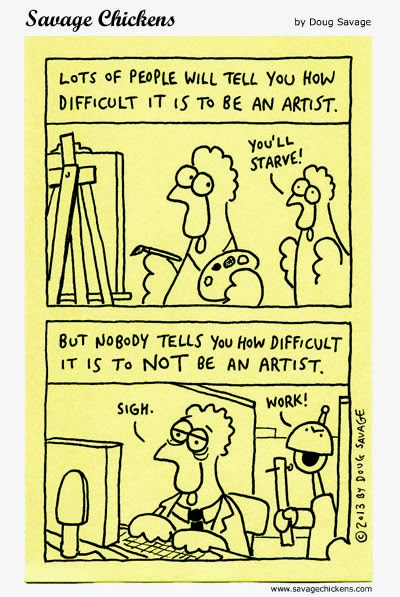
 I get these great little sticky notes cartoons from Doug Savage almost everyday in my inbox. Yesterday's really spoke to me, especially in light of the writer's quiz about supportive/unsupportive writers' partners I'm running on my website.

There will always be naysayers, so don't give up your dreams to write to slog away at something you don't enjoy.

Wednesday, October 2, 2013

Help Get the Word Out! Win a Writer's Guide of Your Choice!

I'm trying to get a lot of responders for the writer's quiz that I posted on Monday about whether writers have supportive or unsupportive partners.

To that end, whoever tweets or facebooks this post (tag me in both), blogs about the quiz (shoot me the link in the comments), or +1s this post on Google will be entered into a drawing for their choice of one of my five Writer's Guides. The more responders I have on the quiz (which is over 50 already--THANKS!), the better the research outcomes.

How entries will be tallied:

Tweets = 2 entries (no limit!!)
Facebook = 2 entries
Blogging = 4 entries
Google + = 2 entires

If you've already tweeted or retweeted one of my tweets, you've been entered already. Really appreciate the help!