The story starts when the makeup company doesn't renew her contract and her uncle/agent wants to send her back home to a small town because she's getting a bad reputation and he can't find her gigs anymore because of her age.
* Names have been changed to protect the fictional and not-so-fictional.
Gertie wants to know: What might this character be like? What issues would she have?
You're in luck, Gertie, because I went to a body image continuing education class not too long ago...and if Liz is going to have issues, I think it'll center around her body. Must of this will be based on generalities, but you'll get the drift. First, anyone who works a job where their faces and figures are plastered across glossy magazine covers are going to be obsessed with maintaining their faces and figures.
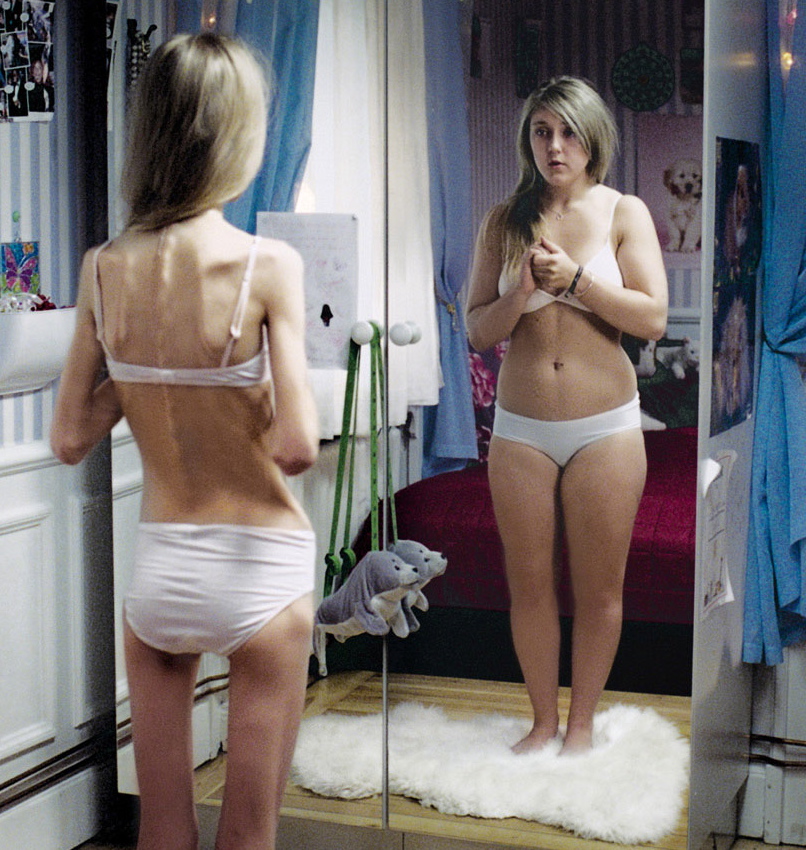
Weight control is a major issue for them because their jobs depend on it. This means watching everything that passes through her lips, and likely means that she's dabbled in her fair share of eating disorder (ED) symptoms, like binging or purging...or at the very least restricting and over-exercising. I'd think this would be more of a fad/modeling industry type thing for Liz to do instead of her having a true ED, because you said she feels powerful and in control when she seduces men. Most people with a true ED develop the symptoms as a way to control at least one aspect of their out-of-control lives (overbearing mothers, etc.). A person with a real ED also has perception problems with their body where they see a much larger, distorted perception of their figure in a mirror. (Doesn't sound like Liz, however, but I'm just sharing some facts.)
Getting older will be something she'll likely fight tooth and nail, literally. The world, with it's commercials and advertisements, has told her since she was 14 that youthfulness is beautiful. Hitting 20 was probably an ordeal...25 even more so of one. Worst of all would be the makeup company not renewing her contract, which would be validation of that message. She'll fear her usefulness is gone. What else is she really good at besides strutting her stuff? It's what she knows, it's what she's good at it.
That, and the men. I think if you're really wanting to examine the difference between God's beauty and the world's beauty, I'd have the hero be somehow disfigured. Maybe he walks with a limp or has a noticeable scar or birthmark. The heroine's reaction to him at first could be really awful, as she might even be disgusted at the lack of worldly beauty the man has. But this would be a great foil for her character development.
(If you don't want to go with the hero having this, I'd also suggest adding a little girl to the story, perhaps a girl without a mother, a girl who reminds Liz of herself at around the same age she lost her own mother? This little girl might want to latch on to Liz. If she was cripple or maybe had facial scars from a house fire that killed her mother, this would also make Liz grapple with the faith-filled questions of why God would allow such a beautiful little girl to be "ruined." Of course, she'll be looking at the little girl from the world's view, not God's view. Just a suggestion...but I always seem to a
 dd a child in my stories...so this popped into my head.)
My guess is that she'll crave time out of the spotlight just as much as she craves time in it. Isn't that what all the celebrities say in the rags about just wanting privacy? They can't dress down in sweats and tennis shoes with no makeup without having paparazzi take their picture that way and plaster it everywhere. Perhaps Liz feels she has to be made up like a diva every time she steps out her front door. Hair done, makeup flawless, nails done, and body recently fake-baked or spray-tanned. But I'd make her have a pimple on one of these days, and then juxtapose her overreaction about the red siren on her forehead with the angry red scars on the little girl's face, scars the little girl has to go out into public with every day. These type experiences will bring her down to size, so to speak, and help her start to see things from a heavenly perspective, not just the perspective of a super up-close camera lens.
You wrote that she could be whoever people want her to be, and taking on different personas is what she's been accustomed to doing because she's been modeling for so long. You wrote, "She has no idea who she really is inside, other than this beautiful shell." The firs
 t thing that came to mind for her character arc was some sort of alteration to that beautiful shell. That might be the only way God can get her attention. If her body has become her idol, than God won't stand for that. You might want to chew on how to get her attention in this manner. While i think interactions with less-than-"beautiful" people will soften her, someone that entrenched in the modeling culture might need a bit more to wake them up. It would be heartbreaking, of course, if something happened to her, but it wouldn't have to be a car accident or the like. It could be a melanoma scare that causes her to have to get surgery to remove a prized mole (her signature mole, like Cindy Crawford or something).
Just throwing out a few ideas, but I think I've hit the highlights of some of the issues she'd be dealing with. Once she gets back to the smaller town, I imagine she'd still try to play her "role," kind of like how Reese Witherspoon was when she went back home in Sweet Home, Alabama. Clearly, she wasn't suppose to drink like a fish in the town bar, or enjoy planting lighting rods in the sand, or any of those hillbilly hick things she used to do. But the true person was underneath...she just needed the proper motivation to let those true colors shine through...and nothing can be more motivating than a good man. :)
If I missed something, let me know. I'm happy to assess further. You know how to reach me.
If you haven't entered for a chance to win Roseanna White's A Stray Drop of Blood, the contest is still going on. Just click here to read my review and leave a comment with your email address to be entered in the giveaway!
This service is for fictional characters only, so any resemblance to real life examples is entirely coincidental. Any other fictional character assessment questions can be directed to charactertherapist (at) hotmail (dot) com.