
LinkedinTwitterThe DetailsConnectBlog Facebook Meet the TherapistHome For Writers
Showing posts with label Communication. Show all posts

Monday, November 4, 2013

How to Communicate Needs to Non-Writing Partners

I'm continuing my series geared toward writers who have partners who don't "get" them. One of the questions that came up from my writer's survey was how do writers communicate with their spouses (who lean toward not being supportive) to let them know what they need, both emotionally and physically?

Let's start with Communication 101, via your friendly Character Therapist.

A Primer on Communication

 
Every message sent to someone has to be encoded by the sender (hopefully this is done well) and decoded by the receiver (hopefully this is done well). Just as in the game of Telephone, when the initial message can get distorted before it gets to the end of the line, there's all manner of "noise" that can warp the message.

Noise can be anything in the environment (children, television, cell phones ringing, etc.) or anything the receiver is going through (rough day at work, had a fender bender, just got a promotion, etc.) or anything that the sender is going through (anxiety, depression, joy, etc.).

I know...that's a lot of variables to consider.

Seven Steps to Effective Communication

1) Try to reduce as much environmental and personal "noise" as possible. (click to tweet!)

Timing is everything. You want your partner to be in a relatively good mood. You don't want them to be distracted. Kids need to be asleep or away. TV needs to be off (muted does not work!).

2) Ask if they have time to talk, because you've got something on your mind. (click to tweet!)

Even if they are sitting there looking unoccupied...you still ASK, don't assume. This means you respect their time and autonomy, and it opens channels more. If they say no, they at least know you've got something in the hopper that you want to address. If they say yes, proceed to step 3.

3) Know exactly what you want to say. (click to tweet!)


Having just a vague idea of what you want to get across isn't a good idea. Your partner likely is already on edge because you've requested to talk to them, which lends a seriousness to the conversation. Their anxiety becomes unavoidable "noise" that you have to cross, so being succinct and to the point will greatly reduce the chance that they misunderstand you.

How do you do that?

4) Be aware of your body language. (click to tweet!)

It is said (from different sources) that anywhere between 60-90% of communication is non-verbal (meaning your body language, expressions, pitch, tone of voice, etc). Be mindful of how you're standing/sitting, how you're using your hands, and how you arrange your facial expressions. The old adage is true: actions speak louder than words.

5) Use I-statements. (click to tweet!)

Never, ever, EVER start sentences with "You." Nothing puts another person on the defensive faster. Then, you've lost them as far as actually listening to you, because I guarantee that they have tuned you out while they try to come up with a rebuttal. Even if you aren't trying to be mean, and you say it nicely, it still comes across as aggressive.

Instead of "You never take care of the kids so I can write," say, "I'm disappointed when I end up caring for the kids all weekend, and I wish you'd offer to take them out some Saturdays so I could write."

That's simplistic, of course, but hopefully you get the idea. People can't argue with how you feel. Using feeling words is a great way to get across what you're wanting to say about what you need.

In general, an I-statement should have three parts:

I feel ___X___ when you do ___Y___, and I wish ___Z___.

"I feel frustrated when you leave the kids at home with me, and I wish you could take them out somewhere when you leave."

"I feel hurt when you ask if I'm ever going to get a real job, and I wish you could respect my writing more by not making comments like that."

"I don't feel valued when you expect me to do all the cooking and cleaning, and I wish you'd offer to wash the dishes or do the laundry every once in a while."

Now, I realize that it looks simplistic, but actually saying these things is very difficult. Your knees might be knocking, even more so if you and your spouse have had many a row over your writing.

6) Listen in return.

Also easier said than done. But you're asking for them to hear you out, so you need to be willing to do the same...even if the outcome isn't what you had hoped to hear. It's okay to be hurt by something that is said in return, and it's okay to cry...but do hear them out. Then you can try to respond with an I-message, conveying your feelings about what they said.

7) End the conversation if things get heated. (click to tweet!)

Request to continue it later when emotions aren't running so high. What happens to folks whose disagreement turns into a fight is that they cease actually arguing about the issue at hand and begin slinging insults about the person and/or fighting about the fighting. Not beneficial...so walk away with an agreement to revisit it later.

Word of Caution

All the communication skills in the world might be insufficient when trying to communicate your needs to someone who doesn't value what you do. Sad, but true. Essentially, you're working within a deficit, and if you don't acknowledge this up front, you're not doing yourself any favors.

Monitor your expectations. If your spouse has been very unyielding, then don't ask for the moon. Start small. Baby steps in the right direction are better than being stonewalled.  (click to tweet!) #3 above should take some thought and consideration. These steps aren't a magic cure-all for a relationship mired in conflict, but they do offer hope and a potential way to meet on the same page.

Consider marital therapy if you think having a mediator present would be helpful. Someone who doesn't have a vested interest in either side can do wonders for helping partners really "see" the issues at hand by stepping outside themselves.

Let's Analyze

Any other suggestions you'd make for communicating effectively about such a touchy subject? Have you ever used I-statements successfully? Leave a story below about how you did.

Wednesday, June 20, 2012

When Families Feud: Effects of Stress

Have you ever looked around your house and wondered, "How did it get this dirty?" My husband and I had this experience last Saturday.

Problem is, no one wants to admit having been the one to start piling the dishes up, or having left a plate on the table or not told our daughter that she really should throw most of her toys in the trash because they are actual trash. (What is it with kids and trash they think are "treasures?")

Anyway...this brought about a little fight disagreement between my husband and me. We exchanged some heated words (proud to say there was no cursing) about whose fault most of the mess was. We usually just point our fingers at our oblivious daughter, sigh, and go into a cleaning session that makes Martha Stewart look bad.

This past Saturday, though, was different.

Why?

Because our family unit is under a bit of stress.

Stress makes even little arguments balloon out of proportion. My husband has started a new job as a youth minister (part of the reason for the no cursing). If you didn't know it, youth ministers have weird hours. I don't think they have an actual "schedule," you know, like normal working folk. It's more of a vague, ambiguous "I don't know when I'll be home" kind of thing.

Bottom line: Our family system reacted differently (heated words) because one family member (my husband) had changed the status quo.

Systems operate that way. Any good Marriage and Family Therapist will tell you that. This is a great example from my own life to illustrate my point.

Family members have to shift to account for a change in another family member. Readjust, if you will. It's the readjustment that sometimes brings a family into therapy, but in contrast, it can be the status quo that needs to be readjusted that brings a family in. Either way, the system changes.

My husband and I are fine, by the way. We both recognize (and more importantly, talk about) the changes in our life and how this affects our reactions to each other. We're hunkering down for this transitional period....and we're going to ride it out on top of the wave.

Let's Analyze: Summer breaks are around the corner (or already here) for most of us...and this is a huge stressor for families because schedules change, as do expectations and responsibilities. Any shifts going on in your family at this time?


Monday, January 9, 2012

New for My Blog in 2012

I did a bit of soul-searching about my blog and the direction it was going. Truth be told, I love the focus of my blog. I love doing character assessments and posts on how psychology can improve fiction writing. I'm a therapist. This is what I do in real life.

But I'm also a wife, a mother, daughter, and sister. Psychology and faith works together in my everyday life, and I haven't shared a whole lot of that up until now, and that's what's going to change for 2012.

That, and I'm likely going to start posting three days a week. Not sure about that change yet. 

I came to a conclusion while on my three-week vacation over the holidays. Technology gets in the way of relationships. At one point, I was sitting in the living room with my entire family, and we were all on our lap tops at the same time. One family member even texted me from another room. Seriously!

Where's the connection in that? I made a resolution to spend less time on the computer and more time visiting, TALKING. To do so, I found the best vehicle in the world to facilitate this between family members: a jigsaw puzzle.

I had bought one of these puzzle caddies for my parents a while back (which is just a piece of felt that you wrap around a cardboard tube) that enables you to use table space while you are still in the assembly process. It was gold!

My parents, my husband, my brothers--we all sat around the table and put together two different 1000-piece puzzles together in about a week. The jigsaw caddy worked great.

But the big change was that the television was set off, the computers were left charging, and relationships were nurtured with communication, laughter, and good-natured ribbing when one person found the missing edge piece ahead of another. Not to mention the feeling of accomplishment of a job well done. (Did you SEE how hard these two puzzles were?)

In truth, when the mind if occupied with a seemingly "mindless" activity like putting together a puzzle, coloring, playing with playdoh, etc., the tongue loosens. I do it all the time in therapy, so I tried it with my family. The result was tons of communication about topics that hadn't been brought up in years, if at all. It was wonderful!

True, I was waaaaay behind checking my email and watching my television programs (that I watch online after my child goes to sleep), but so much the better for it. Everyone was in agreement too.  So next time you're around family members, give it a try!

Let's Analyze: How many of you are jigsaw puzzle people? Do you own one of those nifty caddies?

Bonus: And for those of you who only post 3 days a week, what do you feel you lose from not posting 5 days a week? (I don't have to ask what you gain: TIME!)

Monday, November 28, 2011

Subtext Revisisted


In my research for my characterization book, I've come across another theory of what we writers call subtext. In transactional analysis, transactions between people can be one of 3 things:

2) Crossed (the ego state of one character is thwarted by a different ego state of another character)
3) Covert (SUBTEXT)

A covert transaction is when a person says one thing and means another. The transaction has a social (overt) and a psychological (covert) level. Here's an example of each:

SOCIAL:

Boss: "Let's work late, Ms. Parker, and I'll buy you dinner."
Secretary: "That's a good idea. We have a lot of work to do."

PSYCHOLOGICAL:

David: "I love your smile, Denise. Let's have dinner and drinks, and really get to know each other."
Denise: "I thought you'd never ask, David. I've wanted to go out with you for a long time." 

Basically, the social level is useless in determining what people are really going to do. David's mom would expect to reach him at the office in the evenings based on the social level of their conversation. But if she knew the psychological level of the relationship, she would know to call the local hotel if she wanted to reach her son. 

The reason we say one thing and mean another is because we are generally ashamed of our Child's wishes and desires. These are our immature impulses (in Freud's language, our Id). Nevertheless, we act on these desires while we pretend to be doing otherwise. David's transaction with Denise on the social level was very appropriate-sounding to others who might be listening in. But he was using his social conversation to mask his true Child's desire of wanting to date his secretary, who should be off-limits.

Other ways of socially trying to throw people off our true psychological desires are to use smiling sarcasm instead of directly expressing anger. Or to attack others instead of admitting our fears. These are all examples of covert transactions. 

In therapy, transactional analysts encourage people to be "straight" with one another and themselves about their wants and feelings, rather than covert. But then, if this happened in fiction, it would be most boring. :)

Let's analyze: Any other common examples of covert transactions you want to throw out there?

Wednesday, October 12, 2011

Men are Like Waffles, Women are Like Spaghetti

Intriguing, right? I promise you won't regret reading this post in its entirety.

I've started a couples class at my place of employment, and I'm really looking forward to exploring lots of marriage/family concepts with clients eager to learn. I thought it'd be fun to give my readers a glimpse into my first group session. (This will be content only! No confidential info will be disclosed.)

After starting with introductions and group rules, I presented the following (although my hand-drawn versions were less than stellar):

Of course, food metaphors abounded, but I asked people to really think deeper. We had a discussion about general stereotypes, but many stereotypes do have a basis in reality. (You can read my Character Stereotypes series from CFOM to understand more.)

Basically, these two images represent the typical way men and women process their surroundings, their lives. Men are more compartmentalized. This is not to say simple or easy, but each aspect of their life goes into a a box. Men enter these boxes one at a time, size up a problem (if any), and seek to solve it immediately. Men are problem solvers by nature. They have work, children, wives/partners, dogs, hobbies, chores...all in separate "boxes."

Funny enough, according to the book I read where I got this metaphor (alas, wish I could claim it as my own, but Bill and Pam Farrel wrote the book by the same title; a Christian alternative to Men are from Mars, Women are from Venus) said that men have boxes with no words, just images/memories. They also have boxes with no words and no images...just blank boxes. (Not making this up...straight from the book and confirmed by many men.) A man's mind will often stick close to the boxes that make them feel like successes, feel good about themselves. They tend to avoid the boxes that make them feel like failures.

Women, on the other hand, are very different. We process everything by it touching everything else. It's much more of a process. Everything is connected. While at work, we can think of home or shopping. We're more relational, and can tend to be much better at multi-tasking as a result of out ability to process this way. We will often catch guys in one of their "blank boxes" and ask them, "What are you thinking?" The blank stare we get is the truth!

Communication, as you can imagine, between the two is challenging. A woman will come home from work, and when asked about her day, she can say, "It went fine. I got an email from Susan....the cancer's back. Oh, we need to go to the grocery store and get shampoo and conditioner. Did you pick up David from practice? We should send a thank-you letter to the Johnsons for dinner last night, too."

The man, poor soul, is scrambling! Trying to enter the friend box, then the grocery box, then the children box....it's a mess. Often, if a man feels like the communication box with their significant other is too challenging, they avoid it. (Which is why many women are the pursuers in relationships while men are the retreaters.) You might hear a man saying, "What's the point of this conversation? Where is this going?" The woman is doing their thing, processing to the point (that we do have), taking our own path. The man would prefer the woman to say, "Can we talk [insert subject] now?" Then they enter the box and both people are on the same wavelength.

I LOVED the looks on the guys faces as the lights came on. They turned to their significant others and said, "YES! This is exactly how I feel!" The women were nodding their heads, too. It was eye-opening, this discussion in stereotypes. I love it.

Q4U: Guys, have you ever felt like you were scrambling to catch up? Women, ever feel like you're almost better off talking to yourselves? Does this ring true for anyone else but me?

Thursday, May 26, 2011

T3 - Character Communication

Communication defines relationships, and it is impossible not to communicate. Our behaviors communicate. Our silences communicate. We use words as needed to do the same. How a relationship or family is organized, how it will operate, what it will do--all determined through communication.

Spoken communications have two aspects according to family systems theorists:

1) Content aspect: This is the actual information being passed along. "I like that red blouse you got last Christmas."

2) Relationship aspect: Depending on the context of the situation and inflection in the voice, the informative statement above could be a command from husband to wife to wear that particular blouse to his parent's home that evening. This type of message would define the relationship in some way.

The wife then can either confirm the definition and wear the blouse or attempt to redefine the relationship by ignoring his statement to convey that he has no control over what she wears. Or, if her husband said this after she had finished dressing in that very top, then she could simply say thanks to his compliment.

The Relationship aspect of communication falls into what the writing world calls "subtext."

Subtext can be determined by the character's inflection, tone, and volume. If the husband's words from the example above were spoken with sarcasm, then it would be apparent that he didn't like the blouse at all. If he said it with a sexual connotation, then his meaning would also be clear.

Subtext can also be discovered by a character's body language, which includes facial expressions. If the husband said this while buried under newspapers or yelling it over the blare of the television, this would carry a different meaning than if it he was fingering the blouse in the closet or massaging his wife's shoulder's after she had the blouse on. Likewise if he said it with a grimace or a leer, that would also convey subtext outside of the actual words.

Next time you're writing in dialogue, try to stay away from too much WYSIWYG dialogue, as Brandilyn Collins calls it in her book, Getting Into Character. This stands for What You See Is What You Get dialogue. While people do say exactly what they mean sometimes, it's far more human to include subtexting.

Wordle: signature

Thursday, February 24, 2011

T3 - Who is Saying What?

Have you ever tried to portray in your books a misunderstanding between two characters and found yourself wondering if others would think it was feasible? If you've got two people dialoging with one another, there is always a chance for miscommunication.

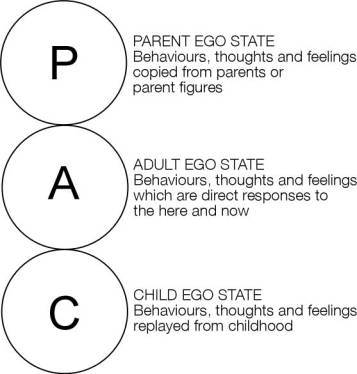
According to Transactional Analysis (TA), we communicate via three different Ego States (parts of ourselves):

(P)arent
(A)dult
(C)hild

[I know what you're thinking, but no, this is not Freud's Id, Ego, and Superego, although they have been compared. Freud's theory says that each state is one type of behavior: Id=feeling, Ego=thinking, Superego=judging. TA says that each Ego State above has all three.]

Every person has a trio of P-A-C, and we constantly shift back and forth between them in our interactions (a.k.a. transactions) with others. I'll break them down.

The Parent ego state is a set of thoughts, feelings, and behaviors that we learn from our parents (or caretakers). It's almost like we unconsciously mimic them, incorporating their values, morals, and core beliefs into our outer communication. We express these ideals by being either critical or nurturing.

The Nurturing Parent is soft, loving, and quick to give permission. The Critical Parent is the other side of the coin. When in this state, a person will react as they imagined their parent might have reacted, or they act toward others the way their parents acted toward them. It's uncanny, but we might use some of the exact same phrases we head from our parents, or strike the same postures, use the same mannerisms or gestures...we become our parents.

The Adult ego state is our data-processor. This is the objective, non-emotional part of ourselves, using all of the resources we have as an adult human being with many years of life experience to influence us. It is factual, responds to situations without passionate convictions, and simply uses what it hears, sees, and thinks to come up with solutions to problems. (Think Mr. Spock.) The Adult is situated in the middle circle of the diagram to orchestrate and mediate between the Parent and the Child.

The Child ego state is who we are at our most natural. This is when we behave like we did in childhood. There are two parts to the Child ego state, both of which have positive and negative aspects. The first is the Natural Child, which is much like my three-year-old. On the positive side, she is spontaneous, playful, lovable, and charming, and experiences the world in a direct, authentic, and immediate way. On the negative side, she can be impulsive to the degree her safety is compromised.

The Adapted Child is the part of our personality that has learned to comply with the parental messages we received growing up. The positive aspect of the Adapted Child is that we respond appropriately in social situations. The negative aspect is that we overadapt and give up our power and discount our value, worth, and dignity.

Dr. Carol Solomon (2003) gives a good example of how each of the above Ego States would respond to the simple action of a child playing in the sand.

Nurturing Parent: Go ahead, play and have fun!
Critical Parent: Now, don't you dare get yourself all messy!
Adult: This sand looks really interesting. I can make a castle.
Natural Child: WOW! Look how tall my castle is!!!!!
Adapted Child: I better not get my clothes all dirty.

At any given moment, our characters (and us) will volley amongst each of these ego states when interacting with others and our inner selves. Depending on which Ego state the person with whom we are communicating is operating from, signals can get BIG time crossed. And this usually is where we have misunderstandings, hurt feelings, and less-than-satisfying communication.

Next week, I'll go into how you can know which Ego State your character is using. Hopefully you find this as fascinating as I!

Q4U: Have you ever stopped mid-sentence, repeating verbatim something your parents said to you? What was it?

Wordle: signature