LinkedinTwitterThe DetailsConnectBlog Facebook Meet the TherapistHome For Writers
Showing posts with label Treatment Tuesday. Show all posts

Tuesday, February 21, 2012

Character Clinic: Bridger Heidemann

I've got Liberty's character, Bridger "Brick" Heidemann on the couch today. Lucky for me, I've already assessed the love interest in the futuristic sci-fi romance. Brick is sort of an anomaly in his convictions for his day and age where everybody is sleeping with everybody else and there are few moral standards adhered to. He's a private investigator, hired by the heroine Tamryn to track down her best friend, who's missing. Brick values remaining chaste, but he's drawn to Tamryn, despite their different backgrounds and moral codes of conduct. Brick gets kidnapped near the end of the book to be part of an "active sperm donor" business for women looking to get impregnated. (Yikes, Liberty!)

Liberty wants to know: How do I play out dynamics between two very different leads in a believable way? What kinds of mental issues will Bridger face following the kidnapping, especially if there is some physical abuse (i.e., kicking, punching, stabbing) to go along with it?

Liberty -

What we've got here is opposites attracting. Nothing new, but the angle of morality that you are taking is a different twist. I'm not sure how much this is played up in your book, but it sounds like remaining pure is a big part of Bridger's identity, and this is a value Tamryn doesn't hold.

One thing's for certain, his or her stance on morality doesn't have to play a part in physical attraction. Sparks between people can often be surprising, given the different poles they come from. So writing some very real scenes of them trying to deny that chemistry will give your romance readers something to appreciate.

Tamryn will likely want to take things to the next level, riding the wave of her baser desires and instincts. This will be the initial cause of conflict, I assume, and it needs to shake Bridger up a bit....that he could get so close again to "doing the deed," this time with his full faculties about him (i.e., not half asleep). But it will be his lesson in how strong physical attraction can be, and you can subtly get a point in with readers that our mental capacity to stop can overcome the pleasure principle (if you so desire).

Bridger will be wary of her, as she embodies and represents a sensual side of himself that he's either refused to acknowledge or has kept buried because it's safer. But he'll be drawn to her anyway b/c of the attraction. Great place for him to feel that tension...which is great for page turning in a romance.

An aside about your idea to have them both ask to marry each other at the end...Bridger seems to be a pretty traditional sort. Comes from a traditional family, remaining pure, etc. If Tamryn beats him to the punch, even if he has the ring in his pocket, I'd make sure that it was the completion of a character arc for both of them. Bridger possible needing to relinquish some of his iron-tight control, and Tamryn forging ahead into a commitment with a man that up until then she's tried to evade. Something like that. Otherwise, it won't be satisfying to the reader (in my opinion) for the original/traditional role of the man asking the woman to marry him to be usurped.

Really quick about the abduction: He's going to be traumatized, especially given the nature of what he's being abducted for. It would be like his worse nightmare...almost like forced prostitution, even though the end result is impregnation rather than debauchery. Still...to him, it won't be much different. So even if he doesn't actually have sex with anyone before he's rescued, that would mess with his head. (In my weird, psychocrazy way, I think this is awesome, btw.) If he's abused, he'll probably have the usual PTSD responses of flashbacks, nightmares, exaggerated startle response, hypervigilance, etc. I've done many posts on this subject, so I won't go into it here.

Hope this helps, and thanks for being so patient!

Let's Analyze: What are some great examples to point Liberty to of books that have dynamic heroes and heroines who are POLAR opposites?


Tuesday, January 31, 2012

Treatment Tuesday: Catrin Passerini (and an Explanation)

It's been a while since I've done a Treatment Tuesday, I realize. But I'm taking the time to let all 22 people who are left in my queue for the freebie assessments know that I WILL get to all of them. 

In the same vein, I've discontinued the freebie assessments due to being overwhelmed with write-ins! I'm grateful it was popular while it lasted, but the freebies still take time and energy away from my family and my writing. My hope is that authors will look into the paid full assessment option I still offer on my website.

So that's the deal with the freebies, since I've received several questions about them.
__________________________________________________________________________________

On to who's on the couch today. Catrin is the 24-year-old brainchild of author Brie and she resides in a romance. Her mom left her with her Dad when she was 7. Seven years later, her father died from complications due to an automobile accident and Catrin herself was scarred on her hands, face, and shoulders from flying glass and debris. She now lives with her Uncle, whose wife also left him with a young daughter, Catrin's cousin, who is 3 years older than Catrin. Now, ten years later, she's an event planner working with her cousin with a crush on a guy who has a girlfriend who's basically her nemesis.

Brie wants to know: Why is Catrin so worried about her scars? They make her beautiful. Also why is she so wary with unknown people? Is it because they would judge her? Who is her perfect guy?

I love to read answers to the question about a character's most significant event in childhood that still affects them today. Catrin had a great response:

I was five and Daddy told me, "I may  not like what you do but I will always love you." I had pushed Jimmy Lock off the slide because he had pulled on my braids. Daddy told me later he was proud of me standing up for myself but he would have preferred if I pushed Jimmy Lock in the mud.

This answers your last question, Brie. The kind of guy who would be perfect for her is the kind of guy who will say/show her something like this. Girls tend to look for (or at the very least, find) someone similar to their fathers, especially if they had good relationships with them (and even if they didn't).

Catrin clearly loved her father and wants to make him proud even though he's deceased. She felt his support even when she did something he wasn't completely happy about. (Which begs a question...would pushing Jimmy Lock in the mud have been less serious or more serious than pushing him off a slide in his mind?--just curious. I took it as less serious, but still gets the point across.)

Based on the rest of the intake form, I didn't see a real clear goal for Catrin. I'd suggest giving her a cause...something she might stick her neck out for, regardless of her scars. It would need to be something she's passionate about....perhaps mentoring young girls also abandoned by mothers? Seems she has a lot of experience (along with her cousin) in this department. Maybe she's a Big Sister? On the board of Big Brother, Big Sister? Anyway...it could be in the course of her cause that she does something dream guy doesn't like, but accepts b/c he loves her. Just brainstorming here, of course.

About her scars...maybe give her a reason to believe beauty is skin deep. What if her mother had been a diva-sort? Flawless. And she drilled into her little girl's mind (prior to skipping town) that she needed to look her best. A 7-year-old can internalize messages like these BIG time. So this would give her extra reason--besides the obvious social discomfiture--to worry about her scars. Unknown people would surely look upon her more curiously or harshly...so it makes sense to be wary of them. Nothing out of the ordinary there, it seems. FYI, I did find an interesting article here on the psychology behind scars.

Wish you the best with her, and my sincerest apologies at the delayed nature of getting it to you!

Let's Analyze: What kind of personality would be the perfect nemesis to Catrin?

Don't forget to go to my Amazon page HERE and "like" The Character Therapist and/or leave a review to be entered to win a Writer's Guide of your choice!

Tuesday, May 10, 2011

Treatment Tuesday - Nazi Sympathizer?

This week's character assessment comes from James. He's writing a historical drama-slash-psychological-thriller during the WWII time period. Otto* is my first Nazi to take up space on the couch. Otto was raised during Hitler's early reign, and his idealistic youth's driving motive was restoring Germany to its rightful place. He enlists in the German army and goes to war against his father's will. He survives, but not without scars and disillusionment in Nazism. Stationed in Russia, Otto comes to feel affection for a Russian girl, who he later discovers is Jewish. She gets killed somehow because of Otto and Otto becomes embittered. He fights to find justification for his decisions, clings to his faith, and dies internally divided but unrepentant.

Then the story begins.

It's in his limbo stage after death that he meets a man named Peter who offers him a way out of he explains why he lived his life the way he did. Otto resists but eventually agrees to sit down, and at length, he reaches catharsis, accepts forgiveness, and is taken into Heaven.

James wants to know: Since this character is a Nazi, how will I be able to confront a stereotype and challenge what people think about God's forgiveness? No one is beyond redemption, but people don't quite grasp that God will forgive anyone for anything, even people with beliefs we demonize.

This will be a challenge to write well, James. Well, actually the challenge will be to write the back cover copy well enough so that people even want to buy and take home a book about a Nazi. 

When I say the word "Nazi" and ask you to free associate (say the first word that comes to mind), the first word that likely goes through anyone's head is Hitler. Hitler was associated with the mass execution of Jews, concentration camps, Aryan Nation....none of this is positive association. To add even more difficulty to your plight, you've got a character who's gung-ho Hitler, at least initially.

I'm not advocating not to write this story at all. I'm intrigued by the concept, and I think others will be, too. But you'll have to be very careful to use people's perception in your favor. Psychology can help with this.

Public opinion about Nazis is largely hatred, disbelief, and some ignorance. It's the ignorance you can play on. I would only hope that there were some people in Hitler's regime who didn't agree with him 100%. Some people who risked it all to save Anne Franks. That's the beauty of fiction...take us to a time, place, and era and show us something we don't expect to see, make us feel something (sympathy) for a Nazi we don't expect to feel.

If you make this Otto a regular guy, with dreams and vices like the average Joe, he'll be someone others can relate to. Not many people in today's age can relate to Nazism. There is the neo-Nazi movement in America (if you really want to be disturbed, check out their website), but by and large, this kind of nationalism hasn't been experienced by people today, unless you count the swell of national sentiment after 9-11. If you could capture that positive feeling of unity and somehow bring readers around to understanding that that was where Otto was coming from, it could work. I could relate, even as I swallowed my bile about him being a Nazi and experiencing the same thing I felt.

I know you didn't ask for that little bit, but consider is a freebie. :)
Really, a book about a Nazi should be no different than a book about a prostitute or a hero who robs banks.  But because the word Nazi will be in the book blurb somewhere, you've got to quickly cover major ground in getting the reader to buy in to the concept, since Nazi is one of the most hated terms in all the land.

How can you do this? Here's a few suggestions:

1) In the back cover blurb, I'd mention his disillusionment very quickly. No need to go into his idealistic youth...not on the cover. Unless you're wanting it to be a secret that Otto is dead at the beginning of the book, I'd start off with the old, bitter Otto...the one who wished he could have done some things differently. We can all relate to that. 

2) Show Otto in a very human moment in the very first scene of the book. Readers who get past the blurb usually go to page one. If your page one has Otto engaged in a battle against Russia or blinking at Hitler with adoring eyes, they'll throw it back immediately.

3) Use Otto's introspection to your advantage. You will need to use this cleverly, since it looks like the book is sort of an interview between Peter and Otto to determine if he can leave his limbo state. So Peter will likely be asking questions and Otto answering (or refusing). If Otto's introspective thoughts bring into question his blind allegiance or whisper at a regret he feels for the death of the Russian girl...you'll grab your readers. We all want to read about that stuff because we've all questioned and regretted. It's universal experience, while Nazism is not.

You know, I feel compelled to mention a book by Francine Rivers, Redeeming Love. Everyone knows that this book is a fictionalized account of Hosea and Gomer, and everyone knows that Gomer was a prostitute in the worst kind of way. This book has been in the top 25 for over ten years. And people knew exactly what it was going to be about before they bought it. Here's her blurb with my interjections in red:

Can God’s Love Save Anyone? (the overarching question...very intriguing)
California’s gold country, 1850. A time when men sold their souls for a bag of gold and women sold their bodies for a place to sleep. (sets the overall tone) Angel expects nothing from men but betrayal. Sold into prostitution as a child, she survives by keeping her hatred alive. (wham! non-prostitutes can relate to this, and it hints that she's not thrilled with her occupation) And what she hates most are the men who use her, leaving her empty and dead inside. Then she meets Michael Hosea. (the sentence that keeps us reading the rest of the blurb)
Like you said, your novel would be a perfect example to showcase how even the very worst sinner can be forgiven. I wish you the best with it. Any additional questions, please leave them in the comment section.

Q4U: What about you, readers? What would make you pick up a book about a Nazi? Please leave constructive comments that James can use in his characterization.


Wordle: signature

Tuesday, May 3, 2011

Treatment Tuesday - Psychoanalyzing the Woman at the Well

This week's assessment is from Anne. She is planning on writing a biblical fiction account of the woman at the well. She's asked me what my thoughts on this woman might be, in hopes of shedding some therapeutic light into her past, present, and future. Of course, this is new territory for me. I've analyzed books with biblical characters, but never the character. (And it's a bit different coming from the side post-published v. pre-published.)

So I'm going to give it my best shot, using my degree from seminary  and psychological training. All I really have to go on is her story found in the Gospel of John, chapter 4 for those who are interested and/or unfamiliar with the Samaritan woman. The basic gist is that Jesus, weary from traveling, sits down beside a well where she is drawing water (which gives some indication that she's not well-to-do). He requests a drink from her, which surprises her, because Jews and Samaritans aren't exactly buddies. (Which is why I chose the picture to the left. I imagine her facial expression was just like that when Jesus approached her.)

The time frame might hold some significance, but scholars can't agree. However, for literary purposes, you might want to take this into consideration. Jesus went to the well around noon, the hottest time of the day. Most of the women drew their water much earlier, when it was cooler. Perhaps the Samaritan woman did not because she wished to avoid the other women, or that she was ostracized by them and not welcome to draw water earlier.

If she wished to avoid them, then most likely, her immoral conduct is well known and she is either embarrassed by it or feels guilt about it. If she is ostracized, then she has accepted this lot in life and doesn't choose to kick against the goads. Perhaps she's resigned about how she'll be treated, or perhaps she doesn't care to be publicly humiliated and shunned.

Either way, when Jesus asked her for a drink, she reacts with a hint of annoyance. (At least, this is how I read it, which would give a glimpse into her personality.) She said, “You are a Jew and I am a Samaritan woman. How can you ask me for a drink?” At the very least, she is stating the obvious, which is a bit saucy, right? I imagine she was a bit sarcastic, even. (This woman was not sweet Mary Ann from Gilligan's Island. She was much more like Ginger.)

She's curious as to what Jesus talks to her about. Jesus used a deliberate misunderstanding to converse with her, confusing her about spiritual water versus physical water. She's intrigued enough to continue talking with a Jewish man, but it's just passing the time as she draws her water, likely.

It's not until Jesus probes into her personal life that she becomes uncomfortable with the direction of the conversation. He asks her to go call her husband. She replies with a deceptive answer: "I have no husband." She didn't want him to dig any deeper. This was a defense mechanism she employed, and likely had employed many times before this. She seemed to revert to using it with ease, perhaps as a result of leading her duplicitous lifestyle for so long and having to fend off personal attacks.

The Samaritan woman made a very quick decision that Jesus must be a "prophet." She understood that he is something special, different, and was willing to make a concession that he is. She also was quick to take action. I mean, enthusiastic action! She left her water jar at the well (indicating she will return) in her eagerness to go and tell the townspeople what Jesus has told her. As much as she might want to avoid others, when faced with something greater than herself--Someone who is offering her a happiness that she so desperately has sought and which had eluded her until now--all of her discomfort, shame, guilt, etc. took a back burner. This really shows a strength of character.

However you write this woman's story, it's important to note that Jesus approached her with gentleness. Not timidity, but with gentleness, lovingly. My guess would be that she'd had very little of this in her life. You're probably right to think she has been verbally and likely physically abused at some point in her past. Of course, anything you write toward this end would be conjecture, but many an author has taken literary license with the Bible. It's what's in your heart as you do so that makes the difference.

I'm excited to see if this will help you as you envision this character. All I did was analyze her speech, body language, etc., that was in the passage. That, with a little creative imagination, and viola! This assessment! Thanks for opening my eyes up to this possibility!

Wordle: signature

Tuesday, April 5, 2011

Treatment Tuesday - Alpha Male on the Couch

Today's assessment puts Elona's character Sam* on the couch. She's writing a historical set in the 1500s on the wild western Irish islands. Sam's family, the MacNamaras, have been fighting over Eagle Island for generations with the heroine's family. At 19, Sam was seduced by his stepmother, his father's third wife. His father caught them en flagrante and shot an arrow into his wife. Sam picked her up, carried her through the night, and buried her, having been sent into exile by his father, who up until then has truly been proud of his son, teaching him how to fight, hunt, and ride. Sam is an alpha male and changes women like he changes tunics.

Elona wants to know: What would be the long-term effect of a young man (19) who had an affair with his stepmother who was then found out, disowned and sent into exile by his father?   What would this character’s attitude toward women be?

After getting more background from you on the traumatic way in which the affair happened, what with his stepmother being killed in front of him and him having to bury her, I'd say that the immediate reaction would be anger toward his father, but that might depend on whether he loved his stepmother or if he was just having a fling like she sounds like she was.

You've already mentioned that he's an alpha male, and this he no doubt learned from his father. The question to ask is why. So romance novels (in the non-Christian arena) generally have an alpha male lead, but you still have to have a reason for this. The father's reason might be simple: he truly loved his first wife, and when she died early in their marriage, he didn't want to risk losing his heart again to a woman who would abandon him.

But what about Sam? What I'm about to suggest for motivations and attitudes is totally just that: suggestions. It's up to you. You could have him really love his stepmother. Like romantically. Perhaps it was his first sexual encounter....the kind that stays with you forever...and he never fully got over her death. And as a result, he buries the part of himself that could ever truly connect with a woman again, and becomes a womanizer (or Don Juan or whatever men were called back in the 1500s).

But maybe his father's anger and violence awakens something in him....a part of him that actually hates his stepmother for what she did. She obviously took advantage of a younger man, and it cost her her life. Maybe Sam could think that she got what she deserved. Thoughts of her infidelity might could be what really affects him in the long-term....and he might come away from the whole traumatic idea with the internal schema that women are never to be trusted.

Or, just to throw it out there, you could have him as the quintessential angry alpha male. His pride was burned when his father exiled him at such a young age for something he felt wasn't his fault. He blames it on the dead stepmother, and somehow this anger transfers to other women. You could still go with the fact that he doesn't deem women trustworthy as the basis for his anger, but he uses and discards them the way he felt his stepmother did to him, and his womanizing ways are really a grand scheme to feel justified and get back at his stepmother and his father.

The exile from his father could also come into play (and should if you ever plan on reuniting them in anyway). Maybe he seeks to dominate women in order to align himself with his father in hopes to make him more appealing as a son and therefore worthy for the father to take back into his fold. This almost sounds too far-fetched, but motivations can be outlandish. It's how you write them that matters. I could totally see a grief-stricken lad of 19 believing this could be true.

So I guess I'd try to solidify a few things before going ahead with this novel:

1) How grief-stricken is he over the exile and/or death of stepmother?
2) What need is he meeting by being a womanizer? (I did an article for Christian Fiction Online Magazine about playboys here.)

Alrighty, then. Guess that sums it up. Hope it's been helpful. Thanks for writing in and thank you for your kind words. :-)

Wordle: signature

Tuesday, March 15, 2011

Treatment Tuesday - Opposites Attract

This week, I've got Jim and Suzy* on the couch, characters in Michelle's novel-in-progress. They've been married for 15 years. Suzy is a Popular Sanguine/Powerful Choleric who loves to have fun and is a great leader. She's a school teacher and her kids love her. Jim is a Powerful Choleric/Perfect Melancholy. He is a highly regarded manager at his company, is well-respected as a leader and has helped grow the company significantly in his role.

* Names have already been changed to protect the fictional.

Michelle wants to know: How are these two going to get along? In my story, they're going to be in love when they meet and marry, but during the next 15 years, will have problems related to accepting one another and modifying some of their own harsher edges. How might this look?

I think everyone who's ever been in a relationship understands the phenomenon of meeting someone and being totally infatuated with the very characteristics that later come to bring resentment, grudges, and discontent. Marriage is no different. We often marry those people who are our opposites, giving credence to the old adage, "opposites attract." The best we can hope for is that there are enough similarities to make up for our differences, enough likemindedness to counteract polar extremes. You as the author will be the only one who knows if Jim and Suzy have what it takes.

You've set up your characters to both have a little bit of the Lion/Choleric personality type, which is good. They'll both probably be direct, which means they won't beat around the bush when it comes to their differences. (Can be good or bad, depending on how they go about the arguments--see below.) Lions actually thrive on opposition, so their differences become something of  regular burr under the marriage saddle.

Suzy is a dominant Otter, so she's very people-oriented, which is why her students love her. Jim is dominant Lion, so he's more of a get-'er-done guy with little tolerance for playing around. I'd imagine this would be one of the largest glaring differences between these two personalities. Suzy might get things out of priority in her quest to have fun. Jim might try to take charge of things too much and try to make decisions for Suzy too much to suit her.

You'll have to figure out what the number one pet peeve for Jim is about Suzy and the number one pet peeve for Suzy about Jim. These two hot-topic buttons will be what the other pushes regularly and will most commonly lead to their arguments.

Lucky for you, I've been doing a series of articles for my Thursday Therapeutic Thoughts (T3) for predicting fictional breakups (which, of course, is very much grounded in research about breakups of real people). I think you might find these beneficial, if for no other reason than to see what you might want to steer away from during their arguments if your intent in the book is to have these two stay together. Dr. John Gottman found that there were six signs that, if present, would indicate that a couple was heading for divorce or breakup. I've gone over Signs 1-2, Signs 3-4, and will conclude with signs 5-6 this Thursday.

I'd think it's important to mention that arguing in and of itself isn't an indicator that the relationship is failed. Arguing without the six signs can actually be an indicator of a healthy relationship. No one is going to get along 100% of the time (except, perhaps, during their courtship, when the negatives are not seen through the haze of goo-goo eyes).

You also wanted to know: I'm thinking that something will happen to shake them up, make them realize what they are doing and start looking to God for the answers, instead of just blaming each other. How might this look from a psychological viewpoint?

As I wrote on my post about Lions, "Spiritually, Lions usually need a traumatic experience or event to spur a recognition of a need to make a commitment to Christ." I could also have said that it would take a traumatic experience to end their self-centered focus and gain a heavenly perspective.

And the sky's the limit on traumatic experiences. But I as brainstormed this (with myself), I thought perhaps some trauma involving a child--either them wanting a child, losing a child, having difficulty getting pregnant/getting pregnant/losing that child....something along these lines might be particularly effective. My reasoning would be simply this: realizing that another person depends on their ability to get along might be enough to give them a good shake-up. And it'd be a shake-up experienced together, no mater how you spinned it.

I've often times talked with clients about how there is no one right way to raise a child. The strengths of one parent can offset the weaknesses of the other, and in fact, the child can have an even better upbringing just by having such varied parents. I read a devotional by Nancy Moser in February from Christian Fiction Online Magazine that spoke to this very thing. Read it here.

Hope that this gives you some direction. Personalities are a very fun thing to play around with, using them against one another.


Wordle: signature

Tuesday, March 1, 2011

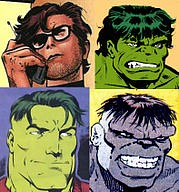
Treatment Tuesday - Bruce Banner/Hulk

An old friend of mine, Glory, wrote in with several comic book characters that she believes need to form a support group. Since my queue for character assessments is empty, I'm going to start diagnosing these superheroes. Bruce Banner is up first.

Bruce is a smart guy. Like, PhD in nuclear physics smart. He was the mind behind Bannertech technology, which is on par with Tony Stark's (Ironman) stuff, and includes a force field and teleporter. Bruce had a teeny, tiny accident with a gamma bomb he himself invented, which transforms him into the Hulk when he gets angry.

Bruce came from a very difficult and tragic background. His father, Brian, thought Bruce was a mutant son due to Brian's radiation work at Los Alamos. His mother, Rebecca, really loved Bruce, which caused Brian to be jealous and hate his son all the more. Brian began to abuse both Rebecca and Bruce, and when Rebecca tried to flee with Bruce, Brian killed her in her attempt. Eventually Bruce testified against his father, which led to his father's institutionalization for many years.

During this time, Bruce created an imaginary friend called "Hulk." He used this coping technique well into his high school years. Brian was eventually released and moved in with Bruce, but his insanity and deep-seated hostility against his son caused him to attack Bruce at Rebecca's gravesite. Bruce killed him, but repressed those memories, choosing to remember a confrontation at the gravesite, but that his father walked away.

Bruce has Dissociative Identity Disorder (DID). Since my research led me to understand that his imaginary friend was called the Hulk, this made me think that his DID was latent (not showing up on the radar) until he got shot with that gamma bomb, which was the traumatic event that triggered his alter identities to begin to taking over.

I discovered five bona fide personalities, three of which were described well on this website: Savage Hulk (a.k.a. Green Hulk), "Joe Fixit" (a.k.a. Gray Hulk), and the Professor (a.k.a. Merged Hulk). This website here discusses the Guilt Hulk and the Devil Hulk, among several others. According to the comics, however, Bruce has hundreds of personalities locked away in his mind.

Due to Brian Banner's abuse, the Savage Hulk split from Bruce's early childhood experience. He's the most well-known of the Hulks, typically referring to himself in the third person. He possesses the IQ and temperament of a child, and just wants to be left alone following one of his "temper tantrums." He represents Bruce's childhood wish to be strong enough to protect his mother.

Joe Fixit split from Bruce during late adolescence/college. He was cunning, crafty, hedonistic, arrogant, and hard-to-reach. He did though, have a conscience he often tried to hide. He represents the typical teenager Bruce never allowed himself to be, a personality repressed by Bruce due to his childhood abuse at the hands of his father. He mostly appears at night, and it could be because Bruce was ashamed of this side of himself.

Bruce receives psychiatric help from Doctor Leonard Samson. Samson tries to reintegrate the Green Hulk an Grey Hulk, but instead creates a third split: the Merged Hulk/Professor, who possesses Banner's intelligence, the Gray Hulk's cunning, and the Savage Hulk's strength.

So, Bruce as the scientist leads a very emotionally detached life, almost Schizoid Personality Disorder in description. It's little wonder, because when his emotions get the better of him, whether it's anger, fear, or grief, he morphs from Dr. Jekyll into a Mr. Hyde-like green monster/humanoid. (Indeed, Dr. Jekyll/Mr. Hyde and Frankenstein were the creator's influences.) He holds people at a distance and shuns emotional intimacy. According to Arie Kaplan's book Masters of the Comic Book Universe Revealed!, "Bruce Banner lives in a constant state of panic, always wary that the monster inside him will erupt, and therefore he can’t form meaningful bonds with anyone." He feels that if he shows emotion, people get hurt.

Bruce also struggles with a diagnosable form of Intermittent Explosive Disorder. Let's face it. He might have a moral compass when transformed into the Hulk, but he doesn't exactly walk around on tiptoe when he's mad. He's like a bull in a china shop...carnage and destruction follow him everywhere due to his aggression. His overreaction is a hallmark symptom of this disorder.


Thanks for bringing this character to my attention, Glory. What a messed-up childhood he had! I had no idea.

Q4U: Did any one else not realize how dark Bruce Banner's past was?

Click here to be entered in the giveaway for Tommie Lyn's High on a Mountain!

Wordle: signature

Tuesday, February 15, 2011

Treatment Tuesday: Hero or Anti-Hero?

This week's assessment comes from Juliette, who is writing a fantasy about Adam*, a member of the declining and inbred noble caste called Grobal. Adam faces an age-old question of love or power. He falls in love with Katelyn,* who is from a servant caste he grew up thinking as inherently inferior to his own. To be with her, he'd fall from his upper caste. Worse, his older brother Nicholas*, who currently sits on the throne and has instructed Adam in methods of cruelty to gain political success, outs Adam's true heritage as the son of his mother's servant. 

To accept the accusation is to lose all power, so Adam reacts by demanding everyone prove the purity of their blood before casting him out. The irony is that Adam knows in his heart that he has experienced true love from both Katelyn and his real father. He wants to be happy with Katelyn, but he tries to distance himself from both of them because the part of him that wants to be a noble and cling to power hates the part of him that was born of the "inferior" group.

* Names have been changed to protect the fictional.

Juliette wants to know: Does Adam feel ambivalent about his day-to-day decisions - like when Nicholas tells him to do things, does he wonder if they're the right thing to do? What aspects of his fundamental identity crisis would impinge on his thoughts before he learns the truth? Would he be likely to have suspicions about his origins, or would denial make that impossible? Would he come across just as conflicted in his behaviors, or as a good guy or bad guy? How far might he go in his backlash reaction against servants after he learns the truth? Would he be likely to verbally abuse Katelyn at this point? Would he be able to recover in a supportive environment, or would he need therapy? How can he be psychologically redeemed?

This spells great conflict, Juliette! Really deep questions, so hopefully I'll have some nuggets for you to work with.

From reading your narratives (thanks for expounding via email), I am having a hard time determining if Adam is a hero or an anti-hero. You mention many things that sound heroic, but because I don't know his ultimate motivation, they may, in fact, not be. 

How great is Adam's motivation to keep power, and is it greater than his desire to be happy and in love? Everything hinges on that answer. I get that his motivation is BIG to keep power. But why? Is it a selfish reason, like that's what he grew up believing to be his heritage, his rightful place, his entitlement (which would make him an anti-hero)? Or is his reason for wanting power more altruistic so he can he make big, positive changes when in control? (which is more heroic). This is a great article on heroes and anti-heroes that might be helpful.

I think that Adam is going to be feel extremely ambivalent and confused about his brother Nicholas's orders. This part of your narrative seems to make Adam more of an anti-hero, because he's had such a dark mentor in Nicholas, which is typical of anti-heroes. (Maybe you have written his real father in as a positive, good mentor?) However, if he is a hero, he'll be very eager to take over Nicholas' reign because he believes Nicholas has been treating people too cruelly. As a hero, Adam would want to change the people's outcome.

As to his suspicions about his origin, unless you've written in some nuances that would make him think his mother was unfaithful to her husband with her servant, or that the servant was taking on more of a fatherly role than was his place, then no, children don't inherently doubt things like who their parents are. They pretty much believe what you tell them, and they'll die defending it, too. (Don't talk about my mama!) I don't think denial will play a big part...it's just not in a child's nature to be suspicious like that...unless it's been planted somehow.

You've got two aspects of Adam: the Adam before he knows the truth about her paternity and the Adam afterward. Before, he still connected with this servant, knowing that she's inferior. He loves her, and surely he must have known going into the relationship that it would be a problem when he was older/on the throne/etc. Did he simply follow the model set before him of his mother and how she got along with her servant? Was the nobility known for indiscretions or improper relationships? Did people turn a blind eye, like Regency England lords keeping mistresses on the side?

After he learns the truth, I'd hate to be around someone like him. Depending on the motivation question earlier, he'd definitely have a backlash toward servants. After all, they represent a part of him that is most decidedly inconvenient to acknowledge. Being rude, emotionally abusive, and hateful toward them will be Adam's way of slaying that inner part of him as well. This makes him sound like an anti-hero, really knocked off kilter because he can't dominate others.

But if the ultimate goal is to keep power (and thereby distance himself from the servants to do so) for some altruistic reason, such as to help servants be on more equal footing in the future, then his backlash will be all an act. In this scenario, if he pushes her away, it is to inflict a little pain in the present to prevent a greater pain later. If there is anyway to bring this aspect into the story, then you'll have absolutely no problem "redeeming" Adam in the reader's eyes, no matter how he might lash out at Katelyn or other servants.

But he also just discovered that the things he knew from birth are just wrong. His mother lied to him, built his life around an important untruth that will cost Adam dearly--the throne. This is a major identity crisis, and people act out, lash out, withdraw, and do all sorts of out-of-character and crazy things when their worlds have been turned upside down. I imagine he would verbally abuse Katelyn, push her away. He'd probably be extraordinarily angry at his mother and his brother, who has the "pure" blood and also outed him.

Since you said neither Adam or Nicholas come to have power in the book, I would hope that Adam's desire for happiness wins out in the end. As one born of a servant, he's in the servant's class and can eventually seize a life with Katelyn once he comes to terms with himself and loss of nobility. What does being noble really mean to him? Can he come to an inner character arc of redemption by understanding that the caste system is mere semantics? That his real father and Katelyn are more stoic, more dependable, more noble than the true nobility because they never gave up on him and were always faithful? That nobility is really a misnomer?

These are just some of my initial thoughts. You've got so much conflict to work with, which is awesome. My biggest suggestion is to make sure the reader knows Adam's fundamental role as either hero or anti-hero. My assessment was more difficult because I wasn't sure. If you have additional questions or clarifications, please feel free to make them below. I'll do my best to answer, and I really welcome dialogue! Sometimes the best stuff comes out in the comments for some people who write in.

Thanks for giving it a shot. I hope it helps!

Wordle: signature

Tuesday, January 25, 2011

Treatment Tuesday - Sympathetic Antagonists

This week's character on my couch comes from Raquel, a returning customer! :) She's writing a 1840s historical romance and wants some insight into her antagonist. She wants him to formidable, yet sympathetic, the best kind! Jeannie = excited.

Her antagonist is Kent*, a man who grew up with the hero Mike* and thought of him like family. They were outlaws together, but Mike has a change of heart when he is shot and nearly dies. He disappears from Kent's life, but Kent finds him a small town, living a quiet life. But an associate of theirs goes to Mike for help, and Kent realizes Mike's loyalties have drastically changed. Mike even stops Kent from trying to shooting the associate by shooting Kent's gun out of his hand, resulting in a painful injury. Angry and betrayed, Kent wants to "rescue" Mike from his "delusion of tranquility" and small-town monotony. He wants Mike to taste freedom and adventure again--with him, of course--so he comes up with a plan to force Mike into pulling off a dangerous heist.

* Names have been changed to protect the fictional.

Raquel wants to know: How far would Kent go to do this? Would he be driven enough to have Mike return to him to go so far as to destroy the life Micah has built? At what point does anger replace the feeling of loss enabling Kent to go so far as to physically harm Mike or those Mike loves? Would a man who basically raised himself have the emotional understanding of brotherhood or would Mike be more of an extension of himself? Would he give up?

Readers out there....these are the type questions I like getting. SO specific. I can't wait to dig in.

My first question for you to consider would be: how far do you want to take Kent? Basically, the answer to any of your questions could be yes, but you'd have to add some additional facets to Kent's portrayal to make him realistic enough to carry this off.

For example, my best friend from high school and I rarely talk. As a normal thinking individual, I can rationalize that this is because we went to different colleges. She's in Kentucky, I'm in California. She got married and started a family before I did. As an individual with a psychological disturbance, I absolutely could believe that she did this in purpose, that she abandoned me, that she didn't love me as much as I loved her.

The above describes a fairly borderline individual. But I could also take it up a notch to a more antisocial personality, which would be in fitting with an outlaw-type, but maybe a bit overboard for the purposes of your story.

A borderline individual who perceives a cut or emotional distance from someone they love would react with intense anger and instability. I could see Kent going to this small town and seeing Mike for the first time and absolutely being in denial about it even being him. I mean, how could Mike have left him? He wouldn't comprehend it. But once he saw that it was Mike, via some quirk or defining physical characteristic, he'd literally go postal. (Think Glenn Close in Fatal Attraction.)

Borderlines don't have to be in a romantic relationship to undergo this perceived feeling of abandonment. It can be bro-mantic. They wold go to great lengths to avoid that abandonment (and in Kent's case, Mike's abandonment was real, not imagined). He'd be frantic to bring Mike back, in essence, to make sure Mike still cared about him the way Kent does Mike.

But if Mike made a solid choice of his quiet life and the heroine over Kent, Kent would definitely fall in and out of devaluing his relationship with Mike and Mike himself. Of course, he'd be feeling empty and alone, which would affect how he views himself. He might have a very low self-image (i.e., I'm nothing, which Mike saw, and he left me) or unstable identity, (i.e., If only I could have amounted to something successful, Mike wouldn't have left, therefore I need to conjure up this huge, amazing jewel heist to prove my self-worth). See where I'm going?

So if you're reading this and Borderline Kent fits, here's a few suggestions to add to his character to be more in keeping with this kind of diagnosis.

1) He'd need a vice - preferably something that is self-damaging and brought about by impulsivity, such as binge drinking, reckless dueling, etc.

2) He'd need to have difficulty controlling his anger - like once set off, it's fireworks or fight to the death. Likely he'd be a big fighter, and his anger would be very inappropriate and intense, probably rarely befitting the situation.

3) He might benefit (read: come off more real to the reader) from a self-mutilating behavior, like picking at his skin or possibly burning himself with cigars (I'm trying to think 1840 period here). I don't think I'd go with suicidal behavior, but this third is just an option if you want to make Kent a bit darker.

I want to touch on a quick version of Antisocial Kent so you can see which might better suit your needs. Antisocial Kent obviously doesn't conform to social norms. He's an outlaw. He's deceitful, cons people out of money/uses aliases/lies, has lots of impulsivity and doesn't really plan ahead. He has a reckless disregard for safety of himself or others, thus shooting people is not a problem. He doesn't have remorse about it, either. He probably doesn't honor financial obligations and can be irresponsible. He's aggressive and irritable, constantly getting in physical fights.

I know what you're thinking: those aren't all that dissimilar. You'd be right, too, because Borderline and Antisocial are in the same Cluster of personality disorders. But an Antisocial Kent would be harder for readers to have sympathy for than a Borderline Kent. However, the root of the sympathy for your antagonist will be found in Mike's perceived abandonment, given that Mike was Kent's only "family."

I found some informative articles on the childhood symptomology of both antisocials and borderlines. There are similarities, again, but maybe something will strike out at you as more feasible for your poor Kent. See, I'm already feeling sorry for him!

I LOVE this idea for your antagonist. Awesome. Good luck!

Wordle: signature

Tuesday, January 4, 2011

Treatment Tuesday - Doctor with Inner Demons

To start 2011 off, my first character assessment is for Alaura. She's written in before, and I'm glad to have her again! (It's akin to the good feeling a therapist gets when a client comes back the next week. They must be getting something out of it, right?) :)


Hero left Heroine when their small child died from an illness/accident. She waits a while for him to return, but eventually divorces him. Hero left because of his internal belief that he's a failure. He's a doctor who couldn't save his child. He also believes that leaving the marriage will "set her free," enabling her to move on with her life as if she'd never met him. Since Heroine married him after an unexpected pregnancy, Hero thinks the child was all that bonded her to him.

Alaura wants to know: Besides depression, what psychologically deeper reason would give the Hero his mistaken belief about himself? What could have happened in his childhood/past to make him believe he's responsible for both the child's death and the heroine's anguish following it--and that she'd be better off without him? Also, could there be something deeper and not so noble behind his reason for leaving?

Great questions. You're thinking along the right lines already, so this assessment is really just fleshing out what you've already discovered.

Let's go back to what prompted him to enter the medical field. For many in the helping fields, something happened to them that made them want to be a doctor (or therapist, or social worker). I guess a few doctors go into medicine because they're just good at chemistry, but they are the boring ones. It's the ones who have a reason behind their passion for helping others who we want to read about...the ones with inner demons (which is why House is so popular).

Some examples could be he witnessed the death of someone and didn't know what to do to save the person before help arrived, or he had a loved one die of cancer/disease because of no known cure, or because he himself was saved by a doctor in a life or death situation, and it made such an impression on him that he wants to give back.

Here's an idea. What if he had a brother--maybe a twin, maybe a few years apart--and something happened in childhood where the brother died? What if he saw what that did to his mother and he now sees it happening to his wife, and it stirs up all the feelings from that trauma? The interesting thing is that his mother would have grieved the life of either boy, but because Hero was the one who survived the tragedy, he doesn't realize that both of their lives were equally precious to the mother.

Perhaps he just feels like he shouldn't have been the one to survive, or that the wrong son lived. Think a Johnny Cash scenario or Faramir telling his dad that he knew his dad wanted him to have died, not Boromir. As restitution then, to his mother, to himself, to his lost brother, he becomes a doctor, intent on saving lives like the one he lost when his brother died by [insert senseless death here].

Now, in present day, have his child die in some fashion that the Hero would feel it is his fault. Either he was driving the car, or he turned his back for a split second at the pool, or lost grasp of his son's hand at the festival...something physically preventable, but only by a man with inhuman strength. Now make that reason he didn't prevent it have something to do with his internal schema or not being good enough or being a failure. He's been living his life trying to live up to his own ideal of inhuman strength (whatever that looks like for him) and when he didn't have it--didn't come up to par--he's completely dejected.

As for a not-so-noble reason for him to leave, I'd bring it back to that major incident when he was a child. Take the mother thing again. He saw the way his mother grieved, and how dealing with her grief turned his father inside-out. Maybe his reason for leaving Heroine is a bit selfish: he's already got enough to deal with, he just can't handle Heroine's grief trapping him, sucking what little life he does have right out of him. Just a thought. If his dad changed, withdrew, stopped caring about things--maybe became an alcoholic--that would be a huge fear for Hero. He wanted to change the world as a doctor, save people...not ruin himself via the grief of someone else rubbing off on him. Does that make sense?

Lots of couples who lose a child break up over the traumatic period following the child's death. That's a very realistic end, but it's also stereotypical as a result. So the difference in your story will have to all be in the backstories, so good luck with it!

Wordle: signature

Tuesday, December 21, 2010

Treatment Tuesday - Two for One

This week's assessment is for Annika. In the spirit of Christmas, this will be a two-for-one special. :)

She's writing a fantasy romance about Anna* and Reed*. Anna has issues with men because she was raised in a place where women were inferior and cowed. She has a gift for healing, but due to her status, can only find work as a midwife. Reed grows up in a land where men are inferior, play toys, pretty boys, and breeders only. He has gift of being a Shaman, even though this is traditionally a position held by a woman. Both resent the fact that in each of their societies, one gender is given preference and dominance over another. Both of them have gotten into repeated trouble for their views, because neither of them is very quiet about those views when pushed. Anna is the more vocal of the two, simply because she's managed to escape the kinds of torture and emotional trauma that Reed faced.

* Names have been changed to protect the fictional.

Annika wants to know: What would draw these two together? The story hinges on them learning to trust each other, work together, and ultimately fall in love. What would make them take notice of each other? Anna barely realizes Reed is in the house with her because of the way Reed was brought up to fade into the background and never draw attention to himself. How do I turn around the kind of physical and emotional abuse that these two went through, that completely twisted their personalities, and get them together as a couple?

I think the answer to your question is in your premise. You've got two people who are alike in their differences. Both shunned, both tired of it. Birds of a feather, flock together. Misery loves company. The bad clichés can keep coming, but the idea is the same.

Anna and Reed are likely to find some commonality in their plights. The beginning evidence might be slight, but eventually, especially if living together, they will see each other's frustration with the society they live through small nuances. Why not have them commiserate with one another?

I think the dynamic is interesting, because it's not like Reed is going to live in a home with a woman who knows to lord her power over him. Anna will be the opposite. She will expect Reed almost to lord over her, right? So the fact will be that they will steer clear of each other initially, or at least I'd expect them to.

In order for them to connect with one another on a different plane, I think it will be important for both Anna and Reed to witness each other behaving in totally non-stereotypical ways, doing something that gives them that initial JAR and makes them look closer at their "roommate" to see that there is something more there than the average expectation. Since you know your story world better than I, you probably already have some idea of how Anna can just really take Reed aback with some action, some kindness he didn't expect. Vice versa for Reed, some courtesy he extends Anna that she never saw coming.

People take note when someone doesn't conform to societal expectations, and you need them to take note in order to develop a romantic attachment. In all honesty, you've got a formula that I think many romance readers enjoy. You've forced the hero and heroine together (as roommates) and the reader will expect their love to grow slowly. Drawing out that tension is what'll get your readers turning the pages. (I'm reminded of many romances where the hero and heroine couldn't be more different, yet find their common ground eventually. Lori Wick's Sophie's Heart comes to mind, with a heroine of a different nationality and socioeconomic background from the hero.)

You know, it might be fascinating to give Reed some affinity for shorter people, maybe because his Shaman qualities make him lean toward protecting who in his mind he perceives as weaker? It might give you some interesting tension to deal with, because Anna would be very uncomfortable with a man who erred on the side of looking out for her. She's never had that before, wouldn't know what to make of it, and wouldn't trust it at first.

But how beautiful it could be, as well as metaphorical, for Reed--a giver, not a taker--to symbolize the male connection she has been missing all her life! Not to say that a woman has to have a man to look out for her, but that true love overlooks gender roles and stereotypes to meet needs.

I think this can work. In my practice, I would never say this aloud (because it could have dire consequences), but I think people want to believe that two damaged halves can make a complete whole. In my faith, though, and in my romantic nature, I believe this wholeheartedly, and I believe a lot of other people do too.

Good luck with this story! As always, any additional questions/comments are welcome below.

Wordle: signature

Tuesday, December 7, 2010

Treatment Tuesday - Comicbook Queen Esther

This week's assessment is from Clarissa. She's doing a comic book in the style of manga that is loosely based on the book of Esther. It takes place in a mythical Eastern Europe country called Karj.

Kilgore* is the son of the prince of Karj and a woman from new-money nobility, a relationship which was not well received by the prince's family. To save Kilgore's live from a "hit" ordered by the king, the king's closest servant switches his stillborn with Kilgore and raises him as his own. When Kilgore meets his biological father, who is now the king of Karj, his father dotes on him, seeing glimpses of the noble woman he had loved and lost to death. However, Kilgore's stepbrother Borimir* is insanely jealous and later tortures Kilgore with cuts to his face and makes him listen as his wife Nadine* is beaten to death. Instead of being psychologically broken, Kilgore fights back, leading a revolution to overthrow Borimir. Dani*, the heroine travels from America back to Karj (where she was adopted from) to do a two-year medical internship, much to her parent's dismay. She saves Kilgore when war breaks out, but his eyes are hurt and he never sees her before his friends spirit him away. Borimir kidnaps Dani and grooms her to become one of his many mistresses, but Kilgore storms the capital and Borimer leaves, leaving Dani as well, and Kilgore forms an instant attachment to her.

* Names have been changed to protect the fictional.

Clarissa wants to know: What would make Kilgore form an instant bond with Dani? Would it be the fact she was almost abused by Borimir? Would the death of Kilian's wife make him protective/possessive over Dani? Are the fears valid that Dani's family have, specifically her mother's fear that she is rejecting her adopted family in some way?
I'd say the best thing you have working for an instant attachment is that time period Dani has with Kilgore when she rescues him from the battle. I'd play that portion of the novel up, because that'll give the reader romantic undertones you'll need later.

If Kilgore's eyes are hurt and he can't see her, his other senses will be heightened. He'll tune in to his rescuer's scent, lilt of her voice (which will sound more Americanized in Eastern Europe, right?), the feel of her clothing brushing against him as she tends to his wounds.

What might make it an even more psychologically powerful scene (or two or four) with him would be to give him the background of his eyes being somehow partially damaged during his earlier torture with Borimir. (Whether for that time period, or a more permanent eye injury to contend with on a daily basis.) Maybe that experience prompted him to hone his other senses more so than average, so that's he's really tuned into the nuances of his experience with Dani a.k.a. Florence Nightengale.

If his eyes were hurt during the time when he had to listen to Borimir kill Nadine, then he wouldn't have had his eyes to rely on to say his final goodbye to Nadine when they brought her corpse in to him. This would connect his past vulnerable state to how he feels when he's in Dani's care, possibly connecting the two women on a high, psychological plane. The fact she was almost abused by Borimir would certainly work in the same vein to connect him to her. Dani was someone he could save, and that might heal a part of him that still grieves over Nadine. Something to play with, at any rate.

You mentioned Kilgore's love language being touch and that if he trusts someone, he will touch them. This will be interesting for his brief recovery time with Dani because if he can't see, there will be much more touching than usual between strangers. Brilliant, if you ask me, as it really puts him out there in unknown or uncomfortable territory, exposing him for this one woman. This is a lot of inner tension for someone like him, which I would think would translate just as well to comics as the page. Plus, it's bound to affect him, because people who speak one love language generally prefer to have that same love language spoken to him....and that will be an instant connection to his rescuer.

Now you just have to figure out a few things to connect the rescuer to Dani in Kilgore's mind. (Presumably Dani will know who she had saved because she will be able to see Kilgore when she's rescued?) So you'll draw back on those things his other ability to evoke powerful memories. I'd use that one along with his love language of touch...so make him aware of something he touched of his rescuer's that Dani has. Maybe it'll be something on her (like a scar on her hand) or an article of clothing, etc.

As far as the possessive/protective question, you have to figure that Kilgore doesn't know who Dani is right away. She's been almost abused in the worst way by Kilgore's archenemy, and I think this will make him very protective of her. I mean, Kilgore's a good guy, right? An average guy would want to keep her out of harm's way, and if you add in Kilgore's history, he'd have even more reason/drive to do so. But possessive? Not initially, but perhaps more and more as he connects his rescuer with her (assume Dani doesn't just come right out and tell him).

You're other question about Dani's foster parents, especially her mother, feeling like Dani is rejecting them when she wants to go back to her homeland....I'd say this could be spot on. Realistic, feasible, you name it. Adoption can be TOUGH. For people who never see things behind the scenes, it's hard to understand. But a parent who finally gets a child, connects/bonds with that child, the greatest fear is always that something or someone--whether a little known legal loophole for bio parents to swoop in and take the child back or a medical internship back to where the child was adopted from--will take them away. Dani's mother's fears are very rationally based, although she acts irrationally, which is her chosen way to deal with the perceived threat.

Hope this has been helpful. As always, I'm happy to field questions in the comments section!

Wordle: signature

Tuesday, November 30, 2010

Treatment Tuesday - Widower Getting Back in the Game

This week's assessment comes from Alice. She's writing a romance and wants some psychological insight into her backstories for her hero and heroine. Hero married young, then lost his wife and baby daughter. He's determined to never love again because he doesn't want to risk the pain. So he shuns emotional attachment.

But a year or so later, he meets Heroine and is drawn to her because he mistakenly assumes she's like him, happy to enjoy an emotionally detached relationship for as long as it lasts. She's a lively, fun-loving 19 or 20-year-old who's in media, traveling all over the world, single, and appearing to be loving it, but in her heart of hearts, she longs for love, marriage, children--long-term commitment.

Alice wants to know: Is it credible that a man who has lost his family would really date someone very young and fun to distract himself from his grief?  Is it likely that a young woman who longed for a traditional home and family would choose a fast-paced adventurous lifestyle instead of a more conventional one that would give her a better chance of finding a man who was ready to settle down and have a family?

Alice, both your characters are experiencing reaction formation (which should sound familiar to you). I did a post here on this defense mechanism. Your heroine is displaying a very classic sense of this, while the hero's might be a bit harder to nail down, but I have a feeling his scenario will fit as well.

For those who don't want to read my other post, here's reaction formation in a nutshell:

Reaction Formation is when a person converts unconscious wishes or impulses that are perceived to be dangerous or anxiety-producing into their opposites. A person could behave in a completely opposite way of how they really want or feel (i.e. a woman fakes indifference to men and gives off an independent vibe when all she really wants is to be loved and cherished). A person could also believe the opposite of something simply because the true belief causes anxiety (i.e. a man believes that all women are gold diggers because to believe only his ex-fiance was is too painful).

Let's take your heroine, because her situation fits so well. She's like Rizzo from Grease. Rizzo was tough on the outside, acted like she didn't care what people thought of her. She played loose and easy because it was better than admitting she really just wanted love like anybody else. Your gal is not wanting to admit that her deepest desire is to have a husband and the requisite 2.5 children. For some reason (which is what you have to figure out), to do this would bring her tremendous anxiety.

So she goes into this adventuresome career and on the outside, ostensibly loves it, thrives on it. But she's empty on the inside, because she does want love so badly, and traveling the world over is hardly conducive to this. Getting a nice, steady job as a librarian or journalism teacher at the high school would be better suited, but that would come at a price to her.

So why wouldn't your heroine want people to know her deepest desire? You mentioned that maybe she was living someone else's dream in order to go into that field. That might answer why she chose that particular field, but it doesn't answer why she doesn't want her inner motivation known. It probably has something to do with fear. Fear of looking weak, fear of not measuring up, fear of making the same mistakes her mother did. I'm afraid I can't help anymore with this, as it's your story, but hopefully that'll get you on the right road with her.

On to Hero. I had to laugh a bit at your question, but I meant you no disrespect. Almost every divorced guy I know has always moved on with someone younger, whether that was the reason for the divorce or if it happened later. Your guy isn't divorced, but widowed, which makes a difference, sure. However, you asked if it was credible for a man to date someone young to distract him from his grief. And I answer that with a RESOUNDING YES.

Why? Because it's credible that a person would do almost anything to distract themselves from grief. I did a ton of posts on grieving and the types of grief here. I'd read through them and figure out which kind he has.

The reason I think he might also be experiencing reaction formation is that he obviously loved deeply and was very happy with his wife, who died. This happiness was at one time so important to him that he doesn't think he can possibly recreate it...even though it might be his deepest desire to have that one again. So he acts in the opposite of what he truly wants, because it gives him anxiety to think he'll never attain happiness again. He goes for no emotional attachment at all, and makes do with a shell of his former life in the form of dates and maybe kisses, but nothing lasting--no connection.

I wouldn't worry about establishing a pattern of this type of behavior for him. She could be his first or his fifth. The first does bring with it some additional challenges...so maybe make her number 2. I don't think a reader would want him to appear like a womanizer or opportunist, so I'd be careful how you introduce this particular backstory. How old is the guy? It might be that he just connected with the Heroine somehow (through your external story skeleton), and since she was quite a bit younger than him, he didn't think his heart was in danger of any attachment. I'd be curious about this tidbit.

You did ask what would be a credible time to reintroduce him to the dating game. I wrote a post here on my general rule of thumb about waiting to move on: two years. I think anything less than that could come across as tacky to your readers, and you wouldn't want to ostracize anyone. I've also read in research that 2 years for the death of a spouse is about the average time it takes for the survivor to feel normal and ready to move on.

There you go, Alice. Hope this assessment has been as helpful as the last one I did for you! Thanks for writing in again!

And to you other writers out there...the queue is LOW, so now's a good time to write in!

Wordle: signature

Tuesday, November 9, 2010

Treatment Tuesday - Book Smart v Street Smart

This week's assessment is from Katrina. She's writing a romantic comedy set in present time about Marnie*, a 20-something who grew up in the special education system even though her IQ is slightly above average. She doesn't correctly predict cause-and-effect outcomes, so she learns things the hard way, and she rarely sees other peoples' perspectives unless she stops and makes a specific attempt. Her parents are deceased, and she has a genius older brother is basically a stranger and an overprotective older sister-cum-mother.


Marnie lives in supported living, but when she makes a wrong judgment call that ends in a small fire, her sister moves her into a group home. Marnie wants to get back to living as independently as she can, to become a "grownup" in the very narrow definition her sister uses. Her inner need to accept herself as she is: quirky and offbeat.

* Names have been changed to protect the fictional.

Katrina wants to know: What makes ordinary life so difficult for Marnie? (A diagnosis, if you will.) What would result in her lacking common sense and struggling to learn street smarts, but paradoxically learning certain types of facts easily and quickly? I need to know why she is this way so I can have a more clear understanding of what she can and cannot do.

This was a tough one, Katrina, and I'll tell you why: I couldn't find a single diagnosis that I'd be comfortable giving this character the way you have depicted her. That tells me one of two things: either I'm in need of brushing up on my diagnosing skills, or your character isn't quite feasible at this point.

Her delay in cause-and-effect reasoning doesn't mean she fits into a developmental disorder diagnosis. In fact, I'd say she doesn't, because she's a way more high-functioning adult than most of the diagnoses on that spectrum (like Autism, Asperger's, Pervasive Developmental Disorder, etc). And most all of those diagnoses require a significant social delay which either Marnie doesn't have or you didn't mention.

I looked into diagnoses for her odd, eccentric behaviors, but she doesn't fit anything like Schizotypal Personality Disorder or Schizoid Personality Disorder.

You mentioned maybe adding a savantism aspect to her character to account for her ability to learn certain things super fast. I did a post here on savantism, but that condition would have some significant challenges for the person to overcome that you don't list Marnie as having.

Maybe she gets overstimulated and has difficulty processing what she needs to do at those times, which might make her seem incompetent to those who witness her in that situation. I considered adult ADHD, and I suppose you might want to Google it to see what you come up with.  

However, I suppose a diagnosis of Amnestic Disorder Due to Head Trauma could fit if you could pinpoint her symptoms as the result of memory loss due to a Traumatic Brain Injury. According to what research on the internet I could do with limited time, a Traumatic Brain Injury wouldn't have affected her IQ. (Click here for more info.) However, for her to have the condition above, the injury would have had to impair her ability to learn new information or impair her ability to recall previously learned information or past events. 

See what I mean? This type of rule-out could go on forever (and it did!).

Quirky and offbeat is how you've described Marnie, and I could picture that. Rather than thinking she has some sort of mental problem, couldn't she just be different? I tried really hard to find some diagnosis that might fit, and came up short every time. But since my field is mental health, that's not to say she might not have some other neurological disorder or something like that to account for the symptoms you've given her. You might want to check with a medical doctor to pick their brain.

There isn't a diagnosis for being book smart and lacking in street smarts, but that sounds exactly like what Marnie is suffering from. There are some highly intelligent people who you might laugh at under the right conditions because they seem so inept with commonsensical things, like parking meters or working a fire extinguisher. But you've got her in supported living, which might be for high functioning individuals, but the people who utilize these services would not be okay completely on their own, and a book smart person would be fine on their own.

I could see this a bit better if she weren't in supported living at all, but in a college dorm or something. The supported living/group home part of what you've written doesn't gel at all with her functioning level. So she doesn't take the time to understand other peoples' perspectives and she might not correctly get cause-and-effect all the time, but this wouldn't warrant the type of situation you have her living in. Her family could consider her unreliable or quirky rather than incompetent. She could be gifted--which comes with its own challenges--rather than in special education. I just think it would fit better.


I hope that this hasn't been mentally defeating, because I think Marnie can definitely go the places you want her to go. It just means changing up her backstory a bit. After you chew on this a bit, feel free to email me (or comment below) any additional questions that might come up. Otherwise, I wish you the very best with this book!

Wordle: signature