LinkedinTwitterThe DetailsConnectBlog Facebook Meet the TherapistHome For Writers
Showing posts with label Dissociative Disorders. Show all posts

Friday, April 11, 2014

Dear Jeannie: Dating Choices and Altered Reality

Dear Jeannie,
Annie has been home-schooled by her quirky parents, who have given her a lot of freedom and support over the years. She has an intense, embarrassing crush on a boy she barely knows--a poet who helps her sometimes with her English homework. But he says he has a serious girlfriend. Meanwhile, there is a wild-eyed jock who keeps showing up at her church and hitting on her. Even after his initial shock that Annie is missing a leg, this hottie keeps asking for her number and a date. She can't get him to leave her alone. Annie's much more interested in the poet, but she can't figure out a way to break him and his girlfriend up. Or if she should even try. How can she murder and bury this unrequited attraction before it pushes her into destructive behavior? Or is that likely for a sheltered, reasonably-balanced girl? Does the jock have a chance of wearing down her resistance?

Sandwiched in Sanditon 


Dear Sandwiched,

Home schooling has its advantages academically, as studies show, but socially, there can definitely be disadvantages. You didn't mention why she was home-schooled (perhaps her parents didn't want to subject her to potentially cruel peers?), but it makes total sense that she'd fall for this poet, especially if their interactions have been limited to online. But I'd also think that she'd be two-parts fascinated, one-part scared by the jock. He's attractive, an up-close-and-personal type who has seen her maimed status and still wants to date her. That would be a huge draw for her, I'd think. Her "defective" status wasn't a deterrent, but the fearful part might come in about why he's not deterred. (Very much a catch 22, but that's how I'd see it.) The poet guy is more cerebral--in her mind. Crushes like that can be hard to rid yourself of, unless faced with physical evidence to counter the powerful mental connection (i.e., the picture your online buddy sent you looks nothing like them). I just don't think someone who has been fairly sheltered would really have "destructive behavior" when she has the other, way-viable option of the jock. But that's my two cents. Thanks for writing in!


Dear Jeannie,

Gen is a young woman in modern times, who is very close to her brother. However, she has trouble telling reality from her imagination, and has terrible waking 'nightmares'. Her brain will latch on to small details and turn it into a life threatening situation. Is this kind of thing plausible, or something I'm completely making up? Also, how would it affect her in day to day life, is it likely to hit often, or only occasionally. How will her close friendship with her older brother affect her? 


Trying 


Dear Trying,

Altered reality is a real thing. I've had folks in my office who see and hear the same thing that I do, but state that they saw/heard something completely different. Their perspective is skewed, because their brain chemistry is altered by mental illness. The question to ask is not whether this is plausible, but what kind of background are you giving Gen to have this affliction? I'd venture that something traumatic would have to happen for her to have these waking "daymares." That's a symptom of PTSD for sure. People with PTSD try to avoid anything that might trigger a reaction like this. So it probably wouldn't be be a very common thing, as she's probably grown accustomed to what sets her brain off. I'm not sure I'm understanding your last question correctly (you want to know how it would affect her symptoms?), but her friendship with her brother would likely be one of her calming factors, as he probably could deescalate her quicker than others. If you're interested in additional posts that discuss the nature of PTSD, check out this link. The first two posts are the most informative, I believe.


Got Questions?

I might have some answers! Leave your question anonymously in the comment section below, using monikers like Sleepless in Seattle. I'll post my responses in future Dear Jeannie columns. Since the queue is getting longer, I'll post a mid-week Dear Jeannie column next week!

Friday, October 11, 2013

Dear Jeannie: Sci-Fi Exclusive


Dear Jeannie,

Dahlia has spent her young life focused on escaping the mining outpost where her family lives so she can get an education and spend more time with fewer aliens (sci-fi alert). She was taken over by a parasite who hijacks her body and dominates her words and actions, even to the point of forcing her to commit crimes. She is eventually rescued from her attacker/parasite, but she spends the next several books coping with the rape-like trauma. I'm concerned about her relationships post-rescue. She formed some friendships while the entity had her, and I'm not sure how she's going to interact with them in the aftermath. Distancing herself? Codependency? Promiscuity and/or social marathons (this would be extremely out of character for the old Dahlia)?

Whiplashed in Space


Dear Whiplashed,

This makes me think of The Host somewhat. Having your body taken over by something else would probably have some traumatic symptomology not unlike PTSD, yet Stephenie Meyer doesn't address this at all. Her heroine is just peachy when the alien is taken out. But for your book, the biggest question is should she be fully aware or not when she's "not herself." If she's not fully aware (i.e., dissociated), then she wouldn't even know who the friends are she made while the parasite had her. I think there's more tension if she is aware, because then she'll have to deal with more angst afterward, having been privy to everything she was "forced" to do. I think she'd stay away from these friends, given that the Dahlia they knew isn't who she is. Even more so, they would remind her of this traumatic period in her life that she's trying to move on from. Not sure how to answer your promiscuity question...was she promiscuous with the friends? At any rate, people who have experienced trauma generally try to avoid anything that could connect them with that trauma. Hope this helps!


Dear Jeannie, 

Conner and Sierra are from the same world. Conner was sent to Earth as a baby by his father in an effort to save his life. He grew up as an orphan and has always felt like an outcast, especially when he develops powers he can't control. Sierra is developing her skills as a Light Mage in Conner's old world. She's told she needs to summon a Guardian Spirit to help protect and defend her. Inexperienced, she inadvertently summons Conner from Earth. Since Conner is used to being on his own and not growing close to others (mainly from fear of abandonment and being used by those he came to trust), how would Conner react to suddenly being thrust into this new world where he is magically bound to protect this girl he doesn’t know? And would it make sense that Conner grows close to Sierra and comes to realize he loves her, or would he be distant to her for fear of her abandoning or using him?

Muddled in Missouri

Dear Muddled,

I like this plot line...reminiscent of Emma's story in Once Upon A Time. Conner has grown up extremely distrustful of others. Most system kids are, whether orphaned or fostered. Adults are synonymous with unsafe and untrustworthy. The only thing Sierra would have going for her is that she's his age. You didn't mention whether Sierra's father was in the picture, but it's also in her favor (and by that, I mean Conner won't be turned off by her) that she's somewhat orphaned as well. This will make them kindred spirits underneath all the awkwardness and confusion about mages summoning mages and being bound to protect her, something no one did for Conner (that he can remember). He's going to be resistant, resentful, and fearful, though he'd never admit it to anyone. But yes, love can develop amidst the most extreme circumstances, so that shouldn't be a problem. But let them get to it slowly. Thanks for writing in!


GOT QUESTIONS?

Post them anonymously below using monikers like Sleepless in Seattle, and I'll post my answers in next week's column. The queue is EMPTY!

And if you haven't taken my writer's survey about whether your partner is supportive of your writing, please do so now! I'm closing in on 100 responders!

Friday, September 13, 2013

Dear Jeannie: Emotional Trauma and Dissociation


Dear Jeannie,

Callie was raised by humans in San Francisco during the California gold rush. Callie's father spent his days panning for gold and her mother was a very cautious laundry woman who spent a lot of time teaching her children the basics of self defense. Callie's family (including her three younger brothers) were killed by gunslingers when she was six. She, in a moment of terrified panic, killed said gunslingers with a hatchet, leaving Callie the only survivor. She was informally adopted by Alfred and is moved to New York City, where she learned that she had an older brother in Texas. Callie and her brother eventually got in touch through letters and became good friends before the outbreak of the Civil War in 1861. Her brother  joined the Confederate army and Callie was ordered to enlist in the Union army alongside Alfred no matter what she had to do. Despite this, Callie and her brother make an effort to keep writing to each other throughout the war. What kind of emotional baggage might she be carrying?

Sincerely,
Stressing in the States


Dear Stressing,

By far the most traumatic thing mentioned is that her family was killed by gunslingers and that she then killed them with a hatchet. Hel-lo, Lizzie Borden. Major trauma. And at 6 years old, too. Very impressionable age. She might well have to mentally repress this in order to continue to function. I can only imagine the amount of blood she saw. So insert her into a war, and this could bring flashbacks. Also learning that she still has family left, even if she never has met her brother...this could be something she latches on to...some semblance of belonging, however meager or thin. Anyway...hope this helps. Thanks for writing in.


Dear Jeannie,

I have some further questions about Dissociative Disorders. Can my character Charlie be aware of other identities he has, but not know them other than what the doctors have observed and reported? Then, his true identity - Brian, married to Susan with four daughters across the Atlantic - is just buried so deep that it hasn't found a trigger? As an undercover he'd want to bury it, right? What about Mary/Susan? Is it possible she could remember her actual childhood, but be stuck in the adult cover of childless Mary and Nick, and not remember Brian's name, or their daughters?

Sincerely,
Splitting Hairs in Alaska 


Dear Splitting Hairs,

People's experience with dissociation is as varied as people are. I've worked with several individuals over the years, and they all have different stories. One woman had other personalities within her that she was unaware of until she would read journal entries she wrote while in that altered state (incidentally, in a completely different penmanship). One woman knew exactly how many alters she had, and they communicated "within" her, for lack of better words. People who have split personalities (as it used to be called and I find actually rather an apt description) may well remember their childhood as in tact (meaning all the personalities have the same memories of the same childhood). You're adding an additional fictional later of the undercover agent storyline, which would further complicate things in a reader's mind, I feel sure (b/c I'm a bit fuzzy on it), but it also opens up possibilities to you that may well could suspend reader disbelief. I wish you the best on this intriguing idea!


Got questions of your own? Leave them in the comment section, using monikers like Sleepless in Seattle, and I will post my answers in next week's column.

Friday, August 30, 2013

Dear Jeannie: Displaced Anger and Multiple Personalities

Dear Jeannie,
In the 18th year of Blake's life, his mother was diagnosed with breast cancer, and he learned that his father had another son, Jaxon, who is just 6 months older than Blake. Jaxon was born in England of a different woman. Blake's mother died a year later, and Blake believed that his mother lost the battle with cancer so quickly because of her husband's obvious betrayal. How would these issues affect the way Blake deals with the woman he's in love with, and what would his feelings be for the half brother, Jaxon, whom he never really knew. How do you think Blake would react when he meets Jaxon for the first time?
 

Sincerely,
Author in the Tropics 


Dear Author in the Tropics,

You could go a few different ways with this, but most likely Blake will harbor residual resentment toward the brother he never knew. It's human nature to want to find a target to blame, even in circumstances when there clearly is no one to blame. Jaxon would be a prime mark. The timing of uncovering the knowledge of his existence, coinciding with his mother's lost battle to cancer would make his emotions run very high. Depending on how much you let Blake simmer and stew about Jaxon, that would make a big difference in how Blake reacts when he meets him. You could have him be standoffish, or take a swing at him, or give him an evil eye. Bound to be tension. As to how he reacts to the woman he loves...I'm not sure I understand the connection. Are you thinking Blake would be wary to commit to someone, being fearful that he might be cheated on like his dad cheated on his mom? Otherwise, I'd think he's cling to the woman in his life to help him get through these difficult events.

I also want to make sure I understand something, so there's not a potential hole in your plot. Did Blake's mother find out about Jaxon when Blake was 18? Or had she already known about him? Feel free to dialogue in the comment section. Good luck!


Dear Jeannie,

My characters were on a cruise ship that exploded, and they lost their memories. Before this, they'd each had multiple undercover assignments. Mary can only remember one of her covers, with her husband, but no children. Meanwhile Charlie/Nicolo/Martin/Danil so compartmentalized his identities that he has developed MPD and different languages or situations will trigger each personality, none of which were married. Which would be the greater trigger to put him back together: falling in love again in the place where he originally proposed, or seeing his daughter's face?

Splitting Hairs in Alaska


Dear Splitting Hairs,

The scenario you've presented is fairly unlikely; however, I realize that you're writing a work of fiction. The proper terminology for multiple personalities is now Dissociative Identity Disorder. (Click on the link and read about half-way down...lots of info.) It's true that people suffering from DID can have various different languages, handwriting styles, tones of voice...very cool. So that works for your story, and it's neat that you've got two people who specialize in undercover operations. As to what can put him "back together," that's oversimplifying things. Treatment for DID varies according to practitioner, but it's never like the self completely shatters and there are no vestiges of the primary identity left. True DID would mean Charlie is aware of the other alternate personalities, but perhaps not in control of when they come out.  Since you've moved away from this idea, I imagine you could take your pick of how you want to reintegrate him. Just make sure it's clear that it's a work of fiction and that you took creative license. No one should take offense. :) Best of luck!


Got questions of your own? Leave them in the comment section, using monikers like Sleepless in Seattle, and I will post my answers in next week's column.

Thursday, May 24, 2012

On the Couch: Alaric Saltzman

I got to thinking that of all the characters on The Vampire Diaries, ol' Alaric "Rick" Saltzman might have gotten the short end of the psychological stick. I'm writing this special Thursday post to celebrate his particular brand of craziness. (As well as grace this post with some pics of his handsome, loony self.)

Alaric came to Mystic Falls as a history teacher-slash-vampire-hunter with a chip on his shoulder about his ex-wife, who turns up to be Elena's bio mother. He had some serious difficulty adjusting to his wife just up and leaving him, and wasn't willing to let sleeping dogs lie. His search for Damon (whom Rick believed killed his wife) led him to the vampire-infested Mystic Falls area. His gym bag didn't just contain gym clothes, but a couple of stakes and vervaine sprays, etc. He becomes involved with Elena's aunt Jenna, but when Jenna dies, he turns to the bottle for comfort (recurring theme on TVD, btw). He also comes to understand that his wife asked Damon to turn her into a vampire, which Damon did.

Rick wears this magical ring that lets him cheat death anytime he's murdered at the hands of a supernatural, which, for Rick, is fairly often.....every 5 episodes or so at least. It's not until Season 3 that this ring becomes something of a two-edged sword.

Rick begins to have these blackout periods, and when he comes to, he can't remember anything about what he's done or where he's been. It's starts pretty benign...he can't remember where he placed something or things have been moved around...and then gets pretty bizarre, as in he's covered with blood. He goes in for a CAT scan, even, because he knows something's wrong with him and thinks he's going crazy.

Rick's diagnosis is undoubtedly Dissociative Identity Disorder. He's got this alter ego who is rather violent on a good day. Turns out that Rick's subconscious (as represented by his alter identity) is going around trying to pick off council members...which is actually a return to his original goal of eradicating vampires. He's doing this vicariously by getting rid of unethical council members who already know about the vampire problem and are perpetuating it by not doing anything about their own children becoming vamps (Caroline Forbes) and hybrids (Tyler Lockwood). 

Here's the breakdown for Rick (his symptomology is in red):

A. The presence of two or more distinct identities or personality states (each with its own relatively enduring pattern of perceiving, relating to, and thinking about the environment and self). 
B. At least two of these identities or personality states recurrently take control of the person's behavior. [That would be Alaric the history teacher and "Dark-Alaric" or The Darkness." When Dark-Alaric is at the helm, he's in complete control, b/c Rick has no idea what he's done when he "comes to."]
C. Inability to recall important personal information that is too extensive to be explained by ordinary forgetfulness. [He doesn't remember small things at first, but then not knowing yow you get covered in blood is a *tad* important.]
D. The disturbance is not due to the direct physiological effects of a substance(e.g., blackouts or chaotic behavior during Alcohol Intoxication) or a general medical condition (e.g., complex partial seizures). [Nope, turns out that craziness just runs in the history of the Gilbert family ring that Alaric wears.]

I believe this'll do it for all you vampire fans out there. At least Rick went out with a bang (as everyone usually does on the show).

Let's Analyze: Anyone else upset that Rick's gone off to star in his own show? I thought he was a nice addition to the almost obsolete human world on TVD.

Tuesday, September 6, 2011

Character Clinic: Layla Bunch

Today I've got Sharon's character Layla on the couch. Layla is a 30-year-old resident in a women's fiction book. She's got horrible scars on her body, but absolutely no recollection how she got them. Her parents died when she was 22 and already out on her own, but eventually Layla was homeless and forced to beg to survive. An older woman Roberta took her in, saving her, and she says Layla just doesn't want to remember what happened to her because it was so bad.

Sharon wants to know: Will Layla's memory come back of its own volition, or must there be a memory trigger to make her remember. She's had this selective amnesia for several years. Is that unusual?

Layla -

When the brain experiences a traumatic event, it can do several things as protective measures. What you're describing isn't selective amnesia (which has the connotation that it's convenient for you to have forgotten bits and pieces of your past), but it's more like a repressed memory.

The main feature of this amnesia is an “inability to recall important personal information, usually of a traumatic or stressful nature, that is too extensive to be explained by normal forgetfulness” (DSM IV-TR, p. 520). This is reversible, which is important if your author plans on you remembering your past by the end of the book. Dissociative amnesia is most likely reported as a gap or series of gaps in recall for aspects of an individual’s life history, and you've got a big gap.

In dissociative amnesia, the lost memories are "stored in long term memory, but access to it is impaired because of psychological defense mechanisms. Persons retain the capacity to learn new information and there may be some later partial or complete recovery of memory" (from Wikipedia).

In essence, your brain dissociated (split) for the time period of your tragic past. And yes, whatever it is you're not remember is likely horrific. The scars on your body is a major clue to the traumatic nature of what you're forgetting. And your brain has set up these defense mechanisms to prevent you from remembering--as a form of cognitive protection, if you will.

As for remembering, the sky really is the limit. I've gotten this question a few times, and there just is no formulaic order for how people remember, if they remember. You might remember snatches of the same memory over and over. Something you smell/hear/see/taste/feel might open the floodgates of your mind. Sky really is the limit.

From a reader's standpoint, we're going to want to know why you've got those scars, so for our sake (and reading satisfaction), I hope you do remember.

Best of luck to you. If you want to go deeper, and talk scenarios about how you might remember or other details, you know where to find me. It's only $14.99, cheapest deal for therapy in the world. :)

Tuesday, March 1, 2011

Treatment Tuesday - Bruce Banner/Hulk

An old friend of mine, Glory, wrote in with several comic book characters that she believes need to form a support group. Since my queue for character assessments is empty, I'm going to start diagnosing these superheroes. Bruce Banner is up first.

Bruce is a smart guy. Like, PhD in nuclear physics smart. He was the mind behind Bannertech technology, which is on par with Tony Stark's (Ironman) stuff, and includes a force field and teleporter. Bruce had a teeny, tiny accident with a gamma bomb he himself invented, which transforms him into the Hulk when he gets angry.

Bruce came from a very difficult and tragic background. His father, Brian, thought Bruce was a mutant son due to Brian's radiation work at Los Alamos. His mother, Rebecca, really loved Bruce, which caused Brian to be jealous and hate his son all the more. Brian began to abuse both Rebecca and Bruce, and when Rebecca tried to flee with Bruce, Brian killed her in her attempt. Eventually Bruce testified against his father, which led to his father's institutionalization for many years.

During this time, Bruce created an imaginary friend called "Hulk." He used this coping technique well into his high school years. Brian was eventually released and moved in with Bruce, but his insanity and deep-seated hostility against his son caused him to attack Bruce at Rebecca's gravesite. Bruce killed him, but repressed those memories, choosing to remember a confrontation at the gravesite, but that his father walked away.

Bruce has Dissociative Identity Disorder (DID). Since my research led me to understand that his imaginary friend was called the Hulk, this made me think that his DID was latent (not showing up on the radar) until he got shot with that gamma bomb, which was the traumatic event that triggered his alter identities to begin to taking over.

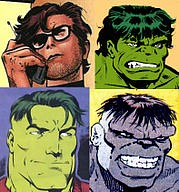
I discovered five bona fide personalities, three of which were described well on this website: Savage Hulk (a.k.a. Green Hulk), "Joe Fixit" (a.k.a. Gray Hulk), and the Professor (a.k.a. Merged Hulk). This website here discusses the Guilt Hulk and the Devil Hulk, among several others. According to the comics, however, Bruce has hundreds of personalities locked away in his mind.

Due to Brian Banner's abuse, the Savage Hulk split from Bruce's early childhood experience. He's the most well-known of the Hulks, typically referring to himself in the third person. He possesses the IQ and temperament of a child, and just wants to be left alone following one of his "temper tantrums." He represents Bruce's childhood wish to be strong enough to protect his mother.

Joe Fixit split from Bruce during late adolescence/college. He was cunning, crafty, hedonistic, arrogant, and hard-to-reach. He did though, have a conscience he often tried to hide. He represents the typical teenager Bruce never allowed himself to be, a personality repressed by Bruce due to his childhood abuse at the hands of his father. He mostly appears at night, and it could be because Bruce was ashamed of this side of himself.

Bruce receives psychiatric help from Doctor Leonard Samson. Samson tries to reintegrate the Green Hulk an Grey Hulk, but instead creates a third split: the Merged Hulk/Professor, who possesses Banner's intelligence, the Gray Hulk's cunning, and the Savage Hulk's strength.

So, Bruce as the scientist leads a very emotionally detached life, almost Schizoid Personality Disorder in description. It's little wonder, because when his emotions get the better of him, whether it's anger, fear, or grief, he morphs from Dr. Jekyll into a Mr. Hyde-like green monster/humanoid. (Indeed, Dr. Jekyll/Mr. Hyde and Frankenstein were the creator's influences.) He holds people at a distance and shuns emotional intimacy. According to Arie Kaplan's book Masters of the Comic Book Universe Revealed!, "Bruce Banner lives in a constant state of panic, always wary that the monster inside him will erupt, and therefore he can’t form meaningful bonds with anyone." He feels that if he shows emotion, people get hurt.

Bruce also struggles with a diagnosable form of Intermittent Explosive Disorder. Let's face it. He might have a moral compass when transformed into the Hulk, but he doesn't exactly walk around on tiptoe when he's mad. He's like a bull in a china shop...carnage and destruction follow him everywhere due to his aggression. His overreaction is a hallmark symptom of this disorder.


Thanks for bringing this character to my attention, Glory. What a messed-up childhood he had! I had no idea.

Q4U: Did any one else not realize how dark Bruce Banner's past was?

Click here to be entered in the giveaway for Tommie Lyn's High on a Mountain!

Wordle: signature

Tuesday, July 14, 2009

Treatment Tuesday - Dissociative Identity Disorder

Today’s Assessment comes once again from Chas. Since he’s having an angelic therapist come to earth to do therapy with former angels and demons-turned-human, he thought it would be helpful to have a therapist’s perspective on what these heavenly counselors might tackle in session. I was happy to help.

Patty* was a demon (formerly named Poisonous) sentenced to be human. Her past as a demon haunted her before and after she accepted the Lord. Seeing people angry or hateful makes her feel even guiltier, because that was her way of life as a demon and she despises it. She is capable of loving others, even to the point of heartbreak. It is helpful to think of Patty as a child of parents who belong to a hate group, like the Neo-Nazis. She has grown up now, and has walked away from the hatred her parents instilled in her all her life. In fact, just like an ex-smoker, she hates the evil she once practiced more than ever, but the healing process takes time.

Now that last characterization brings Patty’s story to a level other writers besides Chas (and his angelic counselors) might benefit from.

Here’s an aside: some of the most difficult and disturbing people I’ve ever encountered in the mental health field were victims of cult abuse. Hearing about the lives they were subjected to (many at a young age) was hard. I had to remember to school my features against the shock. These are the kind of stories you almost can’t believe.

So if Patty had any kind of upbringing in demonhood that was remotely similar, let’s just say it is very realistic for her to have major issues in adulthood. I’m not sure if you’re going to have some repressed memories surface, but that would be very feasible, as well, so I’m including it in case it may be helpful for your plot development.

There are several diagnostic possibilities for her. The people I’ve worked with from similar situations have had Dissociative Identity Disorder (formerly known as Multiple Personality Disorder), Schizophrenia, Post-Traumatic Stress Disorder (almost most definitely), and anxiety disorders that could range from Panic Disorder to Generalized Anxiety Disorder.

Here was a case when I needed a little more information to be of more assistance to the author. So I emailed Chas to find out some particulars. He wrote that Patty has a hard time reconciling who she is today (a born again human Believer) with who she was (former demon Poisonous). She feels “like she’s two different people,” which is very much a dissociative identity disorder type symptom. She’s oppressed by her former life in her present life.

This even affects her sexual life (which really is remarkable how much she sounds like one patient I worked with at a mental hospital). While a demon (or in the cult), Patty took a very natural and beautiful thing—sex—and twisted it into lust and debauchery by inciting lustful thoughts and playing up the outside gloss of this sin. [Many cults are defined by their use of terms used in mainstream religions, but they have been altered to mean something else.] So now Patty is faced with the real deal—marital intercourse between her and her husband—and has a hard time reconciling the very act as something God intended from the corrupt and perverted thing demons made it.

Chas also wrote that Patty is deathly afraid her children will inherit some of her demonic traits, and as such, she essentially wants to strive to protect them from aspects of herself. This further “fractures” her, as she’s trying to be the best mom she can be, but she’s got to accept this other part of her—integrate it, if you will—to really be effective in her parenting or in her role as a wife.

So let’s focus on Dissociative Identity Disorder (DID), even though Patty may or may not fit all these characteristics. You decide, Chas. I’ll include all the symptoms and you can take or leave what you want. ☺

First of all, DID clients have the presence of two or more distinct identities or personality states that recurrently take control of the person’s behavior. Sometimes the person is unable to remember personal details of one identity while presenting as the other identity. This one might not apply…because when I say distinct personalities (or alters, which is short for alternate personalities), the identity will have different speech patterns, vocabulary, handwriting, age, gender, name…you name it, it’s game. And this can happen right before your eyes when they alter.

But the aspect of DID that definitely applies to Patty is a failure to integrate various aspects of identity, memory, and consciousness. Each personality (her former demon self and her present human self) may be experienced as if having its own personal history, self-image, identity and name. The primary identity would be passive, dependent, guilty and depressed. Sounds a bit like Patty! (And I took this straight out of the Diagnostic and Statistical Manual.)

Individuals with this disorder experience gaps in memory sometimes for their personal history, both remote and present (as a result of other identities coming to the fore and making the primary identity “lose time.”

One thing to remember about cult members (esp. young children) is the abuse they suffered at the hands of their parents and cult officials/members. And as research shows, people who are abused are more likely to grow up into abusers themselves. In a way, Satan essentially abused Patty when she was a demon…and she grew to “abuse” others (in inciting lustful thoughts, etc., as a demon). Make sense?

Also, something to be aware of is that the guilt and pain of childhood (or demonhood) can cause these individuals to self-mutilate, be aggressive or suicidal. It’s very common for self-harm behaviors to accompany someone with DID.

Now, for treatment goals. The first—and perhaps most obvious—is integration. You want Patty to be a whole person, feeling whole and complete, not fragmented. The idea behind integration is that you use fusion rituals (can be anything deemed appropriate…I actually had one therapist I worked with who had her DID clients have a session to decide to “kill” off various personalities within them…this John Cusack in Identity…whoa) to make the other alters lose their functioning or purpose. So what function does Poisonous serve in Patty’s new life? I can’t answer this question…and Patty might not be able, too, either, but this is the bottom-line question you’ll have to have your therapist get to in the book. An example of the functionality of one alter in someone who was abused could be that the alter served to protect the person from actually experiencing the abuse. The mind split to preserve itself…and the alter took the brunt of the trauma and pain. (Often, this alter has anger issues at the other alters/primary identity, as you can imagine.) But that’ll give you an idea.

Well, hopefully this helps some. Problem with diagnostic assessments is that sometimes a character doesn’t always fit into one diagnosis completely. In the therapeutic world, we have ways around this, and it’s called “Not Otherwise Specified.” So Patty might fit into the category Dissociative Disorder Not Otherwise Specified. In the fictional world, it could work much the same, I suppose. Take the qualities you want; don’t take the others you (or your character) don’t want to tackle. ☺

Thanks for writing in.

This service is for fictional characters only, so any resemblance to real life examples is entirely coincidental. Any other fictional assessment questions can be directed to charactertherapist@hotmail.com.

Wordle: signature

Tuesday, June 2, 2009

Treatment Tuesday - Dissociative Amnesia

This week’s assessment is courtesy of Debra, the winner of the Seekerville give-away from May 5th (obviously I’m running behind a bit b/c of my move cross-country).

Debra’s heroine, Gretchen*, lives in Glasgow, Scotland, in 1837. She was involved in a violent incident as a child in which she defended and saved her grandmother by killing a man with a pitchfork. She is taken away from her grandmother and put in an institution. Later she is raised as a companion to a young, wealthy woman. Gretchen is intelligent, feisty, bold, and very untrusting. She doesn’t want to remember her past.

The book starts with her acting like a madwoman. She has been in another attack and had to fight for her life to get away (although the reader isn’t privy to this). Local police find her running in the streets out of her head, so they bring her to an asylum, unconscious. When she stirs, she lashes out at p
eople before passing out again. After a rough dream, she wakes up in the morning with no memory whatsoever.

Debra is concerned about portraying Gretchen realistically. Even while she has no memory of her past, is it possible for her to have the presence of mind to find the hero attractive? To have her personality still come through?

* Names have been changed to protect the fictional.

Great questions, Debra! Hopefully I can shed some light for you.

You mentioned that you had done some online research into post-traumatic stress disorder, which I did a post on here. However, the type of amnesia you have described above is unlikely to be the result of PTSD, as usually that type is more pin-pointed toward the traumatic event (which does fit your scenario), but not towards her entire life (which doesn’t fit).


Photo by Jill Greenseth

The best diagnosis for Gretchen is Dissociative Amnesia. The main feature of this amnesia is an “inability to recall important personal information, usually of a traumatic or stressful nature, that is too extensive to be explained by normal forgetfulness” (DSM IV-TR, p. 520). This is reversible, which is important, because Gretchen will remember her past by the end of the book. Dissociative amnesia is most likely reported as a gap or series of gaps in recall for aspects of an individual’s life history.

Less commonly, an individual has a florid episode with sudden onset (which is what Gretchen has). Of the five types of amnesia associated with dissociation, the type of amnesia she has is generalized, which is a failure to recall a person’s entire life. The Diagnostic and Statistical Manual (DSM) therapists use actually says that people with this “rare disorder usually present to the police, emergency rooms, or to general hospital consultation-liaison services” (DSM IV-TR, p. 520). So kudos for you, since you already have this happening in your book.

So, about whether her personality would still shine through…the DSM didn’t have a lot to say about that, which can be a good thing, as it leaves the door open to however you want to portray it. I look at it as more compartmentalized. She’s lost her past, not everything that makes her who she is. You mentioned in the sample chapters I read (due to Debra’s winning the Seekerville contest) that Gretchen wanted prayer when she was feeling anxious. This remembering of an aspect of her life is possible. Her personality could still shine through, too, as long as you are conscious to give her some new aspects to it (i.e., she’s bound to be anxious about not remembering, depressed, even, and may even regress in her maturity level due to this).

A few other common symptoms people reported who have this disorder are trance states, providing approximate inaccurate answers to questions (like 2 + 2 = 5), aggressive impulses (which you’ve already shown), self-mutilation, and suicidal impulses/acts (perhaps from desperation? being overwhelmed? Anything could go here.).

Two other symptoms require a bit more explanation, which I’ll do so in case you want to include these in your manuscript. The first is analgesia, which is the ability to feel pain while still conscious. The second is depersonalization, which is a feeling of detachment or estrangement from one’s self, like the person is living in a dream or movie (i.e., being an outside observer of their own mental process, body or body parts).

One thing that might be of help for Gretchen’s backstory is that people who have already had one episode of amnesia are predisposed to having amnesia for subsequent traumatic circumstances. So, if after killing the guy with a pitchfork she disclose that she had amnesia following that event, it makes the case that much stronger for her having the dissociative amnesia after the second attack. Also, keep the recall of her dissociated memories gradual, as that’s more realistic than WHAM! “Oh, now I remember everything!” (Although that can happen.)

So here's a bit more for you to work with as you're revising what promises to be a great novel! I enjoyed reading what you sent so much.

This service is for fictional characters only, so any resemblance to real life examples is entirely coincidental. Any other fictional character assessment questions can be directed to charactertherapist@hotmail.com.

Wordle: signature