LinkedinTwitterThe DetailsConnectBlog Facebook Meet the TherapistHome For Writers

Tuesday, November 30, 2010

Treatment Tuesday - Widower Getting Back in the Game

This week's assessment comes from Alice. She's writing a romance and wants some psychological insight into her backstories for her hero and heroine. Hero married young, then lost his wife and baby daughter. He's determined to never love again because he doesn't want to risk the pain. So he shuns emotional attachment.

But a year or so later, he meets Heroine and is drawn to her because he mistakenly assumes she's like him, happy to enjoy an emotionally detached relationship for as long as it lasts. She's a lively, fun-loving 19 or 20-year-old who's in media, traveling all over the world, single, and appearing to be loving it, but in her heart of hearts, she longs for love, marriage, children--long-term commitment.

Alice wants to know: Is it credible that a man who has lost his family would really date someone very young and fun to distract himself from his grief?  Is it likely that a young woman who longed for a traditional home and family would choose a fast-paced adventurous lifestyle instead of a more conventional one that would give her a better chance of finding a man who was ready to settle down and have a family?

Alice, both your characters are experiencing reaction formation (which should sound familiar to you). I did a post here on this defense mechanism. Your heroine is displaying a very classic sense of this, while the hero's might be a bit harder to nail down, but I have a feeling his scenario will fit as well.

For those who don't want to read my other post, here's reaction formation in a nutshell:

Reaction Formation is when a person converts unconscious wishes or impulses that are perceived to be dangerous or anxiety-producing into their opposites. A person could behave in a completely opposite way of how they really want or feel (i.e. a woman fakes indifference to men and gives off an independent vibe when all she really wants is to be loved and cherished). A person could also believe the opposite of something simply because the true belief causes anxiety (i.e. a man believes that all women are gold diggers because to believe only his ex-fiance was is too painful).
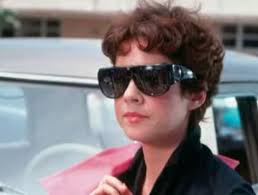
Let's take your heroine, because her situation fits so well. She's like Rizzo from Grease. Rizzo was tough on the outside, acted like she didn't care what people thought of her. She played loose and easy because it was better than admitting she really just wanted love like anybody else. Your gal is not wanting to admit that her deepest desire is to have a husband and the requisite 2.5 children. For some reason (which is what you have to figure out), to do this would bring her tremendous anxiety.

So she goes into this adventuresome career and on the outside, ostensibly loves it, thrives on it. But she's empty on the inside, because she does want love so badly, and traveling the world over is hardly conducive to this. Getting a nice, steady job as a librarian or journalism teacher at the high school would be better suited, but that would come at a price to her.

So why wouldn't your heroine want people to know her deepest desire? You mentioned that maybe she was living someone else's dream in order to go into that field. That might answer why she chose that particular field, but it doesn't answer why she doesn't want her inner motivation known. It probably has something to do with fear. Fear of looking weak, fear of not measuring up, fear of making the same mistakes her mother did. I'm afraid I can't help anymore with this, as it's your story, but hopefully that'll get you on the right road with her.

On to Hero. I had to laugh a bit at your question, but I meant you no disrespect. Almost every divorced guy I know has always moved on with someone younger, whether that was the reason for the divorce or if it happened later. Your guy isn't divorced, but widowed, which makes a difference, sure. However, you asked if it was credible for a man to date someone young to distract him from his grief. And I answer that with a RESOUNDING YES.

Why? Because it's credible that a person would do almost anything to distract themselves from grief. I did a ton of posts on grieving and the types of grief here. I'd read through them and figure out which kind he has.

The reason I think he might also be experiencing reaction formation is that he obviously loved deeply and was very happy with his wife, who died. This happiness was at one time so important to him that he doesn't think he can possibly recreate it...even though it might be his deepest desire to have that one again. So he acts in the opposite of what he truly wants, because it gives him anxiety to think he'll never attain happiness again. He goes for no emotional attachment at all, and makes do with a shell of his former life in the form of dates and maybe kisses, but nothing lasting--no connection.

I wouldn't worry about establishing a pattern of this type of behavior for him. She could be his first or his fifth. The first does bring with it some additional challenges...so maybe make her number 2. I don't think a reader would want him to appear like a womanizer or opportunist, so I'd be careful how you introduce this particular backstory. How old is the guy? It might be that he just connected with the Heroine somehow (through your external story skeleton), and since she was quite a bit younger than him, he didn't think his heart was in danger of any attachment. I'd be curious about this tidbit.

You did ask what would be a credible time to reintroduce him to the dating game. I wrote a post here on my general rule of thumb about waiting to move on: two years. I think anything less than that could come across as tacky to your readers, and you wouldn't want to ostracize anyone. I've also read in research that 2 years for the death of a spouse is about the average time it takes for the survivor to feel normal and ready to move on.

There you go, Alice. Hope this assessment has been as helpful as the last one I did for you! Thanks for writing in again!

And to you other writers out there...the queue is LOW, so now's a good time to write in!

Wordle: signature

Monday, November 29, 2010

Technique Toolbox - You Are Special by Max Lucado

You Are Special Technique


Credited to:  Malinda Fasol, PhD, LPC

For use with: Children or Adults

What you will need:

A copy of Max Lucado's You Are Special

What you do:

I usually will read this book aloud to both children and adults. I like to sit at an angle where the client can see the pictures as I read to them.

The book is about the Wemmicks (wooden people created by Eli, the "carpenter on the hill"). They go about all day long, every day, giving each other stars and dot stickers. Stars for being talented or pretty and dots for being clumsy or having chipped paint. Punchinello, the main character, only gets dots. He meets Lucia (who looks much like an angel, all dressed in white) who has no stars or dots. Lucia says that she visits Eli at the top of the hill often, and the stickers don't stick to her no matter what, because Eli's opinion of her is all that matters.

Punchinello takes Lucia up on her suggestion and begins to visit Eli. Eli tells him how important and unique he is, created just by Eli to be that way. On Punchinello's way out of the workshop, one of his dot stickers fall off as he begins to believe that Eli really means what he says.

After the book, I typically ask at least these 3 questions (sometimes a few more, based on their answers):

1) If you were a Wimmick, would you get more stars or dots?
2) Can you tell me what 5 of the stars/dots would be for?
3) Do you have a Lucia or Eli in your life?
 
Purpose:

Question 1 gives me an understanding of how the child or adult sees him or herself. I can assess their self-esteem based upon the answer to that question.  Question 2 is a cognitive exercise that has the client labeling what's good (or negative) about themselves. This can prove helpful in determine goals for therapy with adults (ostensibly to improve self-esteem or overcome a fear). Children will often parrot back what they have been told from friends or family members. Question 3 tells me what kind of support network the client has.

This book is not overtly Christian. Lucado wrote it from a Christian perspective, though, and I find it's a great way to introduce Christian principles into session without ever saying the words "Jesus" or "God."

From Max Lucado's website: The world tells kids, "You're special if... if you have the brains, the looks, the talent." God tells them, "You're special just because. No qualifications necessary." Only one of those messages will find its place in their hearts. That's why every child you know needs to hear this one, reassuring truth: "You are precious in His sight."

This is a great little technique to make its way into one of your novels. And if you haven't read You Are Special, give it to a child for Christmas this year. Wonderful, heartwarming story. There are several books by Lucado about the Wimmicks you might also want to consider.

Wordle: signature

Friday, November 26, 2010

Friday Free Association Chain


The word is........


BLACK.

(For Black Friday, of course! But you clearly aren't hitting the sales if you're sitting here free associating on The Character Therapist.)

First commenter free associates with the above word. Second commenter takes the first commenter's word and free associates, and so on.

Remember -- FIRST thing that comes to mind. GO!!

Wordle: signature

Thursday, November 25, 2010

Thanksgiving Top Ten

As Thanksgiving roles around again, we're always prompted to ponder that for which we're thankful. 

My list is below:

1. My salvation
2. My husband
3. My daughter
4. My health
5. My intellect
6. My job
7. My home
8. My mom/dad/brothers
9. My friends
10. My lap top (no joke)

Hope your Thanksgiving is a lovely time of investing in the relationships that undergird you 
and the things that matter most to you.


Wordle: signature

Wednesday, November 24, 2010

Art Therapy...Revisited

I'm taking today off. Just because I can.

If you missed it, click here for my post yesterday on art therapy and how it differs from regular therapy.

Check back tomorrow for my Thanksgiving Top Ten list. If I don't see you, then I hope you have a great Thanksgiving!

Wordle: signature

Tuesday, November 23, 2010

Treatment Tuesday - Art Therapy

I recently fielded a question from an email loop about art therapy, and it made me wonder if perhaps some of you out there also had the same type questions.

For the record, I'm not an art therapist. I do therapy utilizing art. There IS a difference, and that's important to note if any of your characters ever see this type of therapist.

Art therapists can be licensed mental health practitioners (like LMFTs, LPCs, LCSWs) but they also hold registration or board certification as an art therapist. Depending on the state the person is practicing in, the practitioner may have had to get a masters degree in art therapy or marriage and family therapy with an emphasis in art, etc.

This is not to say that someone like myself, licensed, but with no particular schooling in "art therapy" can't use crayons and paper and glue and scissors in session with a child or adult. I have and I do. The difference is that I don't label myself, advertise, or practice under the notion that I'm an art therapist. This is a HUGE distinction, and the difference between possibly getting sued for malpractice or practicing beyond the scope of your ability.

So what is art therapy all about? Art therapists believe that it is inherently a healing process to be creative. The broken things on the inside are healed through the act of making art as they express themselves authentically and realistically. This is typically thought of as art therapy. There is also the belief that art is a form of symbolism, a way of communicating emotions and working through trauma and conflict. This latter belief is probably the more stereotyped version of art therapy, and is called art psychotherapy.

In reality, if the above words in bold formed a continuum, real art therapy (in the general sense) is somewhere between these two. Art therapy isn't like an art class. There are no grades and no pressure. The images and ideas come from inside the person, and then the therapist can help guide them into understanding those images, finding a meaning for them or a story. I like to use art therapy techniques along with other eclectic techniques in my treatment of clients. I consider art just another avenue for healing, just as I would any technique from various theories. (But that's just me.)

Anyway, just food for thought. In California, saying you're doing art therapy when you're not a registered or certified art therapist is a big deal. When doing my treatment plans, I usually include "arts and crafts" or "art therapy techniques" as interventions, never "art therapy."

Hope this helps when you come to that crucial point in every writer's manuscript when you wonder, "Is this art therapy or therapy utilizing art?" :)

Wordle: signature

Monday, November 22, 2010

Castle Fans Read On

I discovered the TV series Castle about a month ago. I quickly caught up on all the episodes by going here (you'll see that you can watch many other shows online here, as well).

Like many others, I grew fascinated with the tension presented by Richard Castle (played by Nathan Fillion) and Detective Kate Beckett (played by Stana Katic). I guess this is the usual formula for TV, but the fact that Castle is an author makes it a bit more interesting to me than say, The Mentalist, which is also about a female detective saddled with a male sidekick "consultant." (Although I like The Mentalist also!)

Recently, though, I found out that "Richard Castle" has two books out: Heat Wave and Naked Heat, both of which have been referenced in the television series as books Castle authored based on his research following Beckett and her detectives around.

I purchased Heat Wave, the first book in Castle's new series, following his "wildly successful Derek Storm books." I was instantly engaged, as ABC has put a new spin on advertising with these books! And how enchanting, for a part of my imagination (and millions of other viewers) to come alive on my Kindle screen, as I actually read about Nikki Heat and Jameson Rook, characters based off the imagination of characters!

If you are a fan of the show, you've got to get this book. I've already gotten the second book, Naked Heat, and I'm looking forward to reading it while I have a long Thanksgiving weekend at home. But I couldn't put it down. The reason?

Well, the writing's tight, the pace fast, the tension and one-liners just as taut and dry as they are on the show. But it was like extending the pleasure of the show, because each episode lasts roughly 40 minutes but this book lasts much longer, like reading the original script behind one of the episodes.

And the author doesn't stop with just tension between Rook and Heat, translated Castle and Beckett. For all of you out there who wish the producers at ABC would throw you a romantic Castle-Beckett bone, this book is for you! It's not hard at all to read Castle and Beckett into Heat and Rook's relationship, and it doesn't impact the series at all, the success of which many say hinges on Beckett and Castle not solidifying anything.

I did try to find out who the real author of these books is. (No, I don't believe it's Nathan Fillion, although it's Nathan's picture on Richard Castle's Amazon author page.) I got several websites saying James Patterson is the likely candidate, others Michael Connelly, based on the fact that both of them have appeared as poker playing buddies of Richard Castle's in the series. You know what? I kinda like the mystery of not knowing.


Q4U: Any of you out there have a special connection with this show? Does Richard Castle's writer's mind not strike a chord and resonate with you?

Wordle: signature