LinkedinTwitterThe DetailsConnectBlog Facebook Meet the TherapistHome For Writers

Thursday, September 2, 2010

T3 - Stages of Change: Action

We're at the second to last stage in the Stages of Change, and that would be Action. We've covered Precontemplation, Contemplation, and Preparation already.

During the Action stage, your characters are actively engaged in the change that has eluded or haunted them for most of the book. This is where the rubber hits the road. The character has gone from not even contemplating some drastic, needed change to not only contemplating it, but preparing for it. These characters are dating the guy they know they should have avoided or have crossed the line at work and done something drastic like committed fraud. It's like the point of no return.

Behaviorists, who focus solely on behavior modification, have produced research that indicates the previous stages are vital for success during this stage. Let's return to our heroine from last week who decided she needed to lose weight and get healthier. If she made this decision on December 31st, ran to the store that night and bought all her health foods, threw out her unhealthy snacks in her pantry, and managed to find a gym open on January 1st to join, likely all her efforts will come to a crashing halt because not enough time and energy was given to the previous stages.

We don't want this for our characters (or perhaps some of you devious author-types do)! So while we want to start with an exciting, inciting event, which often includes action of some type, this is not the real action that the main character(s) will ultimately take by the end of the book. (Just don't get caught up in semantics.) We have to bring our characters through all the stages to help the reader be more invested and help the character's Action decision come with the highest stakes possible.

Your character is trying to overcome their problems or start a new way of life, so they seek to modify their behavior, their experiences, of their environment in order to do so. This stage will require the most emotional, mental, and physical effort of your character. They might have thought preparation was rough, but you'll show them!

For many of those writing suspense or action thrillers, the Action stage will be the culmination of all the action up until that point. For mysteries, the Action stage is finally figuring out who-dun-it. For all novels, the Action stage is going to be the climax. It's the reason why people stuck with your book for 200+ pages. It's finding out what exactly happens to this character they've come to care about.

It's okay during the Action stage to periodically look back and question what got them there. This would be your character who is trying to lose weight who sees a pair of old jeans hanging in the back of her closet and realizes she never wants to fit into them again. She might emote over how wearing them made her feel, and it might energize her to push harder during her next workout or forgo that mocha latte with extra whip cream she was tempted to indulge in.

Keeping your character grounded in a support network that they likely surrounded themselves with during their Preparation, as well as finding ways to reinforce their current decision (like the above heroine splurging on a new pair of jeans when the goal weight is acquired), will be crucial during the Action stage.


I want to go back to Edward from Twilight. I like to think of his Action stage beginning not after the aggressive vampire moves in the meadow, but when he slings his arm around Bella in the school parking lot and says, "I'm breaking all the rules now anyway...since I'm going to hell."

For anyone who has ever live through high school relationships to tell about them, this is a very drastic step. They arrive to school in the same car, he walks around the car to open the door for her....they are immediately stared at and labeled a couple. When he says the above quote, he essentially is saying, "Might as well take this all the way and make the most of it." He's made his decision and is acting on it, and this is a climax for the romantic part of the book.


Q4U: Do you agree with my assessment of Twilight's romantic climax? 


Wordle: signature

Wednesday, September 1, 2010

Technique Toolbox - Behavioral Exchange

I thought it might help you write with more authenticity in your manuscripts if I began to provide information about various therapy techniques for children, adults, and families on this blog. You could then realistically portray actual therapeutic methods that I either use or have studied about.

Without further ado:

Behavioral Exchange Technique

The Five Love Languages: How to Express Heartfelt Commitment to Your MateCredited to: Dr. Gary Chapman, The Five Love Languages

For use with: Couples, usually toward the beginning of therapy after it has been established that both the man and the woman want to work on their issues and stay together.

What you will need:

2 index cards
2 pens

What you do:

Give each person an index card and pen. Ask them to write three behaviors that they wish their spouse/significant other did differently (either more of less) that would make them feel more loved/more secure/more appreciated. Explain that the behaviors need to be specific.


For example, "I wish he helped out more around the house" isn't specific enough. Instead, "I wish he would wash the laundry at least every other week and take turns unloading the dishwasher."


"I wish she were more supportive of what I want" would need to be replaced with what exactly would make the man feel more supported. For example, "I wish she wouldn't roll her eyes when I talk about my dream to eventually own a sailboat" or "I wish she would let me unwind from work for about 15 minutes before starting in on what needs to be done with the baby or around the house."


Then have the couple face each other in what therapists call a kneecap session (where knees are close, if not touching), and take turns telling their top three things they wished the other did differently. The therapist mediates, of course, by helping the couple understand what the other is saying by using communication skills such as clarification and summarizing.

End by having them exchange the index cards. Tell them to pick one behavior from the list to work on through the week, but not to tell their partner which one. I like to tell them to go overboard with it, making the behavior they are working on fixing very obvious to their spouse. The following week, I check in with the partner first and ask them what they thought their spouse was working on. Then I ask how it made them feel to see that effort (or lack thereof) and go from there, usually ending on a positive note.


Purpose:


This exercise gives the couple a concrete, proactive way to focus on a specific behavior that causes problems for their mate. What greater way to show commitment to the relationship than to agree to therapeutic homework assignment to do tangible work on one of the three target areas identified by their partner as a problem? And since it was an exchange, it's not one-sided. This technique begins to identify the love languages of each, which comes in handy later. 

Happy writing!

Wordle: signature

Tuesday, August 31, 2010

Treatment Tuesday - Reforming a Sex Addict?

This week's character assessment comes from fellow 2010 Genesis Finalist Rebecca Lynn. She's writing a contemporary romance about Kathy*, a 29-year-old heroine who's something of a sex addict. Kathy tells people she's a Christian, but she's been sexually active for many years. She feels very guilty about her exploits, but that doesn't stop her from picking up guy after guy. She'll chose guys hoping to be together, but once they've had sex, she either continues to use them or bail out/dumps them when they want to be more serious. Then she meets hero Donny*. Donny's not on her radar at first because he's arrogant, on a power trip, and quite a bit older than her. He's had a horrible divorce where he lost his son and is no longer able to see him, and he's decided he'll never be in another relationship. They work together in close proximity for a year and fight a lot, and just as his walls start to come down to allow for an attraction to Kathy, her sexually exploitative past comes up.

* Names have been changed to protect the fictional.

Rebecca wants to know: Is it even realistic to expect that Donny, whose wife cheated on him, would be willing to accept the past of someone who has sexually exploited men (even without Kathy knowing she's done this)?

There is no rule book for the rules of attraction. While our sensibilities would say Donny wouldn't fall for someone so like his ex, how many women do you know who get into relationship after relationship with "bad boys" who all treat them terribly? None of these women get out of an awful relationship thinking they want to do that again. 

So I think the immediate answer to your question is that it's possible, but it would be more realistic if he didn't know on the front end, either by willful denial of Kathy's actions or blissful ignorance. That would be the key. No sensible, conscientious person would fall in love with someone like Kathy if he knew her full, sordid history. But if he were oblivious, attraction could take root before the apprehension of being used or abused would.

I think you're actually asking if Donny could still love Kathy if he found this out about her. Since I don't really know much of Donny's history other than a painful divorce, I can't really answer this. But I can give you some questions to ask Donny that might help.

1) How does having Kathy in his life bring about positive change?
2) Can he imagine a life without her? Is that life better or worse?
3) A year is a long time to have a relationship with someone, even if it's not romantic. How does this information about Kathy's past gel with what he already knows about her? How does it feel in his gut?

Rebecca also wants to know: Is it psychologically plausible for someone with Kathy's sexual addiction to find fulfillment in a monogamous relationship, or will she need extensive therapy in addition to finding someone who accepts that part of her and loves her as a whole person?

Sexual addiction isn't officially recognized as a disorder in the Diagnostic and Statistical Manual (4th edition, text revision). It's also not up for inclusion in the 5th edition. But there are a lot of sexual disorders, usually involving some unusual fetish or urge, but there is a diagnosis of Sexual Disorders Not Otherwise Specified, and that's where Kathy might fit in. Within this disorder, you'd find someone who experiences "distress about a pattern of repeated sexual relationships involving a succession of lovers who are experienced by the individual only as things to be used." Symptoms generally focus more on a compulsive sexual behavior, like fixating on an unattainable target or compulsively searching for more partners.

Really, Kathy isn't as bad as I've known some people with true sexual addictions to act. When a person has multiple anonymous partners, masturbates constantly, is into porn/fetishes/strip clubs/adult stores, and unsafe sexual practices/prostitution, this is more the idea sexual addiction conveys. These exploits take up a tremendous amount of the person's time and energy.

Kathy's symptoms fall more into having repeated/sequential affairs and possibly objectifying men. She's had a large amount of shallow, short-lived affairs, and likely has viewed men as only objects to see to her needs, whether that's physical (sexual) or emotional (need for security, acceptance, etc) as well. Basically, she's been a little slutty. If I had Kathy in my office, I'd want to ask her tons of questions, because increased sexual desire (also called hypersexuality) is a symptom of bipolar disorder, schizoaffective disorder, impulse control disorder, cyclothymic disorder, adjustment disorder with disturbance of conduct and PTSD.

With that in mind, her chances of finding a monogamous relationship increase exponentially. Many sexual addicts join 12-step programs, much like an alcoholic or drug addict or gambler. There are communities out there for sexual addicts, even the website Society for the Advancement of Sexual Health, dedicated to the world of sexual addicts (even though it's not even clinically agreed upon what, exactly, that means!). Antidepressants are also commonly prescribed to help treat this.

In conjunction with therapy, her chances are fairly high at maintaining a normal, one-man kind of life. Therapy would help her find the deep wounds from her childhood that have driven her to her sexual behaviors. You wrote that you had read a book, Soul Wounds, that made you wonder if Donny and Kathy could actually make it. I'd just caution you not to take everything in a book like this to heart. I've not read it, but lots of therapists/psychologists come up with these great concepts for books that make a lot of sense, but it's never a hard-and-fast rule for life.

What I like about your premise is the seeming impossibility of Donny and Kathy's match. You'd have the reader rooting for this from page 1. Yes, Kathy needs to work through why she's felt compelled to use 'em and lose 'em. Donny needs to work through the trauma of his divorce and the pain that's caused. But I'm a firm believer in God taking two broken people and making a whole that just fits together perfect.

This service is for fictional characters only, so any resemblance to real life examples is entirely coincidental. Any other fictional character assessment questions can be directed to charactertherapist (at) hotmail (dot) com.

Wordle: signature

Friday, August 27, 2010

Friday Free Association Chain

Free association is the spontaneous paring of one word with another. A Freudian psychoanalyst would want a client to say the very first thing that pops into their head at the mention of certain words, and I'd like to try the same thing on this blog on Fridays.

I think writers are an interesting bunch, and I'm convinced our brains work differently. I want to have a little reader participation and try doing a free association chain, where every link in the chain is a new comment below.

I'll give the start up word, and then the brave first taker free associates on that word and leaves a comment. Second commenter would free association on the first commenter's word, etc, etc.

Get it?

I don't want to look silly, so PLEASE participate! It'll be fun!


The word is........


HEAD


Who's brave enough to go first? :)


Wordle: signature

Thursday, August 26, 2010

T3 - Stages of Change: Preparation

We've already covered the first two stages of Precontemplation and Contemplation, and this week, we're looking at the third stage of Preparation.

Depending on the type book and genre, either the Contemplation stage or Preparation stage might take the bulk part of your book. I  imagine that characters can vacillate between the two frequently. Either way, you want to make sure that the tension ramps up to a point where at some point they have to make some sort of decision.

During the Preparation stage, the character realizes that they can't put off the decision heralded by the inciting event any longer. They begin to get their ducks in a row, so to speak, to enable them to run for office, attract the elusive guy, or try to catch the killer without getting killed.

Think about the movie Rambo: First Blood Part II. (Bear with me, ladies. I had two older brothers.) Rambo agreed to search for POWs in Vietnam in order to photograph them, not rescue them. He of course doesn't follow rules, and ends up getting captured. He escapes, and has a little kiss scene with the native girl--who then dies. Rambo gets ticked, and begins to assemble his weapons.

This scene goes on for maybe a minute or so, as he's saddling up all his knives and explosives and guns and ammo, cinching them into place on his body. This is Rambo's Preparation stage, as he gets ready for what's sure to be a big "shoot 'em up, kill 'em" event, as my dad would say.

Let's say you have a heroine who is deciding that she needs to lose weight and get healthier. Her first act of Preparation might be to toss out her carb-heavy dinner-in-a-boxes and give away her private chocolate stash. She might stock the pantry with low-fat snacks and more fruit. She might even invest in new walking shoes or a gym membership. This is all in preparation to tackle a new diet and exercise regime, but she can do all of this and not actually lift a finger to cook better or get off the couch. That would be the Action stage.

So the Preparation stage takes the reader right to the brink of action with the character. In a way, it makes every book a little suspenseful. The reader should be just as invested in the character's preparation for action as the character is.

The Preparation stage is also a time when most characters turn to an outside person for advice or support. Friends can give encouragement, therapists can be great sounding boards. Characters (and people) are often driven by an internal mantra of sorts that is their motivation for change. You might be able to discover this mantra by looking at your client's GMC chart (Goal, Motivation, Conflictby Debra Dixon).

For example, if a person thinks they aren't good enough for someone to love them, typically during the Preparation stage, that mantra will begin to morph. They might think, "I'm good enough for some people," (or some other variation), which suffices to motivate them through their preparation.

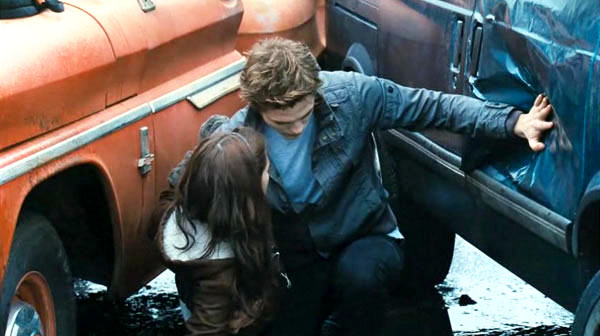
Let's revisit Edward from Twilight.  Last week, we left him contemplating what to do about Bella, the smell of whose blood he can hardly withstand but who is so intriguing because he can't hear her thoughts. Edward's Contemplation moves into Preparation dramatically when he saves Bella's life from her friend's van. If he'd not, though, Bella would be dead, and then his contemplation would be for nothing. At least with her alive, he still has a decision to be made (and the movie can go on). So in a way, he was preparing for the decision he made to get to know her.


Edward's Preparation goes further, of course, when he takes her into the forest on that day when they both just kinda skip off from school. He tries to scare her by getting her to admit that he's a vampire and watching him run fast and chunk trees, etc. He's preparing Bella for his decision. Preparing others is also part of this stage. He's even preparing for his decision when he sneaks up into her bedroom and says he has one thing he wants to try, and that's to kiss her. All of these actions, while being active, are still Edward's way of preparing to have Bella in his life on a more permanent basis.


Q4U: If you're still hanging with me, what are some more famous Preparation stage scenes from books or movies that you can think of?

Wordle: signature

Tuesday, August 24, 2010

Treatment Tuesday - Two Wrongs Don't Make a Right

This week's assessment comes from Shannon. Carter* is the sheltered youngest son in the Rosentia house. Gene*, his oldest brother by 10 years, began forcing Carter to watch increasingly twisted and debauched encounters with women and manipulating him into doing certain things, like taking frightening hallucinogenics, etc., or Gene would hurt the women more.

Carter was to be ritualistically inducted into the Family between the ages of 12 and 16. It's usually done in a way to acknowledge the curse placed upon the Rosentia house and which allows the curse to blossom into its full potential. Carter's experiences with Gene had warped him and influenced his curse so that he was turning into an incubus. His ritual was to be the rape and murder of Elaine*, a 15-year-old girl from an enemy noble house. If he couldn't do it, she would be given to Gene. Carter decided to kill Elaine with a shard from a consecrated mirror and then kill himself. He didn't count on her will to live, as Elaine would rather be raped than die. Elaine begins to seduce him, and given his incubus tendencies, it isn't hard to do.

Gene comes in the next morning and Carter has to seduce him to keep him away from Elaine. The violation breaks a part of him, as does the fact that Elaine is pregnant. Due to failing the ritual induction and allowing himself to be dominated rather than the dominator, Carter is labeled "Chastened" and loses the protection of his family. Carter managed to smuggle the baby out as he kept Elaine secluded from the rest of the family. To keep Elaine safe, he taught her to meditate herself into a trance so that she would appear to others that her mind was broken and she was harmless. The Rosentia family allowed her to be Carter's Campanion, to obey his orders unquestioningly while also trying to ignore Carter's supernaturally potent sexuality, while Carter is driven to alcohol and drugs as a means of coping and deadening his own twisted sexuality.


Shannon wants to know: What sort of issues might crop up between Carter and Elaine in their dealings with each other? What sort of psychological issues might they each have themselves? If they get their son back, and they become a family again, what sort of emotional issues would they have to deal with?

* Names have been changed to protect the fictional.

I would say the overwhelming emotion between these two would be resentment. Elaine, as a 15-year-old being abducted, held hostage, threatened to be raped and killed, then impregnated and then forced to act like she's mentally off to keep her neck, and Carter, being forced to watch harrowing sexual exploits, being labeled "chastened" and losing his family's protection for doing the right thing, and Elaine for basically emasculating him.

I mean, each character would likely have serious traumatic issues - from PTSD to Acute Stress Disorder to Depression to possibly some sort of Shared Psychosis Disorder. Seriously, they are both "off," you know?

Carter's brother is abusive, and witnessing that abuse would likely give him a leaning in that direction, so incubus isn't hard to imagine and actually fits well with the curse he'd get being a part of this majorly jacked-up family. He obviously has a drug/alcohol dependence (as it looks like it's far above just drug abuse). Substances dull the senses and capacity to execute sound judgment, making him a force to be reckoned with when his sex drive kicks into gear.


Elaine is forced into her decision by her sheer will to live. She's a survivor, no doubt. Seducing a man holding a mirror shard trying to reason with you that it's better to die than be introduced to his brother likely isn't high on her list. And getting pregnant with that man even less so. And then living her life out in service to him while she goes about in a fugue state to appear mentally daft even less than that. She had to give up everything about her former life. She even had to give up her son. Resentment would be a huge obstacle, I'd imagine. 

I'm not really sure if Carter would hold resentment against her. You intimated that he was rather weak, and musically inclined, which gives that same softer picture of a man. Perhaps he wouldn't care that he didn't dominate Elaine in the ritual. Maybe he'd be proud of that, even though he lost his family's protection? I mean, what would the respect from members of this house of horrors really mean to him after all?


As to issues that might crop up between them, I think their conversations in private would be laced with tension, as Elaine is no mute. I'd make her a very sharp, intuitive girl, and living the lie of being mentally broken is would rub on her maybe worse than anything else. Rape victims might never forget, but most eventually move on. Pregnant women lose newborns to fates much worse than Elaine's. At least her baby is alive and hidden from these crazy people. But her mind...the one thing that no one should be able to touch...is confined, and that's mentally oppressive and emotionally defeating. 


I'm not sure if you have written her in actual fugue states, or how easy it is for her to "come out" of these states, but I'd play this area up BIG. Lots of almost-being-caught-acting-normal type suspenseful encounters. And the resentment. Oh, yeah. 

Issues they have if they get back together as a family would depend on how old their child was, how heavily Carter is into drugs/alcohol, and where they live. If I remember correctly from the first assessment, their son comes back to them as a teenager, and quite honestly, it'd be almost better if he came back as an adult. Teenagers have so much angst and I've heard from so many clients and older friends that managing the teenage years are the hardest parts of parenting ever. If you've actually wanting the family to solidify, and Carter and Elaine to be "together forever," then I wouldn't put that additional stress of having to worry about their son skipping curfew and staying out all night or getting some teen girl pregnant. 


This family would have a better chance of "making it" if they are outside of the Rosentia Manor and away from the curse as much as possible. Besides, that just seems a healthier way to start a new life anyway. 

I'd be remiss, though, if I didn't point out that two wrongs don't make a right. This family has decks and decks of cards stacked against it. The first time I heard that expression with regards to relationships, it was in the context of pushing to people to get married simply because they had a child. But the wrong of getting married without loving each other won't make the wrong of having a child out of wedlock (depending on who you're talking to) right. I think this same concept might apply to these characters, depending on how you wrote them.


Hope this helps! Thanks for writing in again.


Wordle: signature

Thursday, August 19, 2010

T3 - Stages of Change: Contemplation

We're up to week two in our new series about the Stages of Change. If you missed week one, you can read about the Precontemplation Stage here.

The second stage is called the Contemplation Stage.  This stage takes up most of the most of the novel...probably all the way through Act II at least. At the start of this stage, the main character faces the inciting event (also called the change element or trigger in my world of psychology) where they are introduced to the fact that they do have a problem or some hurdle that they need to overcome. 

This inciting event throws their life into chaos, and they sorely miss the days of their Precontemplative status quo. They are forced to begin to think about making a change or overcoming things, but they are in no way ready to commit. In fact, they might be begrudging to the representative of the new way of things (in a romance, this is usually the lead opposite character) and very resistant to even the idea of change, much less making it for themselves.

In real life, this stage can last months to years. People like things the way they are, and change usually isn't received well. It's messes up the flow of someone's life, so it's not welcome.  All readers can relate to characters going through this same thing, as this is a universal human experience.

Characters in this stage have been known to make pro/con lists or do a cost/benefit analysis to see if it's worth their while to even try to prepare for the change. Usually the costs outweigh the benefits to the person contemplating this, and they tend to focus on every reason why they shouldn't make the change.  
WRITERS: these reasons make for great plot points to address through your sagging middle!! As you unfold your story, you will painstakingly (and meanly!) strip away your characters excuses and defenses, driving them toward the third stage of Preparation.

Writers should show the conflicting emotions of characters contemplating the literary change they need to make. Typically, even though the character can see more cons and pros, they also usually know that they should make the change. This leads to their ambivalence, because along with the pros of the change, they also have to face those perceived cons.


Let me conclude with an example from Twilight. Edward's status quo was going to school forever on overcast days, pretending to be human. This is the Precontemplative Stage. His inciting event is getting a whiff of Bella's scent, his "own personal brand of heroin." He then enters the Contemplative Stage, i.e., What the heck do I do about this girl whose mind I can't read but the temptation of whose blood I can hardly withstand? He weighs the pros/cons, as seen in when he talks to her, trying to get to know her, but then turns around and is rude to her to keep her at arm's length. 

Next week we'll address the Preparation Stage and where this fits into our novels.

Q4U: How long do you give your characters to contemplate what's before them for the rest of the novel? Does this differ according to genre?

Wordle: signature