LinkedinTwitterThe DetailsConnectBlog Facebook Meet the TherapistHome For Writers

Thursday, January 20, 2011

T3 - Character Motivations, Part 3

This week we're covering the Need for Achievement (N-Ach), the third motivating need as identified by psychologist David McClelland. If you missed the Need for Power or the Need for Affiliation, click on the names to read the previous posts.

People with High N-Ach want to excel at what they do and succeed at what they plan. They will go-go-go until they reach the top. They are driven by the challenge of success and the fear of failure. They want to win, master skill sets, be in control, and set new records. They want to "boldly go where no one had gone before."

They don't need praise or recognition of a job well done. Most likely they prefer to work alone or with other high N-Ach people, with a high degree of independence. (They absolutely do not like micromanagers!)

They need constant, specific feedback for them to judge where they are in their progress of meeting their own goals. This feedback ultimately should include advancing up the corporate ladder, with appropriate raises and bonuses. But let me be clear: it's not about the money. It's the achievement of making more money, where the money becomes a symbol of their progress.

They usually set realistic goals that are challenging and always--always--taking them in a forward direction. They are a big believer in calculated risks, preferring neither low-risk situations or high-risk situations. Here's why: a low-risk situation where success is easily achieved is not genuine achievement. If anyone could do it, that would nullify their sense of gain. A high-risk situation could mean success is more a game of chance (low internal locus of control) than the result of the N-Ach's own effort (high internal locus of control). It also carries a chance of failure, which N-Ach's avoid at all costs.

They might have too high of expectations of others, expecting them to be high N-Ach, as well, which could be problematic for them. They might think of people with low N-Ach as being slackers, content to get by with the bare minimum, or reckless cavaliers, choosing high-risk situations where failure would be not only unembarrassing, but also expected.

People with high N-Ach might have parents who encouraged independence in childhood and gave out praise and rewards for success. Positive feelings were associated with achievement (as well as the reverse), so that might help you with backstories.

Next week I'll wrap up this series with some suggestions of how you might best be able to determine what your character's deepest motivating factor is, and how to slam them up against their unstoppable force to create great tension in your novels!

Wordle: signature

Wednesday, January 19, 2011

Movies & Madness: The King's Speech

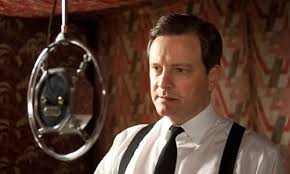
I got to watch this movie this past weekend on a date night (yes!) and was unbelievably moved. Colin Firth deserved the Golden Globe award he got Sunday for his portray of King George XI of England.

Here's a short blurb from the International Movie Database:

The story of King George VI of Britain, his impromptu ascension to the throne and the speech therapist who helped the unsure monarch become worthy of it.

While I would love to rant about the psychological undertones and awful backstory (read: childhood, because he was a real person) King George had, I don't want to give anything away. But, from the blurb and movie trailers, you can determine that the king suffered from a condition they called stammering back then.

If Bertie, the Duke of York, had lived in today's time, he would have been diagnosed with Stuttering.
This is a disorder usually first diagnosed in infancy, childhood, or adolescence. There are two main criteria: 1) disturbance in the normal fluency and time patterning of speech and 2) the disturbance interferes with academic or occupational achievement or with social communication.

What is fluency? According to Stephen B. Hood, editor of Stuttering Words (1997), fluency encompasses several things: the ability to talk with normal levels of continuity, rate, rhythm, and effort. It involves the smoothness with which units of speech (sounds, syllables, words, phrases) flow together. 
So the best way to recognize non-fluent speech is listening for abnormally broken or slow speech, or speech that takes entirely too much effort on behalf of the speaker (and the listener). 

The DSM-IV lists 8 different occurrences that can disturb fluency. A person only has to have one to meet the criteria of stuttering:

(1) sound and syllable repetitions, such as "buh-buh-buh-banana"
(2) sound prolongations, such as "aaaaaaaple"
(3) interjections, such as "um," "uh," "ah," "well, you know"
(4) broken words, such as "pic--[pause]--ture"
(5) audible or silent blocking, which is when the person is speaking but nothing is coming out because there is a stoppage of air, either at the larynx, lips, or tongue
(6) circumlocutions, which is substituting easier-to-say words for problem ones (think of this as the game of Taboo where you would say any word but the word at the top of the card to avoid getting buzzed)
(7) words produced with an excess of physical tension
(8) monosyllabic whole-word repetitions, such as "I-I-I-I see him" (what we stereotypically think of as stuttering)
Quite astounding, really, that any one of the above would mean you could be a stutterer. Don't tell me that you didn't learn something just then!

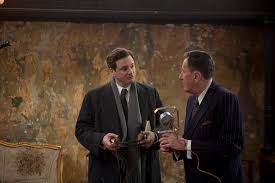
But what makes The King's Speech even better was that his speech therapist, Lionel Logue, takes Bertie deep into his inner demons, to face them head on. He presupposes that no infant is born as a stammerer. It's something that comes on around age 4 or 5, and he believed trauma/anxiety have a lot to do with it. Not to ruin anything, but this is where the heartbreak came for me. Truly amazing what this man overcame and endured, to end up thriving and prospering as the King of England.

This is still a major research topic today, and many researchers believe a criteria about anxiety should be added to the next issue of the DSM, which would be the DSM-V. You can download a scholarly article about chronic anxiety and stammering here if you're interested.

Hope you enjoyed some yummy pictures of Colin Firth. He deserves to be celebrating this week. He was amazing in this film. I highly recommend it.

Q4U: Have any of you watched this? What did you think? More importantly, did you cry like a baby as I did?

Wordle: signature

Tuesday, January 18, 2011

15 Famous People with Mental Disorders


Since my COUCH QUEUE IS EMPTY, I thought many of you would find some real-life celebrity diagnoses interesting:

http://www.onlinedegree.net/15-famous-people-with-personality-disorders/ 

I didn't know that some of these people suffered from mental disorders, so I was glad for the additional links (click on the names) and videos included in the post.

Mental illness is surely no respecter of persons.


Wordle: signature

Monday, January 17, 2011

Happy MLK Jr Day!

Will be back tomorrow with another character assessment. Until then, enjoy the holiday!

Wordle: signature

Friday, January 14, 2011

Friday Free Association Chain


The word is........


INK.


First commenter free associates with the above word. Second commenter takes the first commenter's word and free associates, and so on.

Remember -- FIRST thing that comes to mind. GO!!

Wordle: signature

Thursday, January 13, 2011

T3 - Character Motivations, Part 2

This week we're looking at the second motivation as identified by psychologist David McClelland, the Need for Affiliation (N-Affil). 

If you missed the first part of this new series for writers, click here for the Need for Power (N-Pow).

This second category deals with the people who are social by nature. Affiliation can be defined as a positive, sometimes intimate, personal relationship. These are the people love being a part of a group and are friendly to others. They crave human interaction and want to be liked by everyone they meet. It drives them crazy when someone dislikes them and they don't know why.

They always want to be in harmony with others, so as a result, can often be conformist and reluctant to stand out. These are not competitive people. Most likely, they stick with whatever norms have been established by whatever group of which they are a part. They want approval, rather than recognition, and it's that approval which motivates them the most.

High N-Affil individuals prefer work that provides significant personal interaction. They perform well in customer service and client interaction situations and do best in a cooperative, cohesive environment where they can be a supportive team player. They often make poor managers or leaders because their ability to be objective is impaired by their high need to be popular and liked. A person with High N-Affil placed in a leadership role might avoid making unpopular decisions, permit exceptions to rules, and show favoritism to friends.

Some situations bring out the N-Affil greater than others. For example, take the weeks and months following the 9-11 attack on the World Trade Center. Americans put their differences aside and came together in a time of great distress. In general, situations that lead to fear cause people to want to be together, as well as events of high stress.

It should be noted that people who are high N-Affil don't necessarily have to be with other people all the time. Ideally, they strive for just the right balance between time to their self and time spent with others. If that balance isn't being met satisfactorily, then the person will be more motivated to adjust it one way or the other.

If you know someone who would blow off studying for an exam because they value a relationship more than the grade, they are likely High N-Affil. If you know someone who is uncomfortable socializing with others--minus close friends and family, perhaps--then they are low N-Affil.


Wordle: signature

Wednesday, January 12, 2011

Technique Toolbox - Putting an Affair on Ice

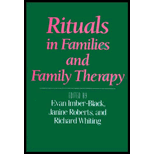
Credited to:  Evan Imber-Black, one of the authors of Rituals in Families and Family Therapy

For use with
: Adults
 
What you will need: 
A willing couple
Symbolic items representing the affair
Bowl of water (at couple's home)
Freezer (at couple's home)

What you do:

Have the couple identify separately an item or object that reminds them "of the unhappy time that has arisen between them." When they decide on their objects, have them meet together, discuss their symbols, but the objects in a large enough bowl to accommodate them, fill it up with water, and put it in the freezer.

The therapist then asks the couple to conduct an experiment (assuming they were willing to do the above). They are asked that the next time they begin a fight on any topic, they will stop the fight and take out the frozen bowl. The items have to thaw enough to be retrievable before they can fight about the affair. 

During the thawing out period, the couple is to talk about positive qualities of their relationship, both past and present. The discussion can be enhanced by the couple soliciting the opinions of their support network (people who have good things to say about them being together).

Purpose
:
This ritual calls upon the couples' creativity, sense of humor, and playfulness--all of which are usually missing in a couple struggling in the aftermath of an affair.

Imber-Black discusses that by having each partner put a symbolic element into the water bowl to freeze, it introduces a symmetry into a system where one partner was viewed at the victim and the other the villain. By both "victim" and "villain" identifying an item that captures their feelings about the affair, they enter the game on a more level playing field. This process also confirms separate viewpoints regarding a joint problem and gives them both ownership.

Selecting an appropriate symbol helps the couple see the affair through the eyes of empathy for the other, rather than anger, blame, or defensiveness. In essence, the affair is re-contextualized collaboratively, and the couple uses their problem-solving abilities to conquer it. The ludicrousness of the frozen water bowl helps remind them that they can have fun even with a major rift between them.

Doing the above in the couples' home shifts the home from a place of catastrophe to a place of humor and problem-solving.

Wordle: signature