LinkedinTwitterThe DetailsConnectBlog Facebook Meet the TherapistHome For Writers

Tuesday, January 11, 2011

Treatment Tuesday - Suppressed Grief

This week's assessment is from Elizabeth, who is writing a futuristic sci-fi novel about Brandon* and Anna*. Brandon is perpetually cheerful and almost never serious. Anna is quiet, reserved, and hard to tell what she's thinking. One might think Anna doesn't like you because she's blunt and sarcastic, but has a good heart deep down. The two have a rocky relationship together after Branden gets Anna out of a bad home life when they are teens. They have a relationship all through high school, and Brandon learns to read her very clearly.

When he goes to college, she joins the military. Brandon tries to stay in contact with her, but Anna couldn't handle the long distance aspect, especially when she thought she feel in love with someone else. Brandon drops out of college and joins the military, and just as he hoped, they get stationed on the same ship together. He tries to re-establish their relationship, but Anna was gun-shy after all the time that had passed and the fact that the last man she loved had betrayed her, causing her to shun romance.

Elizabeth wants to know: Anna eventually dies, and it's clear she dies for Brandon. However, Brandon doesn't seem to show any of the traditional signs of grief. He acts like his normal, happy-go-lucky self. Does this indicate a lack of depth in his emotion, or does he just fail at processing and showing emotions?

Good grief questions, Elizabeth. Grief is so personal and complex. Earlier on this blog, I did a series on the types of grief as well as a later series on the different facets of grief. I'd encourage you to check those out, because they definitely touch on the type of grief Brandon is displaying.

I'm going to do this assessment under the assumption that Brandon loved Anna, and that his feelings for her were far from shallow. In fact, his feelings were so great that at Anna's death, his brain can not process the loss. He is probably in the Denial phase of grief, refusing to accept the possibility that someone who meant so much to him is no longer living.

If Brandon knows she's dead--maybe he saw it with his own eyes or held her in his arms as she slipped away--then the knowledge is buried in his mind even as he goes about living as if it never happened. If something like the above happens in your manuscript, then there could be a case for a severe traumatic reaction to what happened, such as not believing it did.

You'd have to answer that question: Does Brandon know in his knower that Anna is, in fact, dead? If he doesn't, then this assessment would look quite different, but again, operating on the assumption of more common reactions, I'm going to assume he knows that she's dead, but just isn't grieving the way everyone thinks he should.

Suppressed grief usually erupts in some form or fashion over time. A person's body just can't handle it. Brandon might start experiencing psychoemotional and physical disturbances, such as blurred vision, gastrointestinal disturbances, and heart palpitations. (Notice I didn't say psychosomatic--which is in the person's mind.) These are real problems that seem to have no biological basis.

I'd consider giving Brandon one or two of those physical symptoms, at least, to make his level of grief more realistic. A perfectly healthy man having heart palpitations of chest pains would baffle doctors until it slipped out that he had recently experienced the death of a loved one. (Hopefully the doctors would refer him on to a therapist at that point.) 

It is said that the two main healing variables for grief are talk and tears. Now not everyone is going to cry and not everyone is going to talk...but most everyone does one or the other as their primary way to cope. Brandon's happy-go-lucky self will eventually need to peter out into one of these modes, and it would need to be a dramatic, climactic release for him (and for the expectant reader) or readers could have a couple of reactions:

1) Brandon didn't care about Anna as much as he said he did. For some reason, people believe the the amount of tears is somehow a testimony to how much the person was loved. We expect to see people grieving at funerals, and those who aren't are looked at circumspectly.

2) Brandon is going to explode. Depending on if there is tension in your story surrounding his lack of grief, and his acquaintances being worried about him, etc., the reader might begin to think Brandon's just going to go postal, and this would not be a good release, obviously.

3) Brandon is crazy and thinks Anna didn't die. Readers might think he is in need of professional help to get him through the grief.

The reality is that Brandon's world has changed. A reader will probably go along with a portion of the book where Brandon isn't grieving "appropriately," but after a while, they are going to come to expect him to have that catharsis...that acknowledgment that his world has changed and that he's going to try to adapt and reconstruct his world to a new reality without Anna.

The key for you as the storyteller is to make Brandon's reaction of suppressed or absent grief realistic, but gauge how long you want to leave him in that limbo state before you ease the minds of your readers. The easiest way would be to include the physical grief symptoms, as any reader would accept the reasoning that he's having those problems because he's not accepting the loss or beginning to grieve.

Good luck to you! Additional comments or questions are always welcome.

Wordle: signature

Monday, January 10, 2011

Character Stereotypes: The Neat-Freak

Main Entry: neat•freak
Pronunciation: \ˈneet freek\
Function: noun
1 : a person who exhibits a pattern of behavior characterized by obsessive cleaning and ordering

If your character color-codes his sock drawer or lines up all her DVDs in alphabetical order, they qualify as neat-freaks.

Some out there in the world of psychology believe that Obsessive-Compulsive disorder operates on a continuum of sorts. On one end, you’ve got the germophobes, counters, and checkers (and double and triple checkers). They can’t function because their minds just won’t quit.

On the other end, you’ve got people who hand dry their pots and pans to avoid all trace evidence of watermarks, and those who have to iron their wrinkle-free shirts. These behaviors don’t interfere with their ability to function, but they do make them officially Type-A, for anal-retentive.

Kinda anomalous. Kinda admirable. Kinda aggravating.

How can you make your neat-freak pop on the page, larger than life? Read on for four insights that should help here.


Wordle: signature

Friday, January 7, 2011

Friday Free Association Chain


The word is........


NEW.


First commenter free associates with the above word. Second commenter takes the first commenter's word and free associates, and so on.

Remember -- FIRST thing that comes to mind. GO!!

Oh, and stop by Jillian Kent's blog today...I'm her Blog Pick of the Week. :) Super nice of her!

Wordle: signature

Thursday, January 6, 2011

T3 - Character Motivations, Part 1

Today starts a new 4-week series on character motivation. I'll be drawing from the Learned Needs Theory of psychologist David McClelland (1961). He developed a theory that, boiled down, essentially posits that humans have three types of motivating needs, acquired over time and shaped by experience and cultural background:
  1. Need for Power
  2. Need for Affiliation
  3. Need for Achievement
There are many other theories out there, some espousing more needs than others, but they pretty much all boil down to these three, which should be music to a writer's ears! How much easier, then, to nail down the driving motivation behind your characters? Let's flesh out that "M" column from Debra Dixon's Goal, Motivation and Conflict.

If a person has a high need for power (N-Pow), they have a need to make an impact using influence and control. They are most satisfied when their environment and surroundings move in a direction due to their direct involvement. This need could find roots in the person's workplace, church, government or military.

These people are usually good speakers, like to be at the center of attention, demanding in nature, competitive, and ambitious in life. They aren't concerned with getting recognition or approval from others. They just want people to agree with them and comply with them, as that meets their power need.  People skills, compassion, and flexibility might not be their forte.

N-Pow can be expressed in two ways:

1) SOCIAL

Social power is also called institutional power. These people want to further the efforts of the organization they work for, root for, or invest in. They want to direct the efforts of their team, whether financial gurus, cheerleaders, or powerhouse companies, to achieve a greater good.

They want their efforts to be effective and tasks to be accomplished, so they seek the upper level management positions as a way to accomplish this, not because they want to contribute to their status and gain. These individuals are hesitant to abuse their power. They are less narcissistic and welcome consultation and advice. They don't stockpile status symbols to flash about.

2) PERSONAL

Personal power isn't viewed by others to be as desirable as social power. Why? Because a person seeking personal power wants control over people. They aren't necessarily interested in a greater good. They are after their own goals and just want to have power over others to meet those goals.

They aren't as concerned with being effective or making a difference, so they might not make the best managers or CEOs. They typically have less self-control and might exercise their power impulsively. They might be rude, manipulative, and drive about town in fancy cars and $3k suits. They want the people under them to be loyal to them, not the organization.

    It might be important for you to note that men with a high N-Pow express their motive in different ways from women with high N-Pows. Men typically show higher levels of aggression. They are more susceptible to drinking heavily, participating in competitive sports, and being sexually exploitative. Women tend to channel their N-Pow in more socially acceptable ways, like being responsible, caring, and concerned.

    I'll cover the Need for Affiliation and Need for Achievement in the next two weeks and then do a wrap-up for week four to discuss how you can "interview" your characters to determine which need is higher for them than the others. Till then!

    Wordle: signature

    Wednesday, January 5, 2011

    Movies & Madness: Scarlett O'Hara

    Scarlett O'Hara is on the couch today. Let's see if you agree with my diagnosis. 

    Note: This assessment will be done using the Scarlett O'Hara as portrayed by Vivian Leigh in the 1939 film, not the literary figure from Margaret Mitchell's book.

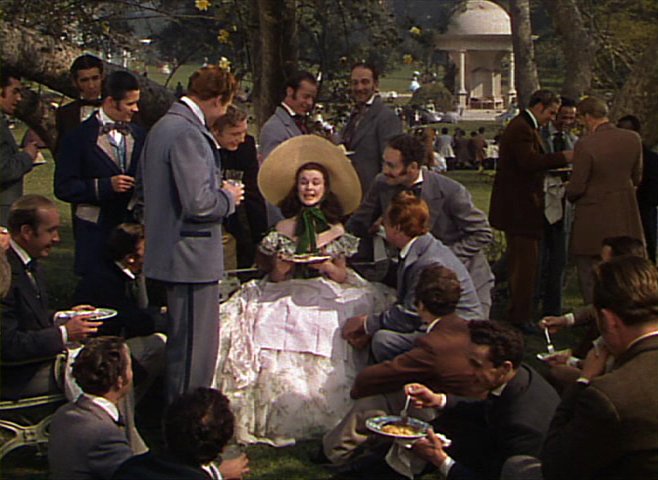
    Scarlett had to be the center of attention. The beginning of the film shows that very well, with the classic picture of her in the middle of all the men, basking in their adulation. She said, "Now isn't this better than sitting at a table? A girl hasn't got but two sides to her at the table."

    She was often seductive or provocative, using her appearance to draw attention to herself. Think of how she had Mammy trying to get her back into the same waist-sized corset she had before her baby was born, of how she took to the desperate measures of making a dress out of curtains in order to keep appearances up. She considers her relationship with Ashley more intimate than it was, telling him that he "led her on" and "made her believe that he wanted to marry her," all the while Ashley denies this.

    Scarlett's emotions shifted rapidly, so therefore seemed to carry little depth. Rhett saw through this immediately, which endears him the viewer. This is not to say that Scarlett didn't feel emotions deeply. I believe she did. But her shallowness emerges when she's happy and smiling one minute then pouting the next. Some might think her to have Bipolar based on this, but that's the only characteristic that fits.

    Scarlett was nothing if not dramatic. Her theatricality made the movie what it was. You can just hear her. "Oh, Ashley!" "Oh, Rhett!" "Oh, Melanie!" Wringing her hands, pacing, using words like "varmint" to degrade someone, fiddle-dee-deeing things of import--she often exaggerated. For example, at the beginning with the Templeton brothers are talking of war, she exclaims, "Fiddle-dee-dee. War, war, war; this war talk's spoiling all the fun at every party this spring. I get so bored I could scream." She warns them that she'll go in the house and slam the door of they keep on.


    She is highly suggestible, too, meaning others can easily influence her. When Mammy is trying to get Scarlett to eat before the barbeque so that she doesn't "eat like a field hand and gobble like a hog" when she's there and reflect badly on her family. Scarlett says that Ashley told her he likes a girl with an appetite, and all Mammy has to do in plant this seed: What gentlemen says and what they thinks is two different things, and I ain't noticed Mr. Ashley askin' for to marry you. Scarlett then starts stuffing food in her mouth like a starved person.

    I've just described in bold every clinical symptom of Histrionic Personality Disorder. To have this diagnosis, you only have to have 5 of 8 symptoms, and have started showing signs of these symptoms by early adulthood in a variety of contexts, which Scarlett does. The one symptom I didn't mention was an vague, impressionistic pattern of speech. I couldn't think of a place where Scarlett lacked detail in her speech, as if trying to impress someone but not really having the knowledge or words to do so.

    Histrionic Personality Disorder is in the same cluster as Borderline Personality Disorder (BPD), and as you will read, Scarlet exhibits a few of those traits, but I don't believe she has the required five of nine to qualify. You can read my post on all the traits of BPD here.

    Scarlett hurled a vase after being rejected by Ashley Wilkes. Yes, it's dramatic, as mentioned above, but it also borders on unstable. Borderline PD is characterized by intense, erratic, interpersonal relationships, which Scarlett definitely has, not only with Ashley, but Rhett also. These relationships usually fluctuate from idealization to devaluation. Hmm. Definitely fits! This also shows her difficulty controlling her anger, which BPD is also known for.

    As most women might select shoes or purses, Scarlett had a tendency to select husbands. She marries Melanie's brother, Charles, to make Ashley jealous. He dies, but Scarlet fakes her mourning. (We all recall the scene where Rhett bids on her, and she accepts, going against societal norms for a grieving widow.) Then Scarlett manipulates her own sister's boyfriend, Frank Kennedy, into marrying her...and all she wanted was his money. This devastates Suellen. For diagnosis purposes, this shows two things: frantic efforts to avoid real or imagined abandonment and impulsivity.

    Theodore Millon identified several subtypes of each personality disorder, and Scarlett would best be desribed as a cross between an Infantile and Theatrical Histrionic. Click on the picture for more detail. (Note: these subtypes are not in the Diagnostic and Statistical Manual.)

    Q4U: Does Scarlett being Histrionic fit? Does this ruin your perception of one of our favorite Southern Belles? Who should be next for a Movies & Madness assessment?

    Wordle: signature

    Tuesday, January 4, 2011

    Treatment Tuesday - Doctor with Inner Demons

    To start 2011 off, my first character assessment is for Alaura. She's written in before, and I'm glad to have her again! (It's akin to the good feeling a therapist gets when a client comes back the next week. They must be getting something out of it, right?) :)


    Hero left Heroine when their small child died from an illness/accident. She waits a while for him to return, but eventually divorces him. Hero left because of his internal belief that he's a failure. He's a doctor who couldn't save his child. He also believes that leaving the marriage will "set her free," enabling her to move on with her life as if she'd never met him. Since Heroine married him after an unexpected pregnancy, Hero thinks the child was all that bonded her to him.

    Alaura wants to know: Besides depression, what psychologically deeper reason would give the Hero his mistaken belief about himself? What could have happened in his childhood/past to make him believe he's responsible for both the child's death and the heroine's anguish following it--and that she'd be better off without him? Also, could there be something deeper and not so noble behind his reason for leaving?

    Great questions. You're thinking along the right lines already, so this assessment is really just fleshing out what you've already discovered.

    Let's go back to what prompted him to enter the medical field. For many in the helping fields, something happened to them that made them want to be a doctor (or therapist, or social worker). I guess a few doctors go into medicine because they're just good at chemistry, but they are the boring ones. It's the ones who have a reason behind their passion for helping others who we want to read about...the ones with inner demons (which is why House is so popular).

    Some examples could be he witnessed the death of someone and didn't know what to do to save the person before help arrived, or he had a loved one die of cancer/disease because of no known cure, or because he himself was saved by a doctor in a life or death situation, and it made such an impression on him that he wants to give back.

    Here's an idea. What if he had a brother--maybe a twin, maybe a few years apart--and something happened in childhood where the brother died? What if he saw what that did to his mother and he now sees it happening to his wife, and it stirs up all the feelings from that trauma? The interesting thing is that his mother would have grieved the life of either boy, but because Hero was the one who survived the tragedy, he doesn't realize that both of their lives were equally precious to the mother.

    Perhaps he just feels like he shouldn't have been the one to survive, or that the wrong son lived. Think a Johnny Cash scenario or Faramir telling his dad that he knew his dad wanted him to have died, not Boromir. As restitution then, to his mother, to himself, to his lost brother, he becomes a doctor, intent on saving lives like the one he lost when his brother died by [insert senseless death here].

    Now, in present day, have his child die in some fashion that the Hero would feel it is his fault. Either he was driving the car, or he turned his back for a split second at the pool, or lost grasp of his son's hand at the festival...something physically preventable, but only by a man with inhuman strength. Now make that reason he didn't prevent it have something to do with his internal schema or not being good enough or being a failure. He's been living his life trying to live up to his own ideal of inhuman strength (whatever that looks like for him) and when he didn't have it--didn't come up to par--he's completely dejected.

    As for a not-so-noble reason for him to leave, I'd bring it back to that major incident when he was a child. Take the mother thing again. He saw the way his mother grieved, and how dealing with her grief turned his father inside-out. Maybe his reason for leaving Heroine is a bit selfish: he's already got enough to deal with, he just can't handle Heroine's grief trapping him, sucking what little life he does have right out of him. Just a thought. If his dad changed, withdrew, stopped caring about things--maybe became an alcoholic--that would be a huge fear for Hero. He wanted to change the world as a doctor, save people...not ruin himself via the grief of someone else rubbing off on him. Does that make sense?

    Lots of couples who lose a child break up over the traumatic period following the child's death. That's a very realistic end, but it's also stereotypical as a result. So the difference in your story will have to all be in the backstories, so good luck with it!

    Wordle: signature

    Monday, January 3, 2011

    Join the 3% Club in 2011!

    I'm reprinting this devotional from the American Association of Christian Counselors because it was really good! Happy New Year to all of you!


    Dieting. Reading the Bible. Spending time with family. Finally getting to that “bucket list.” It’s that time of year when “change is in the air.” Most of us don’t have trouble making New Year’s Resolutions. It’s the “keeping them” part that gets us. In fact, 40 to 45 percent of people do make a New Year’s Resolution, and while it is true that 97% of resolutions are never fulfilled, 75% do make it past the first week, and 46% make it past the six month mark.

    As we look forward to a New Year, there are three “C’s” in Psalm 37 that can offer some encouragement to help create your “breakthrough” year!

    Commit

    Psalm 37:5 “Commit your way to the LORD; Trust also in Him, and He will do it.” Every morning, noon and night (Ps. 55:17) give your desires, plans and goals to Him. Ask Him to bring strength and light to your journey.
    Confess

    Often, when we think of confession, we turn to 1 John 1:9 which deals with confession of sin. While this is important in the life of a Christian, we should also consider confession to the Lord of our deep need for Him. In verses 39 & 40 of Psalm 37, David acknowledges “the salvation of the righteous is from the LORD; He is their strength in time of trouble. And the LORD helps them, and delivers them…”(NAS) Confess to Him that you cannot “do life” without His help.

    Confidence

    David reminds us in verse 25 of the whole hearted confidence that He had in the Lord…“I have been young, and now I am old; yet I have not seen the righteous forsaken, or His descendants begging bread.”(NAS) Such a bold perspective caused David to look expectantly to the Lord. In 1 Samuel 30, even when all was lost at Ziklag, David “strengthened himself in the Lord his God” (vs 6 NASV). He then “inquired of the LORD” (vs 8 NASV), believing that the LORD would hear and answer him. And He did…

    As you set new goals, and face new horizons, come with a “spirit of expectation” to hear from, and be encouraged by God.

    Sounds like a formula to help you join the “3%” club of those who meet their resolutions.


    Wordle: signature