LinkedinTwitterThe DetailsConnectBlog Facebook Meet the TherapistHome For Writers

Saturday, March 6, 2010

Faerie Drawing of ME!

Y'all aren't gonna believe this! I was sketched into a faerie today by the most extraordinarily talented Elizabeth Meuller! This made my day! Check out this picture she drew of me!


I've never looked better! :) Check out her blog if you get a chance. Thanks, Elizabeth!

Wordle: signature

Thursday, March 4, 2010

T3 - "Micromanager" Parenting Style

We're continuing with the "Over-Controlling" parents, and the less severe form of that style that I like to call Micromanagers. (For a glimpse into Power Patrol parents, click here. If you missed taking the quiz to determine what style parent your character is or has, click here.)

The Micromanager isn't quite as dogmatic as the Power Patrol, but they are still over-controlling. The people who fit into this style most likely are going to be your Beavers. (Click here for a detailed description of them.) In short, they are orderly, structured people who make the best Parent-Teacher Association members and church committee chairmen. They are respected by others due to everything they can get done, which makes them push harder to do more. This drive and self-discipline is also expected of their children.

What does a Micromanager believe? They believe that they have to monitor their children constantly to prevent bad behavior. They also believe that children are an extension of themselves, rather than their own entity. This belief can manifest into these parents believing that the child's behavior is a reflection on them as parents. So if a child acts badly, then they think this reflects on them as a poor parent, and vice versa when the child acts good.

A Micromanager listens to their child, but while they do so, they often judge the child's feelings as being right or wrong. Being concerned with opinions of others, they will often try to fit the child's feelings or thoughts into the mold of what they as the parent believe the child should think or feel.

How does a Micromanager discipline? A Micromanager is just that: one who micromanages everything their children do. We're talking about above and beyond the appropriate interest in their children's activities, as as an extension, above and beyond into the child's identity. These parents, being the Beavers they are, take responsibility of supervising their child's activities and then try to improve their child with rewards and incentives. They are proud to have "good" children and are quick to nag, lecture, criticize, and give guilt trips when the child doesn't act the way they want them to. Their ultimate phrase is to tell the child "I'm disappointed in you."

If your hero or heroine had this type of parent growing up, how might she or he end up as an adult? Here are some likely possibilities:

1) Lack of preparedness for the real world.

These children are the ones that never miss a choir rehearsal or forget to turn in homework or arrive late to a doctor's appointment. They are well-mannered and neatly dressed--but only because their parents make sure of it. When it comes time for them to do it on their own, watch out! They aren't ready and often times bellyflop their first semester in college. (These are the kids whose mother shows up at the university to help them fill out papers for their academic advisor and direct them to what classes they will take. You know the type...those who can't let go.)

2) Harbor feelings of resentment.

If your parent has unrealistic expectations of you and makes sure you know how often you miss the mark, don't you think you would, too? These children can be angry, bitter, frustrated, and discouraged. Their internal mantra is "I'm not good enough," or "I never quite measuring up."

3) Big-time people pleasers.

A person can only take disappointing someone so much. And these children use up that quota fast because of their parents. So they take to bending over backwards to please everyone else so they don't have to feel that horrid feeling of not passing muster. They want others to like them so much that they will inhibit their individuality and creativity to fit someone else's mold, which is ironic, since this is ultimately what their parents did to them growing up.

4) Lack self-motivation.

These children have been rewarded with external motivators all their life, whether it was in the form of verbal praise or money or cars for making the grade or what. So when they are put into the work force where the only real motivator is a check they will need every penny of to pay rent, life gets more difficult. They don't want to do a job well done just for the intrinsic satisfaction of having a great work ethic. They want more.

5) Tendency to be rebellious.

Micromanagers have difficulty letting go. Let's face it: a mom who follows her 18-year-old to college has issues. As a result, these teens are resentful of the intrusion (and rightly so), so they spread their wings and rebel just to prove they can't be controlled. The tighter the parent holds on, the greater the rebellion can be.

6) Lean towards being perfectionist...dangerously so.

Like parent, like child. These children can be obsessive over-achievers just like their Beaver parents. After all, they've spent 18 years trying to live up to unrealistic expectations. They will practically kills themselves (and some actually succeed) to try to prove their worth.

Of course, there is always the possibility that a child who grew up with parents like these won't have any of these issues, but I would think that would be a high improbability. They can be well-adjusted, but still carry some residual issues from childhood. Just think about it.

Q4U: Any Micromanager characters out there? If so, what issues did you give them in your novels?

Wordle: signature

* A lot of the information in this series will be derived from Jody Johnston Powel's book, The Parent's Toolshop. Quite a bit is also from my own clinical experiences and opinions.*

Tuesday, March 2, 2010

Treatment Tuesday - Hero or Hoser?

For the first time, I've had a repeat write-in! Laura, who had her first assessment here, wrote in again to get additional feedback on her hero's backstory. Laura's hero is the son of a drug trafficker and the boyfriend of a girl whose father is a politician actively campaigning for stricter drug laws. (Talk about a great juxtaposition!) The hero discovers that his father's wealth has all been gained illegally, but worse than that, association with the hero could bring down the heroine and her entire family, probably ruining her career and her father's. Motivated by this urge to protect his love from this type of exposure, the hero decides he must walk away from the relationship. He reasons that if they stayed together to "weather the storm," so to speak, than the stress and resentment would eventually become to much for the heroine and she'd leave him. He tells her that he's too young to be tied down and goes abroad, out of her life, with a heavy heart.

Laura wants to know: Is this credible? Is the hero's fear of ruining/harming his girlfriend's life compelling enough to make him walk away from her? Is there anything I can add/change to make the hero's reactions and beliefs more credible? The whole story hinges on this, so I need to get it right before I start actually writing!

I'm glad you wrote back in, Laura, because I think your questions are dead accurate. If you don't establish why he left the heroine back when he was 18, then at best, you're reader won't care about their history and at best, your reader won't like him.

Let's piece together a little of the flesh surrounding the bones of your plot.

The way it's written now, your your hero will be larger than life in that he is willing to risk losing happiness with the girl he loves to ensure that she stays happy (i.e., doesn't face social and economical ruin). He's relatable in that this theory is flawed from the get go. When he whisks off, leaving her behind, this is bound to bring her considerable unhappiness and heartbreak.

That doesn't mean his reason for leaving is flawed. Or is it?

Let's take a look at two possible reasons why he would leave, one of which I theorized based on something you wrote above in your sketch.

1) He leaves her for purely selfless motives. (HERO) He genuinely doesn't want to cause her any pain, and figures it would be best to leave before the engagement is announced and the paparazzi descend to start digging into his background. He didn't want his father's association to taint her life, end her career or jeopardize the work her father is doing against drug lords.

2) He leaves her for purely selfish motives. (HOSER: click here for Urban Dictionary definition if you are unfamiliar.) You wrote, "He reasons that if they stayed together to "weather the storm," so to speak, than the stress and resentment would eventually become to much for the heroine and she'd leave him." Could it be that the hero didn't want to abandoned? I mean, his dad had already "abandoned" him by choosing a life of crime and having to go to jail. You didn't mention his mom or any siblings, but just what if he leaves her because he wants to have a little control over the situation and never feel as powerless or helpless as he did when his dad "left?"

I'd think about option #2. It would make sense. Nobody would blame him, yet it's still inherently flawed. And it would give him quite the character arc to come to terms with trusting someone with no proof but their word that they won't leave.

You can up the believability factor for either option, of course. For option #1, maybe he selflessly leaves her because he saw what happened to his best friend's high-profile mom when her association with a less-than-savory person from her past comes to light...and how it ripped up the family and ended up moving his friend across the country as his mother sought to get away from the media. I mean, this could happen in any political arena...and with his dad's connections, it's not unlikely that the hero would have friends in high places.

For option #2, maybe he had a bad relationship prior (less likely, since he's only 18). But what about if his mother left when he was younger? Or his pastor got transferred? Or someone else died who he really looked up to? Maybe his dad's betrayal was the last straw as the world he thought he knew so much about crumbles around his ankles. He decides then to break free--and only tells himself it was all for her good to make himself feel better about the truth: he left because he was scared she'd leave him if she knew about his dad. That somehow his association would crime and drug trafficking through his father would make her love him less or lose her respect, so instead of bearing the premature brunt of her hostility, he saves himself.

If you go with option #2, he could still leave her with a heavy heart, but maybe it would be a mix of sadness and relief. Relief that he extracted himself from the relationship before she had a chance to do so. Sadness that he really did love her, but tempered with the idea that he's better off. He could tell her he's too young to be tied down, and actually reason that excuse away in his head and doing her a favor.

People are so complex...just about any way you write it would be feasible, but I think you can play around with it to give it more psychological impact and power. That's essentially all I've done here, but boy, is that fun. I love brainstorming!

Leave questions in the comment section if you have any. I'd be happy to try to help out more.

This service is for fictional characters only, so any resemblance to real life examples is entirely coincidental. Any other fictional character assessment questions can be directed to charactertherapist@hotmail.com.

Q4U: Any of your characters ever ran off from the best thing that ever happened to them because they were too scared?

Wordle: signature

Monday, March 1, 2010

Articles Published This Month

New articles published this month:


Christian Fiction Online Magazine Column on The Therapist's "Bible"

SAGE Girl's Ministry Online column on Holy Emotion.


Wordle: signature

Thursday, February 25, 2010

T3 - "Power Patrol" Parenting Style

This week, we dig into the first of our parenting styles, the Power Patrol. If you missed taking the quiz, click here. Once you score it for yourself or your character, sit back and wait until I hit on your parenting style. It's amazing what you can learn about where your character comes from and how that background still affects them (or you) today.
The most extreme form of an Over-Controlling Parent is the Power Patrol. In a worst case scenario, these parents are the ones who end up as a Child Welfare case because they have somehow physically or emotionally abused their children. But not every Power Patrol takes it this far.

In general, Power Patrols want to be in control of every situation. These are usually Lion-type personalities (if you haven't taken the Animal Personality Test I based an earlier series on, click here to access it). Everything that applies to the Lion type (click here), both positive and negative mostly applies to the Power Patrol.

How does this relate to parenting? There are some inherent challenges with all the types, but Power Patrols can have difficulty establishing warmth and connection with their children. They are bossy, argumentative and don't allow for different viewpoints other than their own.
are more concerned with the love of power than the power of love.

What does a Power Patrol believe? Deep down, the internal mantra of a Power Patrol is that children should follow the rules, plain and simple. If a child breaks the rules, then it's the parent's job to punish them. These individuals don't have the nebulous "gray area" that many parents struggle with. To them, everything falls into either black or white. Right or wrong. Usually, their way or the wrong way.

Children who have differing opinions from them are not encouraged to voice these opinions at all. They are seen as wrong, and the child's trying to speak his or her mind is seen as disrespectful or defiant. Besides, if a child exercises their right to speak up, the Power Patrol fears not being able to control the situation.

How does a Power Patrol discipline? By issuing orders, threatening the child with possible consequences of not following through, and shaming them if they don't do it quite right. If these don’t work, they often resort to physical punishment to motivate a child.

If your hero or heroine had this type of parent growing up, how might she or he end up as an adult? Here's some likely possibilities:

1) Inability to trust.

These children grow up with barricade over their heart. All they've basically known is harshness and criticism. Their parents might love them, but their actions hardly say the same thing. In fact, their words and even their body language indicates rejection. It's hard to put yourself out there for anyone for fear of additional rejection.

2) Tendency toward lording over others.

These children might be fearful of their parents, but they are also in awe of them. The amount of power that their parents wield impress them, and since they have no control at home, these children will often seek ways to have power over others anyway they can. They become the playground bullies or the boardroom debater who won't let up on a verbal match.

3) Little self-motivation.

Having grown up waiting for the next demand to come, children of this type parenting style aren't self-disciplined. They are other-disciplined. They go through childhood simply wanting to avoid punishment, and that's why they obey rules, not because they see the value of the rule or respect the parent's judgment. This can translate into low ambition in adulthood. At work, they will appear productive only when the boss's eye is on them.

4) May lean toward abusive relationships.
Since their parent was so controlling (or even worse, physically abusive), and this might have even been done in the name of love, these children come to associate pain (physical, mental, or emotional) with love.

5) Uncomfortable around physical affection.

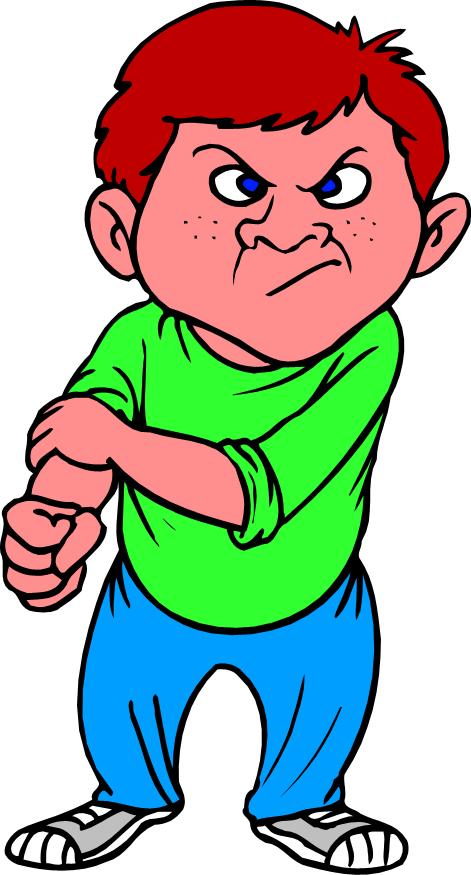
Wouldn't you be a tad out of your element with a "touchy-feely" if you grew up with a man like the one in the cartoon pictured above? It's not like Power Patrols are completely unaffectionate, but they aren't known for their warm, cushy huge and pecks on the cheek.

If any of these fit the bill, then you'd have a nice internal character arc already plotted out for your protagonist.

Q4U: Any of your characters (or YOU) out there have this type of parent? Did you plan any of these types of conflicts for them to overcome?

Wordle: signature

* A lot of the information in this series will be derived from Jody Johnston Powel's book, The Parent's Toolshop. Quite a bit is also from my own clinical experiences and opinions.*

Tuesday, February 23, 2010

Treatment Tuesday - From Bully to Protector

Airdale wrote in for an assessment on her military cadet, Kalish* who lives in her medieval fantasy pages as a 17-year-old who just finished the Academy portion of his training before he is delivered to an outpost in the wilderness where Sergeant Daniels* will supervise Kalish's 2 years of field internship. At the novel's beginning, Kalish is a bully and believes the world exists only to hurt him. By the novel's end, he needs to be "rehabbed" into a leader.

Kalish has a backstory that starts as him being a prank-loving 8-year old who, at 14, has a prank that goes terribly wrong. As an alternative to prison, the Academy Headmaster takes Kalish under his tutelage. The Headmaster really takes Kalish to task, beating him and locking him in his room. The Headmaster, who actually cares for him, believes this abuse is discipline. When in training, Kalish becomes savage, and by the time the novel begins, he wills tart a fight anytime someone looks at him the wrong way and won't stop until he causes injury.

* Names have been changed to protect the fictional.

What Airdale wants to know is this: What can Daniels and Kalish's fellow cadets do help Kalish stop being a bully and become a protector and leader? What kind of milestones and lapses might happen along the way? Wh
at kind of situations could I create to help Kalish heal and grow?

With Kalish, I'd like to start at his childhood (of course!). The prankster and fun-loving child who makes a huge mistake. Since you didn't specify what went wrong, I can only imagine that Kalish would feel guilt, shame, and a hardening of his heart when he's sent to the Academy, knowing he was destined for prison if he didn't go. This might cause him to really resent the Academy, what it stands for, and what he's learning there. He might decide to beat those who beat him, so to speak. This would give him the motivation to be the best swordsman and best cadet he could be.

Being locked in his room during his formidable teenage years, when Kalish is developing a sense of who he is, and a sense of his self-worth, would be perhaps the most psychologically damaging. It would teach him that he can only depend on himself and trust no one. He'd likely develop the mentality that it's him against the world, since no one was really coming to his aide to stop the abuse (regardless of how much more it might be accepted in your story world). The one man that took him under his wing was also the same man whose hand brought pain. Pain done in the name of love is the most detrimental kind.

For him to want to channel his violent tendencies toward protection, you'll have the hard job of making him actually care about something. You don't want to protect something you don't care about, and if you do protect something you don't care about, then you do so begrudgingly. So what's out there in this wilderness to make him care? Is it incredibly dangerous so that he would care about his life? Is it home of native inhabitants, one of which might become a romantic interest? (Think Avatar here. Being immersed in a completely foreign culture makes a person put up guards initially, yes, but respect tears them down. Learning to respect others is key to not being a bully. This is a mode of treatment for preschool bullies, even.)

I suppose that you could pit him against another cadet in the wilderness who is a contender for the role as "top dog." Then perhaps Kalish might be more of a protector or defender since he's still got something to prove, so he'd recognize that the rules of engagement at the Academy have changed and now he's got to shift his focus from self to something else in order to prove he's the best. Just something to consider.

This Sergeant is going to have to have long-suffering and consistency in order to gain Kalish's respect. If the man didn't beat him or do some other degrading punishment, then I think Kalish would pay attention to him. After all, that's the only sort of discipline he's known. Something completely foreign to him would make him come up short. At the very first "challenge" or behavioral faux pas, have Sergeant show his displeasure drastically different from the Headmaster.

For Kalish to heal from his past and become a man of honor and a great leader, then the internal transformation will have to start small, like learning there are other ways to handle conflict, and then realizing those ways are actually better than his old ways. It would be helpful for him to see someone he's come to respect make a true sacrifice for what they believe in...perhaps even Daniels himself. You might not have planned to kill the Sergeant off in your book, but if Kalish comes to really respect him, looks up to him like a father, so to speak, then having Daniels die at the end, and sort of "pass the torch" on to Kalish would be a powerful motivator for Kalish to finally change his ways. To have someone on his death bed tell Kalish that they believe in him, trust him, would heal all sorts of hurts and wounds from his past. Kalish might very well move mountains not to let Daniels (or whoever) down posthumously. Just another plot twist to think about...one that would be very dramatic for the reader.

All young men--and women--just want to be believed in, to be affirmed and to be blessed by someone they love and care about. The Headmaster's ways weren't affirming, even though he might have cared for Kalish. Having a dying Daniels or someone else affirm Kalish not only because of his military prowess, but because of who he is, would be passing on to him the blessing that he's been denied ever since he played that prank that went horribly awry. He might be able to forgive himself for it, as well.

This assessment has been written a bit stream of consciousness, which I hope is still helpful. I found this was more difficult, and I'm not sure why. Perhaps it's because of my association with the military (husband is 10 years in the Coast Guard) and having heard all the stories about boot camp, academy, etc...it's hard not to try to put this storyline into modern time for me. If someone was a bully in the military, not able to keep their fists to themselves, then they would just be kicked out. So in a fantasy world, you've got lots more to play with that could be feasible.

Please, leave any additional questions in the comment section. Maybe one of your questions will spur me to think of something else I might have forgot or missed.

Good luck with writing Kalish's emergence into a worthy man. :)

This service is for fictional characters only, so any resemblance to real life examples is entirely coincidental. Any other fictional character assessment questions can be directed to charactertherapist@hotmail.com.

Wordle: signature

Thursday, February 18, 2010

T3 - Parenting Styles Overview (and Quiz!)

If you're stuck on developing a truly rich backstory for your character--a reason to give them the current quirks and neuroses they have as adults--then look no further! For the next five weeks, this series on parenting styles will not only help enrich the lives of your characters on the page, but it will also help you parents out there know a little bit more about yourself and where YOU come from.


To begin with, we'll start with a two-part quiz. It's a little involved, so do yourself and your character a favor by grabbing a pencil and paper to take this puppy for real. (If you don't have time right now, then come back! Don't rush this one.) Using the scale below, write the number from 1 to 5 that corresponds to your level of agreement with each statement below.


1 strongly disagree; 2 disagree; 3 neutral; 4 agree; 5 strongly agree


Part I: Beliefs


_____1. It is better to give a little ground and protect the peace than to stand firm and provoke a fight.


_____2. Children need discipline that hurts a little so that they will remember the lesson later.


_____3. Children shouldn’t always get their way, but usually we ought to learn to listen to what they have to say.


_____4. The parent-child relationship is like a war in which if the parent wins, both sides win; but if the parent loses, both sides lose.


_____5. If parents provide a good environment, children will pretty much raise themselves.


_____6. The parent’s role is like that of a teacher who is preparing the child for a final exam called life.


_____7. Childhood is so short that parents should do everything to make it a happy time.


_____8. “Spare the rod and spoil the child” is still the best policy.


_____9. Children need to learn what they may or may not do, but we don’t have to use punishment to teach.


_____10. Whether we like it or not, children have the last word about what they will or won’t do.


_____11. If you let children have pretty free rein, they will eventually learn from the consequences of their behavior what is appropriate.


_____12. Children first have to learn that the parent is boss.


_____13. Too many children today talk back to their parents when they should just quietly obey them.


_____14. If we want children to respect us, we must first treat them with respect.


_____15. You can never do too much for your child if it comes from genuine love.


Part II: Actions


_____16. I often have to call my child more than once to get her or him out of bed in the morning.


_____17. I have to constantly stay on top of my child to get things done.


_____18. When my child misbehaves, he or she usually knows what the consequences will be.


_____19. I often get angry and yell at my child.


_____20. I often feel that my child is taking advantage of my good nature.


_____21. We have discussed chores at our home and everybody takes part.


_____22. My child gets a spanking at least once a month.


_____23. My child has no regular chores around the home, but will occasionally pitch in when asked.


_____24. I usually give my child clear instructions as to how I want something done.


_____25. My child is finicky eater, so I have to try various combinations to make sure he or she gets the proper nutrition.


_____26. I don’t call my child names, and I don’t expect to be called names by my child.


_____27. I usually give my child choices between two appropriate alternatives rather than telling my child what to do.


_____28. I have to threaten my child with punishment at least once a week.


_____29. I wish my child wouldn’t interrupt my conversations so often.


_____30. My child usually gets up and ready without my help in the morning.


Now, to get your scores, add the numbers for each color.

Part I: Beliefs

Over-Controlling belief score:


RED = ________


Under-Controlling belief score:


GREEN = ________


Balanced belief score:


BLUE = ________


Part II: Actions


Over-Controlling action score:


RED = ________


Under-Controlling action score:


GREEN = ________


Balanced action score:


BLUE = ________


Now add your Belief score with your Action score, and the highest number indicates what type of parent your hero grew up with, or what type of parent your heroine is (or you are). Here's a picture I created to depict how the styles interact with each other. The darker gray rectangles (Avoiders and Power Patrols) are the more severe styles of Over and Under Controlling (scores are between 34-50) while the lighter gray rectangles represent the less severe Over and Under Controlling styles (scores between 0-33). Balanced, as indicated, falls in the middle. You're considered "Balanced" if your Balanced score is higher than the others.


I'll be delving in deeper into what kinds of people most likely fall into each category, their approaches to discipline, parental beliefs, view of negative emotions, and possible outcomes of their children (i.e., your hero or heroine!) when they grow up and strike out on their own. Stay tuned!

Q4U: Did your Belief and Action scores line up? Or did you find you're more one style in beliefs but don't act that style out?

Wordle: signature