LinkedinTwitterThe DetailsConnectBlog Facebook Meet the TherapistHome For Writers

Tuesday, March 1, 2011

Treatment Tuesday - Bruce Banner/Hulk

An old friend of mine, Glory, wrote in with several comic book characters that she believes need to form a support group. Since my queue for character assessments is empty, I'm going to start diagnosing these superheroes. Bruce Banner is up first.

Bruce is a smart guy. Like, PhD in nuclear physics smart. He was the mind behind Bannertech technology, which is on par with Tony Stark's (Ironman) stuff, and includes a force field and teleporter. Bruce had a teeny, tiny accident with a gamma bomb he himself invented, which transforms him into the Hulk when he gets angry.

Bruce came from a very difficult and tragic background. His father, Brian, thought Bruce was a mutant son due to Brian's radiation work at Los Alamos. His mother, Rebecca, really loved Bruce, which caused Brian to be jealous and hate his son all the more. Brian began to abuse both Rebecca and Bruce, and when Rebecca tried to flee with Bruce, Brian killed her in her attempt. Eventually Bruce testified against his father, which led to his father's institutionalization for many years.

During this time, Bruce created an imaginary friend called "Hulk." He used this coping technique well into his high school years. Brian was eventually released and moved in with Bruce, but his insanity and deep-seated hostility against his son caused him to attack Bruce at Rebecca's gravesite. Bruce killed him, but repressed those memories, choosing to remember a confrontation at the gravesite, but that his father walked away.

Bruce has Dissociative Identity Disorder (DID). Since my research led me to understand that his imaginary friend was called the Hulk, this made me think that his DID was latent (not showing up on the radar) until he got shot with that gamma bomb, which was the traumatic event that triggered his alter identities to begin to taking over.
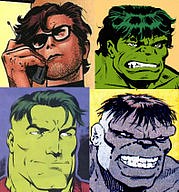
I discovered five bona fide personalities, three of which were described well on this website: Savage Hulk (a.k.a. Green Hulk), "Joe Fixit" (a.k.a. Gray Hulk), and the Professor (a.k.a. Merged Hulk). This website here discusses the Guilt Hulk and the Devil Hulk, among several others. According to the comics, however, Bruce has hundreds of personalities locked away in his mind.

Due to Brian Banner's abuse, the Savage Hulk split from Bruce's early childhood experience. He's the most well-known of the Hulks, typically referring to himself in the third person. He possesses the IQ and temperament of a child, and just wants to be left alone following one of his "temper tantrums." He represents Bruce's childhood wish to be strong enough to protect his mother.

Joe Fixit split from Bruce during late adolescence/college. He was cunning, crafty, hedonistic, arrogant, and hard-to-reach. He did though, have a conscience he often tried to hide. He represents the typical teenager Bruce never allowed himself to be, a personality repressed by Bruce due to his childhood abuse at the hands of his father. He mostly appears at night, and it could be because Bruce was ashamed of this side of himself.

Bruce receives psychiatric help from Doctor Leonard Samson. Samson tries to reintegrate the Green Hulk an Grey Hulk, but instead creates a third split: the Merged Hulk/Professor, who possesses Banner's intelligence, the Gray Hulk's cunning, and the Savage Hulk's strength.

So, Bruce as the scientist leads a very emotionally detached life, almost Schizoid Personality Disorder in description. It's little wonder, because when his emotions get the better of him, whether it's anger, fear, or grief, he morphs from Dr. Jekyll into a Mr. Hyde-like green monster/humanoid. (Indeed, Dr. Jekyll/Mr. Hyde and Frankenstein were the creator's influences.) He holds people at a distance and shuns emotional intimacy. According to Arie Kaplan's book Masters of the Comic Book Universe Revealed!, "Bruce Banner lives in a constant state of panic, always wary that the monster inside him will erupt, and therefore he can’t form meaningful bonds with anyone." He feels that if he shows emotion, people get hurt.

Bruce also struggles with a diagnosable form of Intermittent Explosive Disorder. Let's face it. He might have a moral compass when transformed into the Hulk, but he doesn't exactly walk around on tiptoe when he's mad. He's like a bull in a china shop...carnage and destruction follow him everywhere due to his aggression. His overreaction is a hallmark symptom of this disorder.


Thanks for bringing this character to my attention, Glory. What a messed-up childhood he had! I had no idea.

Q4U: Did any one else not realize how dark Bruce Banner's past was?

Click here to be entered in the giveaway for Tommie Lyn's High on a Mountain!

Wordle: signature

Monday, February 28, 2011

High on a Mountain Book Review and Giveaway!

Author Tommie Lyn writes historicals with heart. She sent me a copy of her newest release, High on a Mountain, to review, and it was a pleasure to do so on many levels.

You can read the Prologue and Chapters One-Three from Tommie's website, but here's the backcover blurb:

As a boy, Ailean MacLachlainn dreamed of living an adventurous life and longed to be a celebrated warrior of his clan. Until a shy smile and a glance from Mùirne's blue eyes turned his head and escalated his rivalry with Latharn into enmity and open conflict. 

When Ailean became a man, his boyhood dreams faded. Until Bonnie Prince Charlie came to reclaim his father's throne. The Jacobite loyalties of Ailean's clan chief involved the MacLachlainns in the uprising and set Ailean on a course toward a destiny of which he could never have dreamed. 

What happens when a man's dreams turn to dust? And when a man loses everything, does he have what it takes to go on?

So, as my last name might imply, my husband's heritage is very Scottish. Unfortunately for me, Campbells aren't exactly known for being the nicest people in history. (In fact, my husband visited Scotland and was turned away from several villages just because his last name is Campbell. The people still hold a grudge, but it's little wonder.) Tommie has clearly done a lot of research into the feuds and fights, especially of certain battles.

So I open up her Prologue, which is available to read on her webpage, and it's all about us nasty "Cambeuls." (And nasty we were. Geez.) At this point, I closed the book, looked over to my husband, and said, "I believe I know why Tommie wants me to review this book." HA!

But the further I read, the more engrossed I became in Tommie's great story. I realized that her main guy, Ailean, (pronounced A-lun, according to the Scottish Gaelic pronunciation guide at the front of the book), is one psychologically tormented guy. It was fascinating to read--and heartbreaking. It's hard to imagine all this bad stuff happening to one guy, but as her backcover blurb reads, Ailean's dreams do turn to dust and he does lose everything. And I mean everything. (Think 18th century Job.)

And he is way traumatized from it. He suffers PTSD in a very severe form. Tommie portrays the flashbacks accurately and feasibly, and they definitely interfere with Ailean's daily functioning. He avoids things that remind him of his loss. He wishes death upon himself to ease his awesome misery. He was almost instantly stripped of everything that he had previously defined himself as: son, brother, husband, father, freeman, and even his beloved Scotland. He's angry at God, of course, because he feels forsaken and from the looks of things, he has been. He can't move on because he's held captive by his traumatic past and encompassing grief.

The villain is a Cambeul (go figure). And he's a wicked, wicked man. He's got a problem with anger management for sure, and develops a propensity toward alcoholism (actually, it's more than a propensity....it's full blown alcohol dependence). He has a great backstory, which sets up his life direction well, and Tommie even made me feel sorry for this horrible man once or twice.

This book had a satisfying ending and is ultimately about Ailean coming to understand that life might look more beautiful from the mountaintop, but he lives down in the glen. However, if one trusts God's direction, the glen can be beautiful as well.

To be entered in this book giveaway, you need to do 3 three things:

1) Be a follower of this blog.
2) Live in the lower 48 states.
3) Leave a comment below about why modern-day Campbells aren't so terrible (any positive about any Campbell will do) and your email in a spam-me-not format in the comment section below.

I would say that the best Campbell-positive comment will win the book, but I'll use a random generator. :)

Wordle: signature

Friday, February 25, 2011

Friday Free Association Chain


The word is........


RICH.


First commenter free associates with the above word. Second commenter takes the first commenter's word and free associates, and so on.

Remember -- FIRST thing that comes to mind. GO!!

Wordle: signature

Thursday, February 24, 2011

T3 - Who is Saying What?

Have you ever tried to portray in your books a misunderstanding between two characters and found yourself wondering if others would think it was feasible? If you've got two people dialoging with one another, there is always a chance for miscommunication.

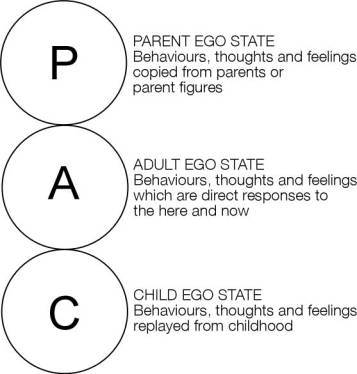
According to Transactional Analysis (TA), we communicate via three different Ego States (parts of ourselves):

(P)arent
(A)dult
(C)hild

[I know what you're thinking, but no, this is not Freud's Id, Ego, and Superego, although they have been compared. Freud's theory says that each state is one type of behavior: Id=feeling, Ego=thinking, Superego=judging. TA says that each Ego State above has all three.]

Every person has a trio of P-A-C, and we constantly shift back and forth between them in our interactions (a.k.a. transactions) with others. I'll break them down.

The Parent ego state is a set of thoughts, feelings, and behaviors that we learn from our parents (or caretakers). It's almost like we unconsciously mimic them, incorporating their values, morals, and core beliefs into our outer communication. We express these ideals by being either critical or nurturing.

The Nurturing Parent is soft, loving, and quick to give permission. The Critical Parent is the other side of the coin. When in this state, a person will react as they imagined their parent might have reacted, or they act toward others the way their parents acted toward them. It's uncanny, but we might use some of the exact same phrases we head from our parents, or strike the same postures, use the same mannerisms or gestures...we become our parents.

The Adult ego state is our data-processor. This is the objective, non-emotional part of ourselves, using all of the resources we have as an adult human being with many years of life experience to influence us. It is factual, responds to situations without passionate convictions, and simply uses what it hears, sees, and thinks to come up with solutions to problems. (Think Mr. Spock.) The Adult is situated in the middle circle of the diagram to orchestrate and mediate between the Parent and the Child.

The Child ego state is who we are at our most natural. This is when we behave like we did in childhood. There are two parts to the Child ego state, both of which have positive and negative aspects. The first is the Natural Child, which is much like my three-year-old. On the positive side, she is spontaneous, playful, lovable, and charming, and experiences the world in a direct, authentic, and immediate way. On the negative side, she can be impulsive to the degree her safety is compromised.

The Adapted Child is the part of our personality that has learned to comply with the parental messages we received growing up. The positive aspect of the Adapted Child is that we respond appropriately in social situations. The negative aspect is that we overadapt and give up our power and discount our value, worth, and dignity.

Dr. Carol Solomon (2003) gives a good example of how each of the above Ego States would respond to the simple action of a child playing in the sand.

Nurturing Parent: Go ahead, play and have fun!
Critical Parent: Now, don't you dare get yourself all messy!
Adult: This sand looks really interesting. I can make a castle.
Natural Child: WOW! Look how tall my castle is!!!!!
Adapted Child: I better not get my clothes all dirty.

At any given moment, our characters (and us) will volley amongst each of these ego states when interacting with others and our inner selves. Depending on which Ego state the person with whom we are communicating is operating from, signals can get BIG time crossed. And this usually is where we have misunderstandings, hurt feelings, and less-than-satisfying communication.

Next week, I'll go into how you can know which Ego State your character is using. Hopefully you find this as fascinating as I!

Q4U: Have you ever stopped mid-sentence, repeating verbatim something your parents said to you? What was it?

Wordle: signature

Wednesday, February 23, 2011

Movies & Madness: Finding Nemo

Since I was at home almost a week with my flu-ridden child about two weeks ago, I watched a lot of animated movies in a short period of time. Finding Nemo happens to be one of my daughter's favorites. As an occupational hazard, I began to point out all the therapeutic issues the characters displayed, especially those in the fish tank. (They might as well be representative of an in-patient psychiatric population!)

Gurgle - OCD - disgusted by human mouth, ocean is contaminated
Deb - delusional about her "sister" Flo who is really just her reflection in the glass
Bubbles -neurotic about the bubbles
Gill - the hard-as-nails fish who's been there, done that, got the scar to prove it; into conspiracy theories
Crush - thrill-seeking adrenaline junkie
Bruce - shark with abandonment issues from his dad
Chum - the shark who relapsed on fish by eating his "bring a buddy" before support group
Dory - major short-term memory loss
Nemo - guilt over last words spoken to his father

But none come close to Nemo's father, Marlin. Let's take a look at him. He got married and hopped on the good fin to do the bad thing, resulting in tons of little babies in need of loving care. He then suffers surely the worst kind of pain when he loses his new wife to a shark attack, as well as all his babies--save one: Nemo.

Marlin has severe PTSD from the attack, as is evident in how he babies Nemo and doesn't want to let him grow up. He believes the little fin is proof positive of Nemo's need to be overly smothered. After all, Nemo can't swim as well with his little fin, which serves as a visual reminder to Marlin of all he lost when the shark ate his wife and other babies. Marlin has a fear of the open ocean, now, and does his best to instill that in Nemo. It's "not safe" to swim there.

Then Nemo comes into his own obstinacy when his dad makes him feel foolish in front of his new school friends, harping on how they could have been killed at the drop-off and that Nemo can't swim because of the little fin. Most of you probably know what happens: Nemo gets defiant and goes to the boat, touches it with his fin--a part that resonates in the hearts of all parents with children--and gets caught by the Australian deep-sea diver/dentist before he can return.

Then Marlin is on a mission to find Nemo and bring him back safely. He encounters all manner of traumatic problems, any one of which would send a sane fish over the edge. First Dory - who can't remember anything. Then the sharks and their "Fish are Friends, Not Food" support group--I can only imagine the true terror Marlin would feel after losing his wife and children to a shark and then to have Bruce chase him down, intent on taking "just a little bite." Then they have the jellyfish ordeal, and the whole getting-eaten-by-a-whale ordeal, having to jump in the mouth of a pelican to prevent getting eaten by seagulls, and all this to see little Nemo belly-side up in a plastic bag, pretending to be dead.

Now Marlin is super depressed. Who wouldn't be? But to be reunited with his son, who is alive, brings out the fierce protective part of Marlin once again. He doesn't want Nemo to do anything to endanger himself or put himself out further than Marlin thinks is appropriate.

Then the last upheaval happens....the part where Nemo is small enough to swim through the fish net, where Dory and thousands of other fish are trapped, to motivate the entire group to "swim down!" as a way to fight against being taken in the net--something Nemo has learned from his time with the Fraternal Bond of Tankhood members. Marlin has to make the decision to let Nemo go once again, and this is the deciding moment for him as a father. (I would think writers would get a lot out of watching this movie as it relates to internal motivation and external tensions. Incredible, really.)

It's a kid's movie, after all, so all ends well. But Marlin has come to a more healthy decision about how to parent Nemo, which leaves Nemo happier and Marlin happy, as well. He's beat his mental illness. Realistic? No...not after all Marlin went through. But then again, who are we to try to fight against the willful tenacity of a father with everything to lose? Perhaps its a lesson of the power of the mind over mental illness.

Wordle: signature

Tuesday, February 22, 2011

Treatment Tuesday: Personality vs. Parenting

This week's assessment is for Michelle. She wrote in about her character Shannon,* who was raised with a Golden Retriever, over-indulgent mom and a Beaver, micromanaging dad. Shannon craved her dad's approval so much that she put a Beaver mask over her Otter/Golden Retriever personality and is still wearing that mask today. Shannon's husband, Rod*, had a power patrol Lion father and an avoidant mom. Since they were wealthy, his parents hired others to deal with Rod.

* Names have been changed to protect the fictional. 

Michelle wants to know: How will Shannon parent her daughter Allison, who knows just what to do to get her mom to do what she wants and Josh, who stays buried in his iPod and video games? How would her beaver mask impact her parenting? When Rod looses his job and the family has to move in with Shannon's parents (who tend cattle and cotton), how will this affect them based on their personalities?

I'm totally flattered that Michelle has obviously been scouring my old posts! As you can see, she referenced almost every parenting style post and personality types post I wrote above. Thanks for that feel-good, Michelle.


I want to start this assessment out with Rod, even though you couched your questions as being about Shannon. But Rod's my concern because of his power patrol father who he looks up to so much. I'm not sure how much interaction Rod really had with his parents, since they hired people to look after him (I assume nannies and the like), but you indicated Rod was a Lion like his father, which will probably give him the tendency to be a power patrol. And that's what he knew, after all.

So if his tendency is toward power patrol, that could cause some problems between him and Shannon, who is at heart a Golden Retriever and might have a bent toward over-indulging, like her mom. It all would depend on how well Shannon wears the mask of a Beaver. If she's still seeking approval from dad, or trying to heal the rift that developed after her barrel racing accident, then she might try to be more like him, micromanaging everything her children do like he did to her in hopes of connecting with him. This will be confounded by her moving back into her childhood home.

There's something almost magical about grownups boomeranging back to their parents' home. Fully functioning adults can become sniveling little brats as they adopt the method of interacting with their parents they had growing up. If Shannon's mother was such an over-indulger, she might revert to not making her bed or washing her own clothes because mom is there to do it--not only for Shannon, but for Shannon's family.

The controlling part of Rod will not like this. To say that living as extended guests in his wife's parents' home will be difficult for Rod is the understatement of the year. He's going to kick against this with all his might, as he's used to being in control and managing his own family (and career). Accepting anything like charity or handouts will not be easy, if not impossible. Rod would be desperate enough to take a job that he doesn't like to remove themselves quicker from this scenario.

The generosity of Shannon's nurturing mother will not be appreciated by Rod...he'll likely see it as an affront to his ability to provide those things for his own family. This will move Shannon into a difficult mediating position. She'll find herself split between defending her parents and their way of life and way of interacting with others and trying to ease Rod's disappointment and anger over the living situation by commiserating with him about her parents.

But I digress. Back to the parenting. Shannon's figured out how to be a Beaver by observing her dad. She knows how to approach Allison to get what she wants done. It's the underdog Golden Retriever/over-indulger inside of her that may let Allison think Shannon's a pushover--when in reality, Shannon is indulging Allison, possible against her better judgment, but doing it all the same. Rod isn't going to have that close of a relationship with Allison, likely, because she knows he's not the person to go to if she wants something. Allison will favor her mother.

As for Josh, it's pretty typical for boys to go through their video game phase where they hardly say ten words a day to human beings because they are playing their marathon rounds of Zelda (can I just date myself here?). Shannon will lean toward either micromanaging the amount of time she lets him spend on the video games and turning a blind eye when he doesn't get off right at the one-hour mark. Rod will not be this way. When he says "thirty minutes and lights out!" he means just that.

I'm not sure I'm really helping that much with this assessment simply because you've got this great backstory for Shannon and have given her a personality mask of being a Beaver when she's really an Otter. As you can read from my post here, Otters and Beavers don't mix. They are fairly diametrically opposed. Rod probably fell for the Beaver part of Shannon...but a Lion can get along with an Otter just fine....so when Shannon's true personality shines through, it shouldn't put an end to their relationship. However, if she swings more toward the Golden Retriever style of over-indulging, this will be a problem for his power patrol Lion (as I mentioned before).

Shannon's got a unique problem, because when projecting an image to the world that's not who you really are...it's exhausting. Your body has to use energy to keep up pretenses that it could use otherwise to repair the body. So FYI, when Shannon gets tired or sick...her true colors will shine through because she'll have less energy to keep the mask in place.

That's all I have Michelle. I hope it helps put you on the right direction. I welcome any additional comments below. Thanks for writing in!

Wordle: signature

Monday, February 21, 2011

Mental Illness in the Presidency

Happy President's Day to you! Hopefully you're off work, laid back in your recliner, and getting some serious writing and social media networking done. 
In honor of our presidents, I thought a post on mental illness in the Oval Office might be appropriate for my blog readership. Duke University psychiatrists Jonathan Davidson, Kathryn Connor, and Marvin Swartz teamed up in 2006 to diagnose our fearless (or not-so-fearless, in some cases) commanders-in-chief from 1776 to 1974 using biographical information.

37 presidents were researched, and 18 (49%) suffered from some sort of clinically diagnosable disorder. The most common disorders were depression (24%), anxiety (8%), bipolar disorder (8%), and alcohol abuse/dependence (8%) were the most common. 10 of these presidents (27%) suffered a disorder during their presidency, which in most cases probably impaired job performance.

So which president had what? Some of the more notable ones are below:

Abraham Lincoln: depression (more than the others, this was widely known)
Franklin Pierce: PTSD/depression from witnessing his son's violent death in railway accident
Ulysses S. Grant: alcohol abuse/dependence; social phobia
William Taft: sleep apnea (often dozed off during important meetings)
Theodore Roosevelt: bipolar (showed signs of manic energy b/c he was indefatigable)
Lyndon B. Johnson: bipolar
Richard Nixon: heavy alcohol abuse/dependence (especially through Watergate--go figure)
Calvin Coolidge:social phobia; depression (after teen son died of an infection); hypochondria
Thomas Jefferson: social phobia

Interestingly, the contemporaries of Grant, James Madison, Rutherford Hayes and Woodrow Wilson who knew them as young men wouldn't have thought that either of them would grow up to do very much based on their seeming mental problems/deficiencies. 

Just goes to show you that you can't judge a book--or a president--by it's cover too early.

Wordle: signature