Scarlett O'Hara is on the couch today. Let's see if you agree with my diagnosis.
Note: This assessment will be done using the Scarlett O'Hara as portrayed by Vivian Leigh in the 1939 film, not the literary figure from
Margaret Mitchell's book
.
Scarlett had to be the
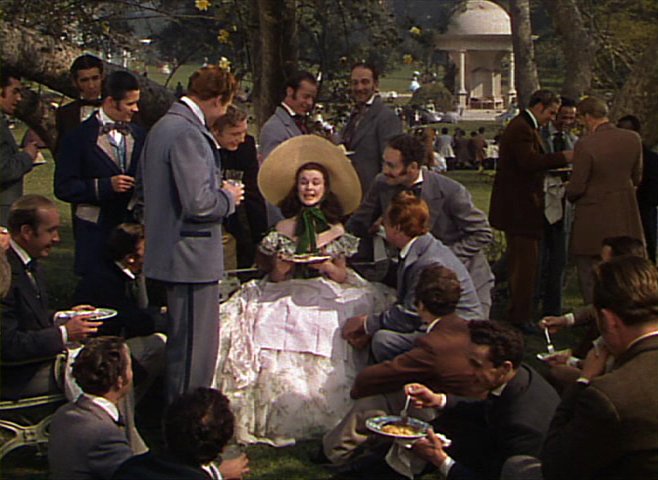
center of attention. The beginning of the film shows that very well, with the classic picture of her in the middle of all the men, basking in their adulation. She said, "Now isn't this better than sitting at a table? A girl hasn't got but two sides to her at the table."
She was
often seductive or provocative,
using her appearance to draw attention to herself. Think of how she had Mammy trying to get her back into the same waist-sized corset she had before her baby was born, of how she took to the desperate measures of making a dress out of curtains in order to keep appearances up. She
considers her relationship with Ashley more intimate than it was, telling him that he "led her on" and "made her believe that he wanted to marry her," all the while Ashley denies this.
Scarlett's
emotions shifted rapidly, so therefore seemed to carry little depth. Rhett saw through this immediately, which endears him the viewer. This is not to say that Scarlett didn't feel emotions deeply. I believe she did. But her
shallowness emerges when she's happy and smiling one minute then pouting the next. Some might think her to have Bipolar based on this, but that's the only characteristic that fits.
Scarlett was nothing if not
dramatic. Her
theatricality made the movie what it was. You can just hear her. "Oh, Ashley!" "Oh, Rhett!" "Oh, Melanie!" Wringing her hands, pacing, using words like "varmint" to degrade someone, fiddle-dee-deeing things of import--she often
exaggerated. For example, at the beginning with the Templeton brothers are talking of war, she exclaims, "Fiddle-dee-dee. War, war, war; this war talk's spoiling all the fun at every party this spring. I get so bored I could scream." She warns them that she'll go in the house and slam the door of they keep on.

She is
highly suggestible, too, meaning
others can easily influence her. When Mammy is trying to get Scarlett to eat before the barbeque so that she doesn't "eat like a field hand and gobble like a hog" when she's there and reflect badly on her family. Scarlett says that Ashley told her he likes a girl with an appetite, and all Mammy has to do in plant this seed: What gentlemen says and what they thinks is two different things, and I ain't noticed Mr. Ashley askin' for to marry you. Scarlett then starts stuffing food in her mouth like a starved person.
I've just described in bold every clinical symptom of
Histrionic Personality Disorder. To have this diagnosis, you only have to have 5 of 8 symptoms, and have started showing signs of these symptoms by early adulthood in a variety of contexts, which Scarlett does. The one symptom I didn't mention was an
vague, impressionistic pattern of speech. I couldn't think of a place where Scarlett lacked detail in her speech, as if trying to impress someone but not really having the knowledge or words to do so.
Histrionic Personality Disorder is in the same cluster as Borderline Personality Disorder (BPD), and as you will read, Scarlet exhibits a few of those traits, but I don't believe she has the required five of nine to qualify. You can read my post on all the traits of BPD
here.
Scarlett hurled a vase after being rejected by Ashley Wilkes. Yes, it's dramatic, as mentioned above, but it also borders on unstable. Borderline PD is characterized by
intense, erratic, interpersonal relationships, which Scarlett definitely has, not only with Ashley, but Rhett also. These relationships usually fluctuate from idealization to devaluation. Hmm. Definitely fits!
This also shows her difficulty controlling her anger, which BPD is also known for.
 As most women might select shoes or purses, Scarlett had a tendency to select husbands. She marries Melanie's brother, Charles, to make Ashley jealous. He dies, but Scarlet fakes her mourning. (We all recall the scene where Rhett bids on her, and she accepts, going against societal norms for a grieving widow.) Then Scarlett manipulates her own sister's boyfriend, Frank Kennedy, into marrying her...and all she wanted was his money. This devastates Suellen. For diagnosis purposes, this shows two things: frantic efforts to avoid real or imagined abandonment and impulsivity.
Theodore Millon identified several subtypes of each personality disorder, and Scarlett would best be desribed as a cross between an Infantile and Theatrical Histrionic. Click on the picture for more detail. (Note: these subtypes are not in the Diagnostic and Statistical Manual.)
Q4U: Does Scarlett being Histrionic fit? Does this ruin your perception of one of our favorite Southern Belles? Who should be next for a Movies & Madness assessment?
As most women might select shoes or purses, Scarlett had a tendency to select husbands. She marries Melanie's brother, Charles, to make Ashley jealous. He dies, but Scarlet fakes her mourning. (We all recall the scene where Rhett bids on her, and she accepts, going against societal norms for a grieving widow.) Then Scarlett manipulates her own sister's boyfriend, Frank Kennedy, into marrying her...and all she wanted was his money. This devastates Suellen. For diagnosis purposes, this shows two things: frantic efforts to avoid real or imagined abandonment and impulsivity.
Theodore Millon identified several subtypes of each personality disorder, and Scarlett would best be desribed as a cross between an Infantile and Theatrical Histrionic. Click on the picture for more detail. (Note: these subtypes are not in the Diagnostic and Statistical Manual.)
Q4U: Does Scarlett being Histrionic fit? Does this ruin your perception of one of our favorite Southern Belles? Who should be next for a Movies & Madness assessment?


 .
. 


 is so popular).
 scenario or
  telling his dad that he knew his dad wanted him to have died, not Boromir. As restitution then, to his mother, to himself, to his lost brother, he becomes a doctor, intent on saving lives like the one he lost when his brother died by [insert senseless death here].


